Department of Health Behavior, Division of Cancer Prevention and Population Sciences, Roswell Park Cancer Institute, Elm and Carlton Streets, Buffalo, NY 14263, USA.
Tob Control. 2010 Oct;19 Suppl 2(Suppl_2):i47-53. doi: 10.1136/tc.2009.030163.
China is the home to the world's largest cigarette maker, China National Tobacco Company (CNTC), yet little is known publicly about the design and emissions of Chinese cigarettes. CNTC is currently in the process of consolidating its brands and has ambitions to export its cigarettes. Machine-measured tar yields of many of its cigarette brands have also been reduced, similar to what occurred in Western countries from the 1970s through the 1990s with so-called 'low-tar' cigarettes introduced to address consumer concerns about health risks from smoking.
The current study examines the design and physical characteristics, labelled smoke emissions and tobacco metals content of leading brands of Chinese cigarettes from seven cities purchased in 2005-6 and in 2007.
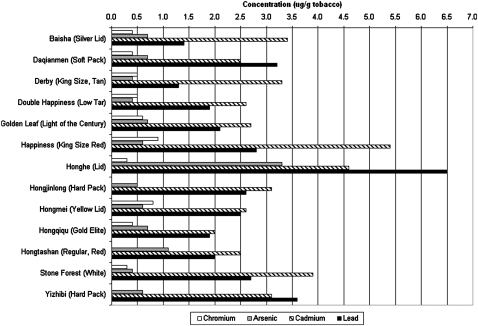
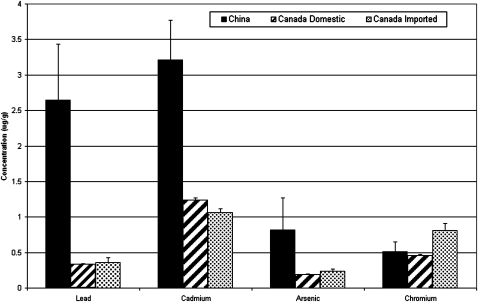
Findings suggest that similar to most countries, tar levels of Chinese cigarettes are predicted primarily by tobacco weight and filter ventilation. Ventilation explained approximately 50% of variation observed in tar and 60% variation in carbon monoxide yields. We found little significant change in key design features of cigarettes purchased in both rounds. We observed significant levels of various metals, averaging 0.82 μg/g arsenic (range 0.3-3.3), 3.21 μg/g cadmium (range 2.0-5.4) and 2.65 μg/g lead (range 1.2-6.5) in a subsample of 13 brands in 2005-6, substantially higher than contemporary Canadian products.
Results suggest that cigarettes in China increasingly resemble those sold in Western countries, but with tobacco containing higher levels of heavy metals. As CNTC looks to export its product around the world, independent surveillance of tobacco product characteristics, including tobacco blend characteristics, will become increasingly important.
中国是全球最大的香烟制造商中国烟草总公司(CNTC)的所在地,但公众对中国香烟的设计和排放知之甚少。CNTC 目前正处于整合品牌的过程中,并希望将其香烟出口。与 20 世纪 70 年代至 90 年代西方国家推出的所谓“低焦油”香烟类似,其许多香烟品牌的机器测量焦油产量也有所降低,以解决消费者对吸烟健康风险的担忧。
本研究检测了 2005-2006 年和 2007 年从中国七个城市购买的领先品牌中国香烟的设计和物理特性、标签烟雾排放和烟草金属含量。
研究结果表明,与大多数国家一样,中国香烟的焦油含量主要由烟草重量和过滤通风决定。通风解释了焦油和一氧化碳产量观察到的变化的大约 50%和 60%。我们发现,在两轮购买的香烟中,关键设计特征几乎没有显著变化。我们观察到各种金属的含量显著,平均砷含量为 0.82μg/g(范围 0.3-3.3)、镉含量为 3.21μg/g(范围 2.0-5.4)和铅含量为 2.65μg/g(范围 1.2-6.5)在 2005-2006 年的 13 个品牌的子样本中,远高于当代加拿大产品。
研究结果表明,中国的香烟越来越类似于西方国家销售的香烟,但烟草中含有更高水平的重金属。随着 CNTC 着眼于向全球出口其产品,对烟草产品特性(包括烟草混合特性)的独立监测将变得越来越重要。