Department of Energy Great Lakes Bioenergy Research Center and Department of Energy Plant Research Laboratory, Michigan State University, East Lansing MI 48824, USA.
Biotechnol Biofuels. 2010 Oct 12;3:22. doi: 10.1186/1754-6834-3-22.
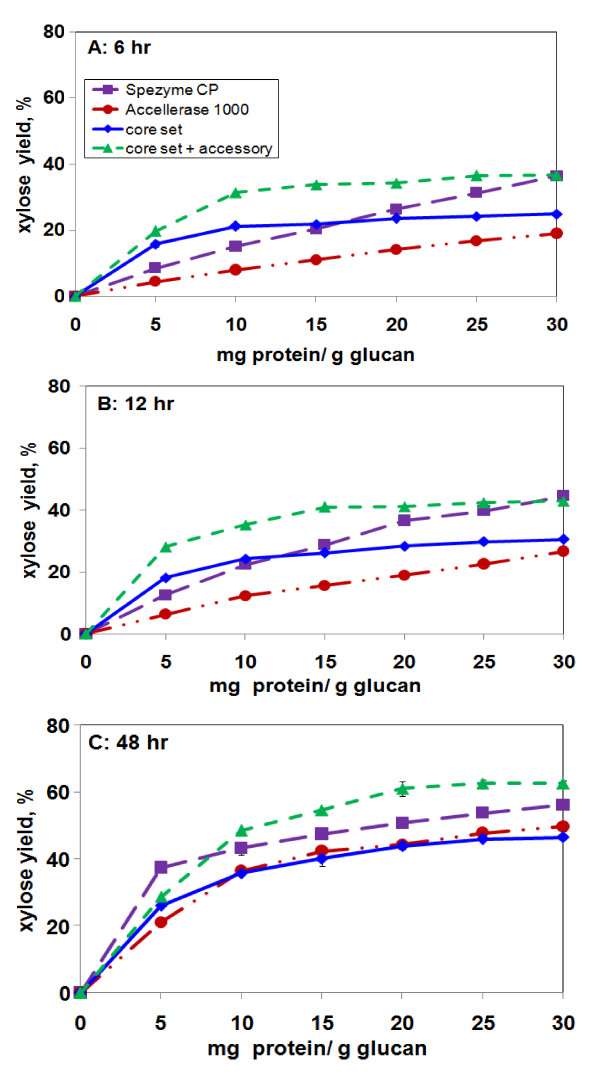
Enzymes for plant cell wall deconstruction are a major cost in the production of ethanol from lignocellulosic biomass. The goal of this research was to develop optimized synthetic mixtures of enzymes for multiple pretreatment/substrate combinations using our high-throughput biomass digestion platform, GENPLAT, which combines robotic liquid handling, statistical experimental design and automated Glc and Xyl assays. Proportions of six core fungal enzymes (CBH1, CBH2, EG1, β-glucosidase, a GH10 endo-β1,4-xylanase, and β-xylosidase) were optimized at a fixed enzyme loading of 15 mg/g glucan for release of Glc and Xyl from all combinations of five biomass feedstocks (corn stover, switchgrass, Miscanthus, dried distillers' grains plus solubles [DDGS] and poplar) subjected to three alkaline pretreatments (AFEX, dilute base [0.25% NaOH] and alkaline peroxide [AP]). A 16-component mixture comprising the core set plus 10 accessory enzymes was optimized for three pretreatment/substrate combinations. Results were compared to the performance of two commercial enzymes (Accellerase 1000 and Spezyme CP) at the same protein loadings.
When analyzed with GENPLAT, corn stover gave the highest yields of Glc with commercial enzymes and with the core set with all pretreatments, whereas corn stover, switchgrass and Miscanthus gave comparable Xyl yields. With commercial enzymes and with the core set, yields of Glc and Xyl were highest for grass stovers pretreated by AP compared to AFEX or dilute base. Corn stover, switchgrass and DDGS pretreated with AFEX and digested with the core set required a higher proportion of endo-β1,4-xylanase (EX3) and a lower proportion of endo-β1,4-glucanase (EG1) compared to the same materials pretreated with dilute base or AP. An optimized enzyme mixture containing 16 components (by addition of α-glucuronidase, a GH11 endoxylanase [EX2], Cel5A, Cel61A, Cip1, Cip2, β-mannanase, amyloglucosidase, α-arabinosidase, and Cel12A to the core set) was determined for AFEX-pretreated corn stover, DDGS, and AP-pretreated corn stover. The optimized mixture for AP-corn stover contained more exo-β1,4-glucanase (i.e., the sum of CBH1 + CBH2) and less endo-β1,4-glucanase (EG1 + Cel5A) than the optimal mixture for AFEX-corn stover. Amyloglucosidase and β-mannanase were the two most important enzymes for release of Glc from DDGS but were not required (i.e., 0% optimum) for corn stover subjected to AP or AFEX. As a function of enzyme loading over the range 0 to 30 mg/g glucan, Glc release from AP-corn stover reached a plateau of 60-70% Glc yield at a lower enzyme loading (5-10 mg/g glucan) than AFEX-corn stover. Accellerase 1000 was superior to Spezyme CP, the core set or the 16-component mixture for Glc yield at 12 h, but the 16-component set was as effective as the commercial enzyme mixtures at 48 h.
The results in this paper demonstrate that GENPLAT can be used to rapidly produce enzyme cocktails for specific pretreatment/biomass combinations. Pretreatment conditions and feedstock source both influence the Glc and Xyl yields as well as optimal enzyme proportions. It is predicted that it will be possible to improve synthetic enzyme mixtures further by the addition of additional accessory enzymes.

用于植物细胞壁解构的酶是从木质纤维素生物质生产乙醇的主要成本。本研究的目的是使用我们的高通量生物质消化平台 GENPLAT 为多种预处理/底物组合开发优化的酶合成混合物,该平台结合了机器人液体处理、统计实验设计和自动化 Glc 和 Xyl 测定。在固定酶加载量为 15mg/g 葡聚糖的情况下,对六种核心真菌酶(CBH1、CBH2、EG1、β-葡萄糖苷酶、GH10 内切-β1,4-木聚糖酶和β-木糖苷酶)的比例进行了优化,以从所有五种生物质原料(玉米秸秆、柳枝稷、芒草、干酒糟及其可溶物[DDGS]和杨树)的所有组合中释放 Glc 和 Xyl,这些原料经过三种碱性预处理(AFEX、稀碱[0.25%NaOH]和碱性过氧化物[AP])。包含核心集加 10 种辅助酶的 16 成分混合物针对三种预处理/底物组合进行了优化。将结果与在相同蛋白负载下的两种商业酶(Accellerase 1000 和 Spezyme CP)的性能进行了比较。
用 GENPLAT 进行分析时,与商业酶和所有预处理的核心集相比,玉米秸秆的 Glc 产量最高,而玉米秸秆、柳枝稷和芒草的 Xyl 产量相当。与商业酶和核心集相比,AP 预处理的草类秸秆的 Glc 和 Xyl 产量最高,而 AFEX 或稀碱预处理的则不然。用 AFEX 预处理的玉米秸秆、柳枝稷和 DDGS,与用稀碱或 AP 预处理的相同材料相比,需要更高比例的内切-β1,4-木聚糖酶(EX3)和更低比例的内切-β1,4-葡聚糖酶(EG1)。通过向核心集添加α-葡萄糖醛酸酶、GH11 内切木聚糖酶[EX2]、Cel5A、Cel61A、Cip1、Cip2、β-甘露聚糖酶、淀粉葡萄糖苷酶、α-阿拉伯糖苷酶和 Cel12A,确定了用于 AFEX 预处理玉米秸秆、DDGS 和 AP 预处理玉米秸秆的优化酶混合物。AP-玉米秸秆的最佳混合物比 AFEX-玉米秸秆的最佳混合物含有更多的外切-β1,4-葡聚糖酶(即 CBH1+CBH2 的总和)和更少的内切-β1,4-葡聚糖酶(EG1+Cel5A)。淀粉葡萄糖苷酶和β-甘露聚糖酶是从 DDGS 中释放 Glc 的两种最重要的酶,但对于用 AP 或 AFEX 处理的玉米秸秆则不需要(即 0%最佳)。作为酶负载从 0 到 30mg/g 葡聚糖的函数,AP-玉米秸秆的 Glc 释放率在较低的酶负载(5-10mg/g 葡聚糖)下达到 60-70%的 Glc 产率的平台,低于 AFEX-玉米秸秆。Accellerase 1000 在 12 小时时的 Glc 产率优于 Spezyme CP、核心集或 16 成分混合物,但在 48 小时时,16 成分集与商业酶混合物一样有效。
本文的结果表明,GENPLAT 可用于快速为特定预处理/生物质组合生产酶混合物。预处理条件和原料来源都会影响 Glc 和 Xyl 的产量以及最佳酶比例。预计通过添加额外的辅助酶,可以进一步改进合成酶混合物。