Mehrotra P, Sookhoo S, Kolla S, Halbert H, Lavell K, England S
Department of Radiology, Sunderland Royal Hospital, Kayll Road, Sunderland SR4 7TP, United Kingdom.
J Med Life. 2010 Jul-Sep;3(3):338-42.
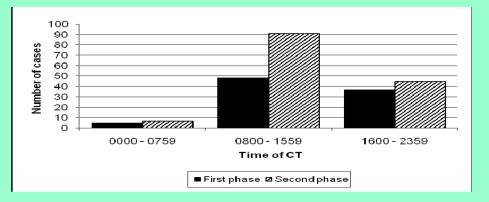
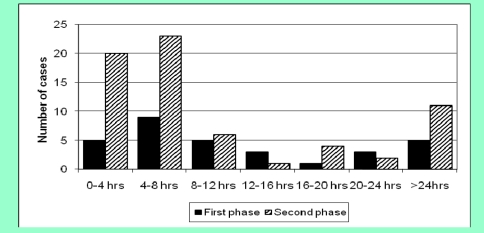
In patients suspected of having a subarachnoid haemorrhage (SAH), a normal CT should be followed by lumbar puncture (LP) to detect xanthochromia. We studied the practice of performing a LP following a normal CT in patients with a clinical suspicion of SAH in a District General Hospital. We aimed to assess whether patients were being fully investigated for SAH and whether standards were being met.
This was a prospective study aiming to improve the patient's care by implementing the best practice. We initially recorded CT and LP results of patients with suspected SAH (phase 1) and presented the results to the referring clinicians. After a period of time, data was re-collected to study any change in practice (phase 2).
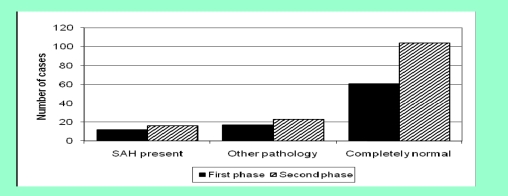
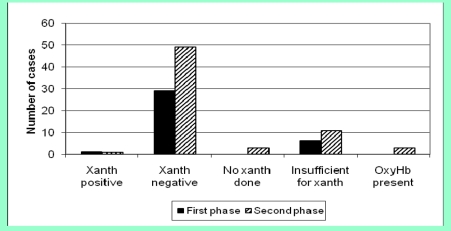
In phase 1, 36 of 61 patients (59.0%) with a normal CT had a subsequent LP compared to 67/104 (64.4%) in the second phase (p = 0.51). In the first phase, xanthochromia was detected in 1 of 36 patients (2.8%) who had a LP following a normal CT, compared to 1 of 67 patients (1.5%) in the second phase (p = 1.0).
Approximately a third of patients with symptoms of SAH in both study periods did not undergo LP following a normal CT scan. This is an important finding, as it is known that a normal CT does not exclude the diagnosis of SAH and by not proceeding to LP, patients have not been fully investigated for a SAH.
对于疑似蛛网膜下腔出血(SAH)的患者,CT结果正常后应进行腰椎穿刺(LP)以检测脑脊液黄变。我们研究了在一家地区综合医院中,对临床怀疑SAH且CT结果正常的患者进行LP的情况。我们旨在评估患者是否针对SAH进行了全面检查以及是否符合相关标准。
这是一项前瞻性研究,旨在通过实施最佳实践来改善患者护理。我们首先记录了疑似SAH患者的CT和LP结果(第一阶段),并将结果反馈给转诊的临床医生。一段时间后,重新收集数据以研究实践中的任何变化(第二阶段)。
在第一阶段,61例CT结果正常的患者中有36例(59.0%)随后进行了LP,而在第二阶段,104例中有67例(64.4%)进行了LP(p = 0.51)。在第一阶段,36例CT结果正常后进行LP的患者中有1例(2.8%)检测到脑脊液黄变,第二阶段67例患者中有1例(1.5%)检测到脑脊液黄变(p = 1.0)。
在两个研究阶段中,约三分之一有SAH症状且CT扫描正常的患者未进行LP。这是一个重要发现,因为已知CT正常并不能排除SAH的诊断,不进行LP则患者未针对SAH进行全面检查。