Department of Gynecology and Obstetrics - Campus Innenstadt, Ludwig-Maximilians-University, 80337 München, Germany.
Eur J Med Res. 2010 Aug 20;15(8):362-6. doi: 10.1186/2047-783x-15-8-362.
To compare the pelvic floor function of primiparous women to women after a second delivery regarding symptoms of urinary and anal incontinence, anal sphincter ruptures and bladder-neck mobility.
A questionnaire evaluating symptoms of urinary and anal incontinence was used in nulliparous women before and 27 months after childbirth. Furthermore these symptoms were correlated with functional changes of the pelvic floor based on a careful gynecologic examination as well as perineal and endoanal ultrasound.
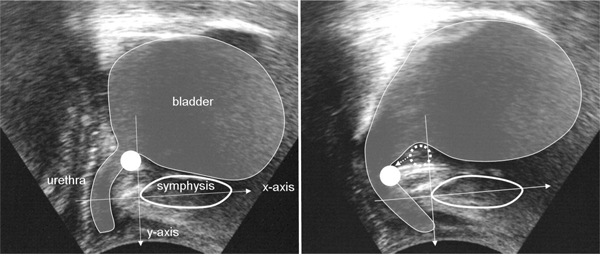
112 nulliparous women were included, 49 women returned for follow-up on average 27 months (SD 4.4 months) after the first delivery. 39 women (group A) had just one delivery, 10 women (group B ? 10/49) had had a second delivery. Apart from levator ani muscle strength, no significant difference between pelvic floor function of group A vs group B was demonstrable. Furthermore, we could show no significant difference for symptoms of urinary (11 (28.2%) vs. 5 (50.0%)) and anal incontinence (14 (35.9%) vs. 4 (40.0%)) between both groups. However, we found a lasting increase of stress urinary and anal incontinence as well as overactive bladder symptoms after one or more deliveries. The position of the bladder neck at rest was lower in both groups compared to the position before the first delivery and bladder neck mobility increased after one or more deliveries.
Our study shows several statistically significant changes of the pelvic floor function even on average 27 months after delivery, but a subsequent delivery did not compromise the pelvic floor any further.
比较初产妇和经产妇的盆底功能,包括尿失禁和肛门失禁、肛门括约肌破裂和膀胱颈移动的症状。
对未产妇在分娩前和分娩后 27 个月使用评估尿失禁和肛门失禁症状的问卷进行评估。此外,根据详细的妇科检查以及会阴和内超声检查,将这些症状与盆底功能的变化相关联。
共纳入 112 名未产妇,49 名妇女在第一次分娩后平均 27 个月(SD 4.4 个月)时返回随访。39 名妇女(A 组)只有一次分娩,10 名妇女(B 组-10/49)有第二次分娩。除了肛提肌肌力外,A 组和 B 组的盆底功能无显著差异。此外,我们也未发现两组间尿失禁(11 例(28.2%)与 5 例(50.0%))和肛门失禁(14 例(35.9%)与 4 例(40.0%))症状存在显著差异。然而,我们发现一次或多次分娩后,压力性尿失禁和肛门失禁以及膀胱过度活动症症状持续增加。与第一次分娩前相比,两组的膀胱颈在休息时的位置均较低,且在一次或多次分娩后,膀胱颈移动度增加。
我们的研究表明,即使在分娩后平均 27 个月,盆底功能仍会发生多项具有统计学意义的变化,但再次分娩不会进一步损害盆底。