Department of Continental Ecology-Biogeodynamics & Biodiversity Interactions, Centre d'Estudis Avançats de Blanes, CSIC, E-17300 Blanes, Spain.
BMC Microbiol. 2010 Oct 15;10:262. doi: 10.1186/1471-2180-10-262.
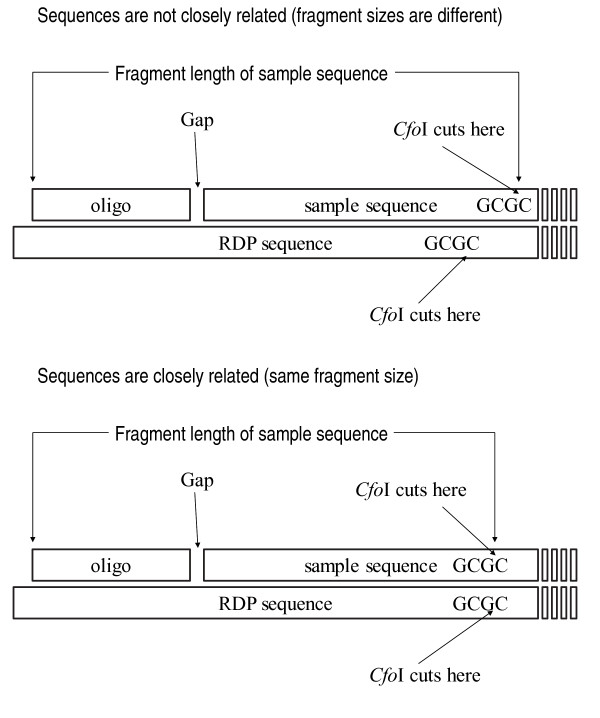
Terminal-Restriction Fragment Length Polymorphism (T-RFLP) is a technique used to analyze complex microbial communities. It allows for the quantification of unique or numerically dominant phylotypes in amplicon pools and it has been used primarily for comparisons between different communities. T-RFPred, Terminal-Restriction Fragment Prediction, was developed to identify and assign taxonomic information to chromatogram peaks of a T-RFLP fingerprint for a more comprehensive description of microbial communities. The program estimates the expected fragment size of representative 16S rRNA gene sequences (either from a complementary clone library or from public databases) for a given primer and restriction enzyme(s) and provides candidate taxonomic assignments.
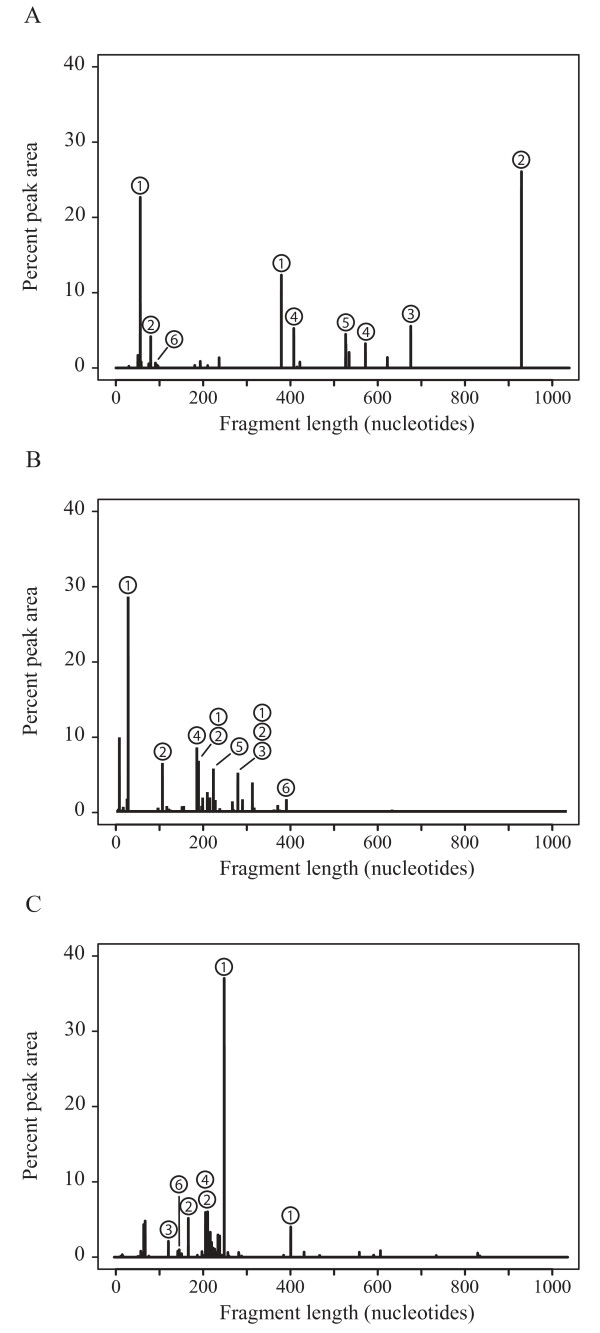
To show the accuracy of the program, T-RFLP profiles of a marine bacterial community were described using artificial bacterioplankton clone libraries of sequences obtained from public databases. For all valid chromatogram peaks, a phylogenetic group could be assigned.
T-RFPred offers enhanced functionality of T-RFLP profile analysis over current available programs. In particular, it circumvents the need for full-length 16S rRNA gene sequences during taxonomic assignments of T-RF peaks. Thus, large 16S rRNA gene datasets from environmental studies, including metagenomes, or public databases can be used as the reference set. Furthermore, T-RFPred is useful in experimental design for the selection of primers as well as the type and number of restriction enzymes that will yield informative chromatograms from natural microbial communities.
末端限制性片段长度多态性(T-RFLP)是一种用于分析复杂微生物群落的技术。它允许对扩增子池中的独特或数量占优势的类群进行定量,并主要用于不同群落之间的比较。T-RFPred(末端限制性片段预测)是为了识别和分配 T-RFLP 指纹图谱的色谱峰中的分类信息而开发的,以便更全面地描述微生物群落。该程序估计给定引物和限制酶的代表性 16S rRNA 基因序列(来自互补克隆文库或公共数据库)的预期片段大小,并提供候选分类分配。
为了展示程序的准确性,使用从公共数据库获得的序列的人工海洋细菌浮游生物克隆文库来描述海洋细菌群落的 T-RFLP 图谱。对于所有有效的色谱峰,都可以分配一个系统发育组。
T-RFPred 提供了比当前可用程序更强大的 T-RFLP 图谱分析功能。特别是,它在 T-RF 峰的分类分配过程中避免了对全长 16S rRNA 基因序列的需求。因此,可以将来自环境研究(包括宏基因组)或公共数据库的大型 16S rRNA 基因数据集用作参考集。此外,T-RFPred 在实验设计中对于选择引物以及将产生来自自然微生物群落的信息丰富的色谱图的限制酶的类型和数量都很有用。