Department of Environmental Health Science, School of Public Health, University of Michigan, Ann Arbor, Michigan 48109, USA.
Reprod Biol Endocrinol. 2010 Oct 15;8:121. doi: 10.1186/1477-7827-8-121.
Cytokine signaling within the amnionic, chorionic and decidual extraplacental gestational membranes plays an important role in membrane rupture and the timing of birth. The predominant in vitro explant culture system for evaluating cytokine induction in human gestational membranes has been the free-floating biopsy punch culture. Punch systems have been used to investigate the impact of various toxicants, pharmaceuticals and genetic variation on expression of pro-inflammatory cytokines. More recently, a dual compartment transwell culture system has been developed that more closely mimics the intrauterine compartment. The current study compares these two systems with respect to release of pro- and anti-inflammatory cytokines in response to lipopolysaccharide (LPS), a model stimulant.
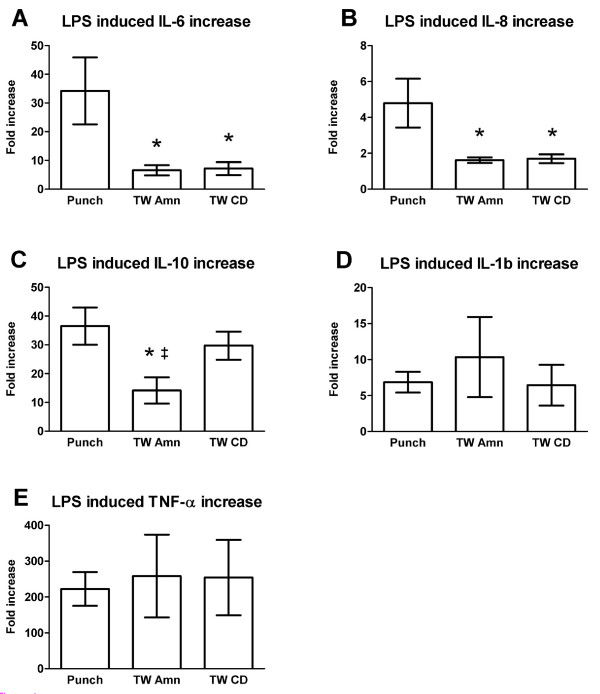
Tissue samples were exposed to 100 ng/ml LPS for 12 h and cytokines were measured by ELISA. Data are expressed as increase relative to non-treated controls.
Levels of interleukin-6 increased in punch culture medium samples to a significantly greater extent (34.2 fold) compared with medium from transwell cultures in the amnion (6.6 fold) or choriodecidual (7.1 fold) compartments. Interleukin-8 also showed a significantly greater induction in punch (4.8 fold) than transwell amnion (1.6 fold) or choriodecidual (1.7 fold) samples. The anti-inflammatory interleukin-10 showed a significant difference between punch (36.5 fold) and transwell amnion (15.4 fold) samples, but no difference was observed between punch and transwell choriodecidual (28.5 fold) samples. Neither interleukin-1beta nor tumor necrosis factor-alpha (TNF-alpha) showed a significant difference between the punch and transwell samples.
These results indicate that the pattern of LPS-stimulated cytokine release from gestational membranes in vitro depends on the culture system used, confounding comparisons of studies that use different gestational membrane culture systems to study inflammatory responses.
羊膜、绒毛膜和蜕膜这些胎盘外妊娠膜中的细胞因子信号在胎膜破裂和分娩时机中起着重要作用。评估人类妊娠膜细胞因子诱导的主要体外离体培养系统是游离活检冲孔培养。冲孔系统已被用于研究各种毒物、药物和遗传变异对促炎细胞因子表达的影响。最近,开发了一种双室 Transwell 培养系统,该系统更能模拟宫内环境。本研究比较了这两种系统对脂多糖 (LPS) 刺激下促炎和抗炎细胞因子释放的反应。
组织样本暴露于 100ng/ml LPS 12 小时,通过 ELISA 测量细胞因子。数据表示为与未处理对照相比的增加倍数。
与 Transwell 培养的羊膜(6.6 倍)或绒毛膜蜕膜(7.1 倍)腔室相比,冲孔培养物中的白细胞介素-6(IL-6)水平增加了显著更大的程度(34.2 倍)。白细胞介素-8(IL-8)在冲孔(4.8 倍)中也表现出比 Transwell 羊膜(1.6 倍)或绒毛膜蜕膜(1.7 倍)样品更大的诱导。抗炎性白细胞介素-10(IL-10)在冲孔(36.5 倍)和 Transwell 羊膜(15.4 倍)样品之间存在显著差异,但在冲孔和 Transwell 绒毛膜蜕膜(28.5 倍)样品之间没有差异。白细胞介素-1β(IL-1β)和肿瘤坏死因子-α(TNF-α)在冲孔和 Transwell 样品之间均无显著差异。
这些结果表明,体外妊娠膜中 LPS 刺激细胞因子释放的模式取决于所使用的培养系统,这使得使用不同妊娠膜培养系统研究炎症反应的研究之间的比较变得复杂。