Interdepartmental Neuroscience Program, Northwestern University, Evanston, Illinois, USA.
PLoS Comput Biol. 2010 Oct 21;6(10):e1000967. doi: 10.1371/journal.pcbi.1000967.
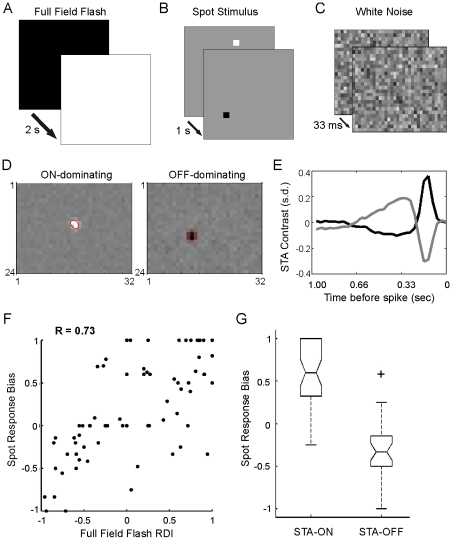
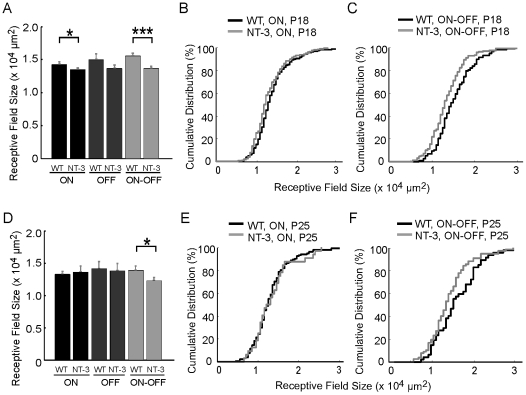
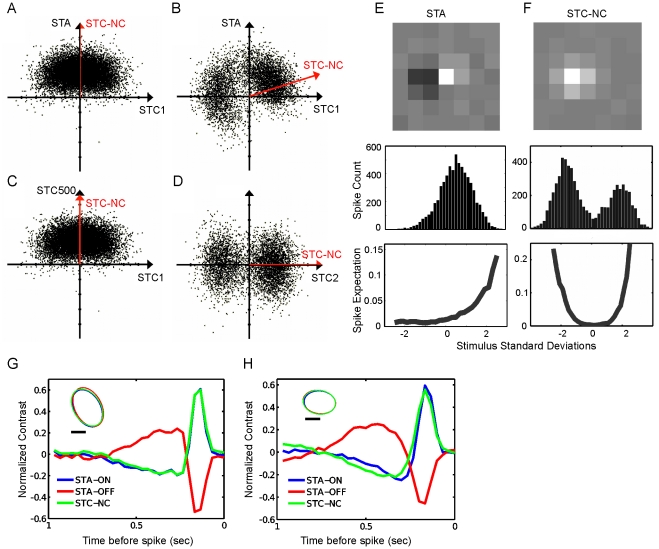
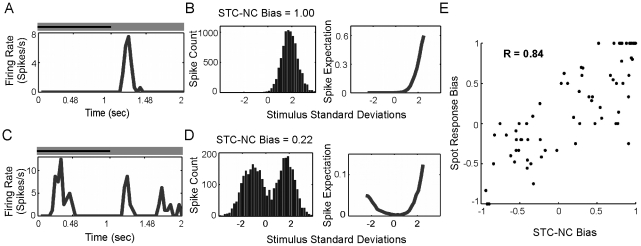
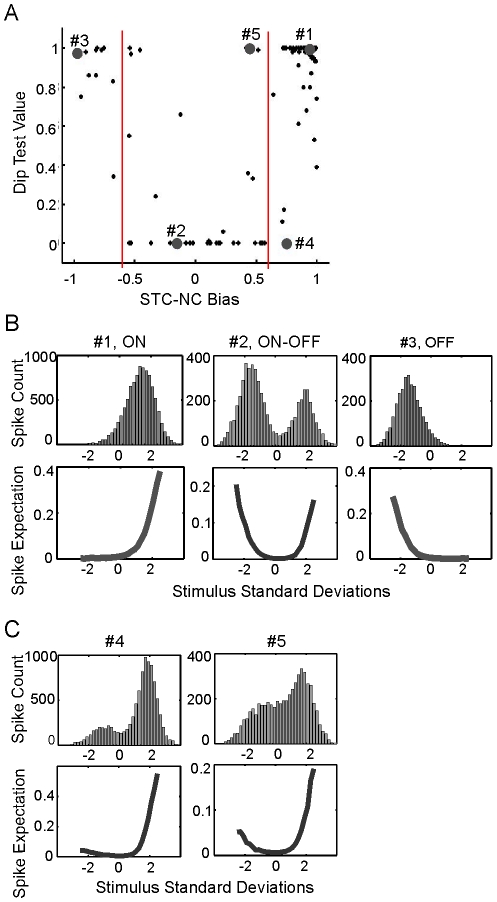
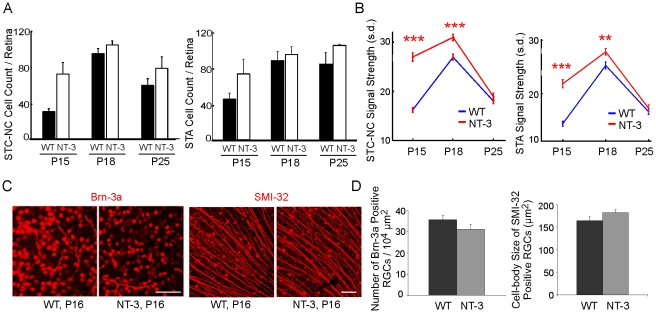
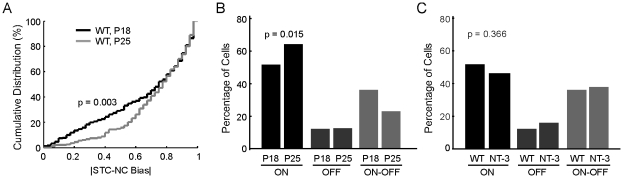
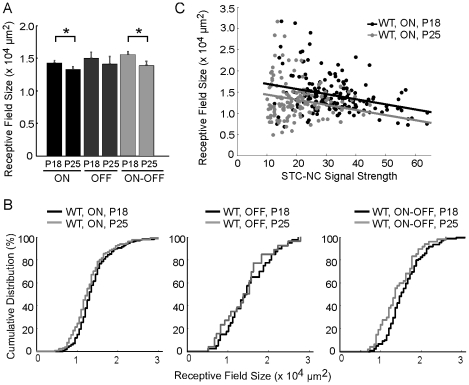
The functional separation of ON and OFF pathways, one of the fundamental features of the visual system, starts in the retina. During postnatal development, some retinal ganglion cells (RGCs) whose dendrites arborize in both ON and OFF sublaminae of the inner plexiform layer transform into RGCs with dendrites that monostratify in either the ON or OFF sublamina, acquiring final dendritic morphology in a subtype-dependent manner. Little is known about how the receptive field (RF) properties of ON, OFF, and ON-OFF RGCs mature during this time because of the lack of a reliable and efficient method to classify RGCs into these subtypes. To address this deficiency, we developed an innovative variant of Spike Triggered Covariance (STC) analysis, which we term Spike Triggered Covariance - Non-Centered (STC-NC) analysis. Using a multi-electrode array (MEA), we recorded the responses of a large population of mouse RGCs to a Gaussian white noise stimulus. As expected, the Spike-Triggered Average (STA) fails to identify responses driven by symmetric static nonlinearities such as those that underlie ON-OFF center RGC behavior. The STC-NC technique, in contrast, provides an efficient means to identify ON-OFF responses and quantify their RF center sizes accurately. Using this new tool, we find that RGCs gradually develop sensitivity to focal stimulation after eye opening, that the percentage of ON-OFF center cells decreases with age, and that RF centers of ON and ON-OFF cells become smaller. Importantly, we demonstrate for the first time that neurotrophin-3 (NT-3) regulates the development of physiological properties of ON-OFF center RGCs. Overexpression of NT-3 leads to the precocious maturation of RGC responsiveness and accelerates the developmental decrease of RF center size in ON-OFF cells. In summary, our study introduces STC-NC analysis which successfully identifies subtype RGCs and demonstrates how RF development relates to a neurotrophic driver in the retina.
视觉系统的基本特征之一是 ON 和 OFF 通路的功能分离,这种分离始于视网膜。在出生后发育过程中,一些树突在神经内丛状层的 ON 和 OFF 亚层中分枝的视网膜神经节细胞 (RGC) 转变为树突仅在 ON 或 OFF 亚层中分层的 RGC,以依赖于亚型的方式获得最终的树突形态。由于缺乏可靠和有效的方法将 RGC 分类为这些亚型,因此在此期间 ON、OFF 和 ON-OFF RGC 的感受野 (RF) 属性如何成熟知之甚少。为了解决这一不足,我们开发了 Spike Triggered Covariance (STC) 分析的一种创新变体,我们称之为 Spike Triggered Covariance - Non-Centered (STC-NC) 分析。我们使用多电极阵列 (MEA) 记录了大量小鼠 RGC 对高斯白噪声刺激的反应。正如预期的那样,Spike-Triggered Average (STA) 无法识别由对称静态非线性驱动的响应,例如那些构成 ON-OFF 中心 RGC 行为基础的非线性。相比之下,STC-NC 技术提供了一种有效的方法来识别 ON-OFF 响应并准确量化它们的 RF 中心大小。使用这个新工具,我们发现 RGC 在睁眼后逐渐对焦点刺激产生敏感性,ON-OFF 中心细胞的比例随年龄而降低,并且 ON 和 ON-OFF 细胞的 RF 中心变小。重要的是,我们首次证明神经营养因子-3 (NT-3) 调节 ON-OFF 中心 RGC 生理特性的发育。NT-3 的过表达导致 RGC 反应性的早熟成熟,并加速 ON-OFF 细胞中 RF 中心大小的发育性减小。总之,我们的研究介绍了 STC-NC 分析,该分析成功地识别了亚型 RGC,并展示了 RF 发育如何与视网膜中的神经营养驱动因素相关。