Xu Shan, Zhang Yiyuan, Zhen Zonglei, Liu Jia
Beijing Key Laboratory of Applied Experimental Psychology, Faculty of Psychology, Beijing Normal University, Beijing, China.
Department of Psychology & Tsinghua Laboratory of Brain and Intelligence, Tsinghua University, Beijing, China.
Front Comput Neurosci. 2021 May 20;15:626259. doi: 10.3389/fncom.2021.626259. eCollection 2021.
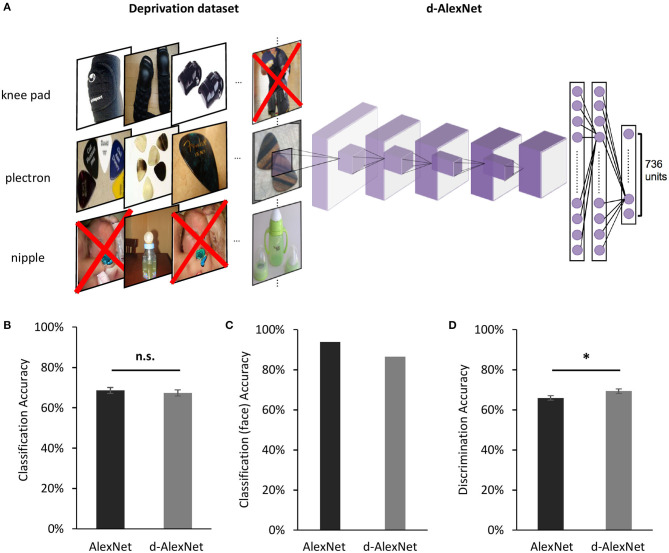
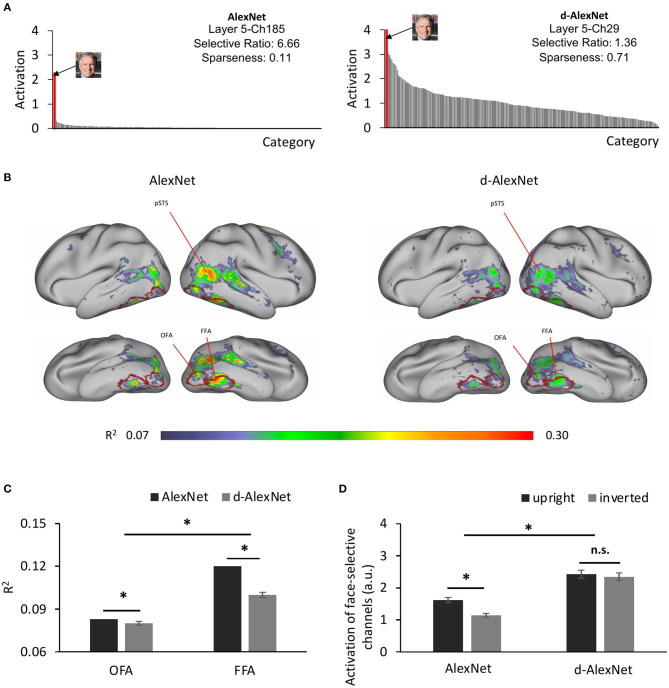
Can we recognize faces with zero experience on faces? This question is critical because it examines the role of experiences in the formation of domain-specific modules in the brain. Investigation with humans and non-human animals on this issue cannot easily dissociate the effect of the visual experience from that of the hardwired domain-specificity. Therefore, the present study built a model of selective deprivation of the experience on faces with a representative deep convolutional neural network, AlexNet, by removing all images containing faces from its training stimuli. This model did not show significant deficits in face categorization and discrimination, and face-selective modules automatically emerged. However, the deprivation reduced the domain-specificity of the face module. In sum, our study provides empirical evidence on the role of nature vs. nurture in developing the domain-specific modules that domain-specificity may evolve from non-specific experience without genetic predisposition, and is further fine-tuned by domain-specific experience.
我们能否在完全没有面部经验的情况下识别面孔?这个问题至关重要,因为它考察了经验在大脑中特定领域模块形成过程中的作用。对人类和非人类动物在这个问题上的研究很难将视觉经验的影响与内在的特定领域特异性的影响区分开来。因此,本研究通过从其训练刺激中去除所有包含面孔的图像,用具有代表性的深度卷积神经网络AlexNet构建了一个面部经验选择性剥夺模型。该模型在面部分类和辨别方面没有表现出明显的缺陷,并且自动出现了面部选择性模块。然而,这种剥夺降低了面部模块的领域特异性。总之,我们的研究为先天与后天在特定领域模块发展中的作用提供了实证证据,即特定领域性可能从没有遗传倾向的非特定经验中演变而来,并通过特定领域经验进一步微调。