Studies, Research and Sport Medicine Center, Government of Navarre, Navarre, Spain.
PLoS One. 2010 Oct 19;5(10):e13486. doi: 10.1371/journal.pone.0013486.
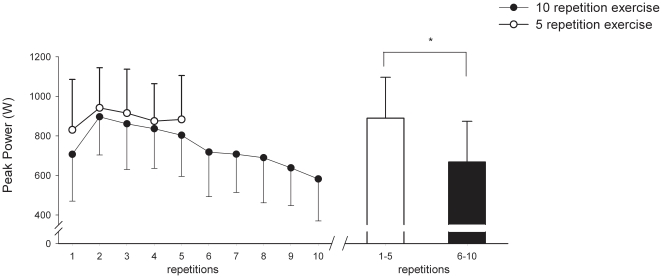
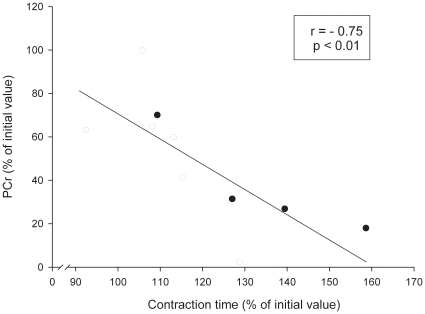
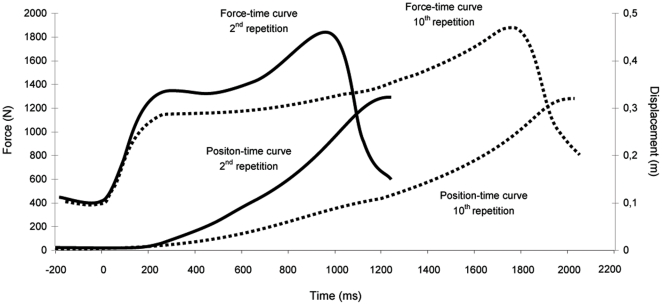
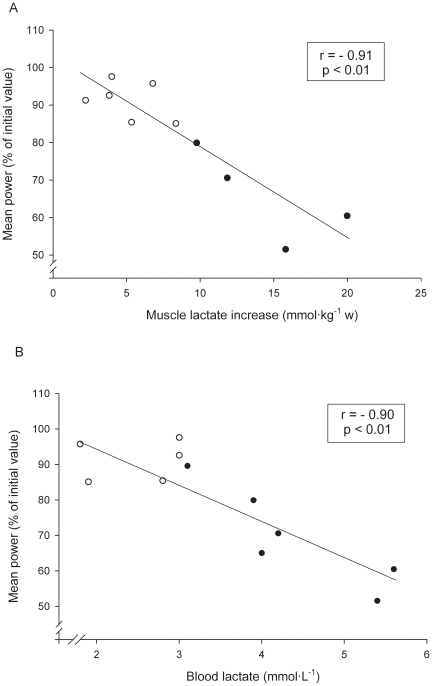
Information about anaerobic energy production and mechanical efficiency that occurs over time during short-lasting maximal exercise is scarce and controversial. Bilateral leg press is an interesting muscle contraction model to estimate anaerobic energy production and mechanical efficiency during maximal exercise because it largely differs from the models used until now. This study examined the changes in muscle metabolite concentration and power output production during the first and the second half of a set of 10 repetitions to failure (10RM) of bilateral leg press exercise. On two separate days, muscle biopsies were obtained from vastus lateralis prior and immediately after a set of 5 or a set of 10 repetitions. During the second set of 5 repetitions, mean power production decreased by 19% and the average ATP utilisation accounted for by phosphagen decreased from 54% to 19%, whereas ATP utilisation from anaerobic glycolysis increased from 46 to 81%. Changes in contraction time and power output were correlated to the changes in muscle Phosphocreatine (PCr; r = -0.76; P<0.01) and lactate (r = -0.91; P<0.01), respectively, and were accompanied by parallel decreases (P<0.01-0.05) in muscle energy charge (0.6%), muscle ATP/ADP (8%) and ATP/AMP (19%) ratios, as well as by increases in ADP content (7%). The estimated average rate of ATP utilisation from anaerobic sources during the final 5 repetitions fell to 83% whereas total anaerobic ATP production increased by 9% due to a 30% longer average duration of exercise (18.4 ± 4.0 vs 14.2 ± 2.1 s). These data indicate that during a set of 10RM of bilateral leg press exercise there is a decrease in power output which is associated with a decrease in the contribution of PCr and/or an increase in muscle lactate. The higher energy cost per repetition during the second 5 repetitions is suggestive of decreased mechanical efficiency.
关于短时间内最大运动期间厌氧能量产生和机械效率的信息稀缺且存在争议。双侧腿推是一种有趣的肌肉收缩模型,可以在最大运动期间估计厌氧能量产生和机械效率,因为它与迄今为止使用的模型有很大不同。本研究检查了在一组 10 次重复至力竭(10RM)的双侧腿推运动的前半部分和后半部分期间肌肉代谢物浓度和功率输出的变化。在两天的时间里,从股外侧肌中获得了肌肉活检,分别在一组 5 次或一组 10 次重复之前和之后。在第二组 5 次重复中,平均功率输出下降了 19%,磷酸原消耗的平均 ATP 利用率从 54%下降到 19%,而来自无氧糖酵解的 ATP 利用率从 46%增加到 81%。收缩时间和功率输出的变化与肌肉磷酸肌酸(PCr;r = -0.76;P<0.01)和乳酸(r = -0.91;P<0.01)的变化相关,并且伴随着肌肉能量电荷(0.6%)的平行下降(P<0.01-0.05),肌肉 ATP/ADP(8%)和 ATP/AMP(19%)的比例,以及 ADP 含量(7%)的增加。由于运动的平均持续时间延长了 30%(18.4 ± 4.0 对 14.2 ± 2.1 s),因此在最后 5 次重复中,估计来自厌氧源的平均 ATP 利用率平均下降至 83%,而总厌氧 ATP 产生增加了 9%。这些数据表明,在一组 10RM 的双侧腿推运动中,功率输出下降,这与 PCr 的减少和/或肌肉乳酸的增加有关。第二组 5 次重复的每一次重复的能量成本更高,这表明机械效率降低。