Department of Physical Education, University of Las Palmas de Gran Canaria, Las Palmas de Gran Canaria, Spain.
PLoS One. 2010 Oct 18;5(10):e13435. doi: 10.1371/journal.pone.0013435.
To determine if there is an association between physical activity assessed by the short version of the International Physical Activity Questionnaire (IPAQ) and cardiorespiratory and muscular fitness.
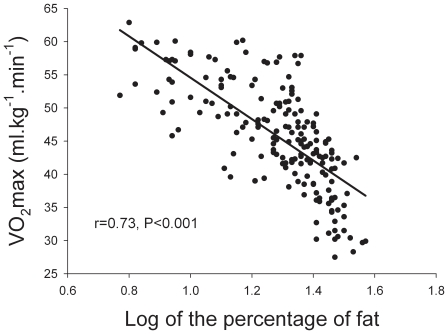
METHODOLOGY/PRINCIPAL FINDINGS: One hundred and eighty-two young males (age range: 20-55 years) completed the short form of the IPAQ to assess physical activity. Body composition (dual-energy X-Ray absorptiometry), muscular fitness (static and dynamic muscle force and power, vertical jump height, running speed [30 m sprint], anaerobic capacity [300 m running test]) and cardiorespiratory fitness (estimated VO(2)max: 20 m shuttle run test) were also determined in all subjects. Activity-related energy expenditure of moderate and vigorous intensity (EEPA(moderate) and EEPA(vigorous), respectively) was inversely associated with indices of adiposity (r = -0.21 to -0.37, P<0.05). Cardiorespiratory fitness (VO(2)max) was positively associated with LogEEPA(moderate) (r = 0.26, P<0.05) and LogEEPA(vigorous) (r = 0.27). However, no association between VO(2)max with LogEEPA(moderate), LogEPPA(vigorous) and LogEEPA(total) was observed after adjusting for the percentage of body fat. Multiple stepwise regression analysis to predict VO(2)max from LogEEPA(walking), LogEEPA(moderate), LogEEPA(vigorous), LogEEPA(total), age and percentage of body fat (%fat) showed that the %fat alone explained 62% of the variance in VO(2)max and that the age added another 10%, while the other variables did not add predictive value to the model [VO(2)max = 129.6-(25.1× Log %fat) - (34.0× Log age); SEE: 4.3 ml.kg(-1). min(-1); R(2) = 0.72 (P<0.05)]. No positive association between muscular fitness-related variables and physical activity was observed, even after adjusting for body fat or body fat and age.
CONCLUSIONS/SIGNIFICANCE: Adiposity and age are the strongest predictors of VO(2)max in healthy men. The energy expended in moderate and vigorous physical activities is inversely associated with adiposity. Muscular fitness does not appear to be associated with physical activity as assessed by the IPAQ.
为了确定通过国际体力活动问卷(IPAQ)短版评估的体力活动与心肺和肌肉健康之间是否存在关联。
方法/主要发现:182 名年轻男性(年龄范围:20-55 岁)完成了 IPAQ 短版,以评估体力活动。所有受试者均进行了身体成分(双能 X 射线吸收法)、肌肉力量和爆发力(静态和动态)、垂直跳跃高度、跑步速度(30 米冲刺)、无氧能力(300 米跑步测试)和心肺健康(估计 VO(2)max:20 米穿梭跑测试)的测试。中度和剧烈强度活动相关的能量消耗(分别为 EEPA(中度)和 EEPA(剧烈))与肥胖指数呈负相关(r=-0.21 至-0.37,P<0.05)。心肺健康(VO(2)max)与 LogEEPA(中度)(r=0.26,P<0.05)和 LogEEPA(剧烈)(r=0.27)呈正相关。然而,在调整体脂百分比后,VO(2)max 与 LogEEPA(中度)、LogEPPA(剧烈)和 LogEEPA(总)之间没有关联。从 LogEEPA(步行)、LogEEPA(中度)、LogEEPA(剧烈)、LogEEPA(总)、年龄和体脂百分比(%fat)预测 VO(2)max 的多元逐步回归分析表明,%fat 单独解释了 VO(2)max 变异的 62%,年龄增加了 10%,而其他变量对模型没有增加预测价值[VO(2)max=129.6-(25.1×Log%fat)-(34.0×Log 年龄);SEE:4.3ml.kg(-1).min(-1);R(2)=0.72(P<0.05)]。即使在调整体脂或体脂和年龄后,肌肉健康相关变量与体力活动之间也没有正相关。
结论/意义:肥胖和年龄是健康男性 VO(2)max 的最强预测因子。中等和剧烈体力活动所消耗的能量与肥胖呈负相关。肌肉健康似乎与 IPAQ 评估的体力活动无关。