Institute for Biology, Theoretical Biophysics, Humboldt University Berlin, Invalidenstraβe 42, 10115 Berlin, Germany.
Curr Genomics. 2010 May;11(3):199-211. doi: 10.2174/138920210791110942.
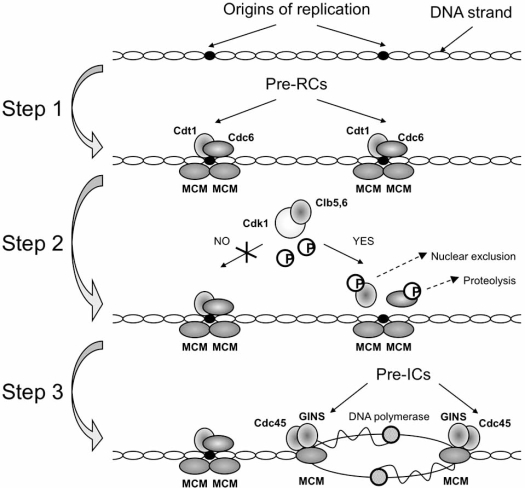
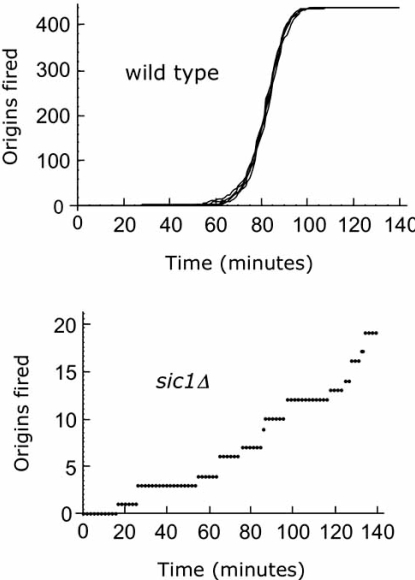
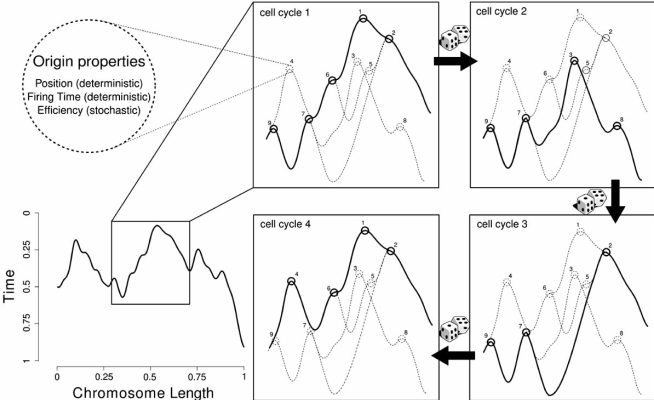
Similarly to metazoans, the budding yeast Saccharomyces cereviasiae replicates its genome with a defined timing. In this organism, well-defined, site-specific origins, are efficient and fire in almost every round of DNA replication. However, this strategy is neither conserved in the fission yeast Saccharomyces pombe, nor in Xenopus or Drosophila embryos, nor in higher eukaryotes, in which DNA replication initiates asynchronously throughout S phase at random sites. Temporal and spatial controls can contribute to the timing of replication such as Cdk activity, origin localization, epigenetic status or gene expression. However, a debate is going on to answer the question how individual origins are selected to fire in budding yeast. Two opposing theories were proposed: the "replicon paradigm" or "temporal program" vs. the "stochastic firing". Recent data support the temporal regulation of origin activation, clustering origins into temporal blocks of early and late replication. Contrarily, strong evidences suggest that stochastic processes acting on origins can generate the observed kinetics of replication without requiring a temporal order. In mammalian cells, a spatiotemporal model that accounts for a partially deterministic and partially stochastic order of DNA replication has been proposed. Is this strategy the solution to reconcile the conundrum of having both organized replication timing and stochastic origin firing also for budding yeast? In this review we discuss this possibility in the light of our recent study on the origin activation, suggesting that there might be a stochastic component in the temporal activation of the replication origins, especially under perturbed conditions.
与后生动物类似,出芽酵母酿酒酵母(Saccharomyces cerevisiae)以确定的时间复制其基因组。在该生物体中,明确的、特异性的起始点是高效的,几乎在每一轮 DNA 复制中都会启动。然而,这种策略在裂殖酵母酿酒酵母(Saccharomyces pombe)、爪蟾或果蝇胚胎以及高等真核生物中都没有被保守,在这些生物中,DNA 复制在 S 期随机起始于不同的位置,没有固定的起始时间。时间和空间的控制可以有助于复制的定时,如 Cdk 活性、起始点定位、表观遗传状态或基因表达。然而,关于如何选择起始点进行复制的问题,仍存在争议。两种相反的理论被提出:“复制子范式”或“时间程序”与“随机点火”。最近的数据支持起始点激活的时间调控,将起始点聚类成早期和晚期复制的时间块。相反,强有力的证据表明,作用于起始点的随机过程可以产生观察到的复制动力学,而不需要时间顺序。在哺乳动物细胞中,提出了一种时空模型,该模型解释了 DNA 复制的部分确定性和部分随机性顺序。对于出芽酵母,这种策略是否是解决组织复制时间和随机起始点火之间矛盾的解决方案?在这篇综述中,我们根据我们最近关于起始点激活的研究讨论了这种可能性,表明在时间激活复制起始点时可能存在随机成分,特别是在受到干扰的情况下。