• 文献检索
  • 文档翻译
  • 深度研究
  • 学术资讯
  • Suppr Zotero 插件Zotero 插件
  • 邀请有礼
  • 套餐&价格
  • 历史记录
应用&插件
Suppr Zotero 插件Zotero 插件浏览器插件Mac 客户端Windows 客户端微信小程序
定价
高级版会员购买积分包购买API积分包
服务
文献检索文档翻译深度研究API 文档MCP 服务
关于我们
关于 Suppr公司介绍联系我们用户协议隐私条款
关注我们

Suppr 超能文献

核心技术专利:CN118964589B侵权必究
粤ICP备2023148730 号-1Suppr @ 2026

文献检索

告别复杂PubMed语法,用中文像聊天一样搜索,搜遍4000万医学文献。AI智能推荐,让科研检索更轻松。

立即免费搜索

文件翻译

保留排版,准确专业,支持PDF/Word/PPT等文件格式,支持 12+语言互译。

免费翻译文档

深度研究

AI帮你快速写综述,25分钟生成高质量综述,智能提取关键信息,辅助科研写作。

立即免费体验

并非所有发光的都是金子——创始人效应使流感突变与疾病严重程度的关联变得复杂。

All that glitters is not gold--founder effects complicate associations of flu mutations to disease severity.

机构信息

Bioinformatics Institute (BII), Agency for Science Technology and Research (A*STAR), 30 Biopolis Street, #07-01, Matrix 138671, Singapore.

出版信息

Virol J. 2010 Nov 1;7:297. doi: 10.1186/1743-422X-7-297.

DOI:10.1186/1743-422X-7-297
PMID:21040570
原文链接:https://pmc.ncbi.nlm.nih.gov/articles/PMC2989967/
Abstract

BACKGROUND

The recent 2009 (H1N1) influenza A pandemic saw a rapid spread of the virus to essentially all parts of the world. In the course of its evolution, the virus acquired many mutations, some of which have been investigated in the context of increased severity due to high occurrences in fatal cases. For example, statements such as: "42.9% of individuals who died from laboratory-confirmed cases of the pandemic (H1N1) were infected with the hemagglutinin (HA) Q310 H mutant virus." give the impression that HA-Q310 H would be highly dangerous or important, while careful consideration of all available data suggests that this is unlikely to be the case.

RESULTS

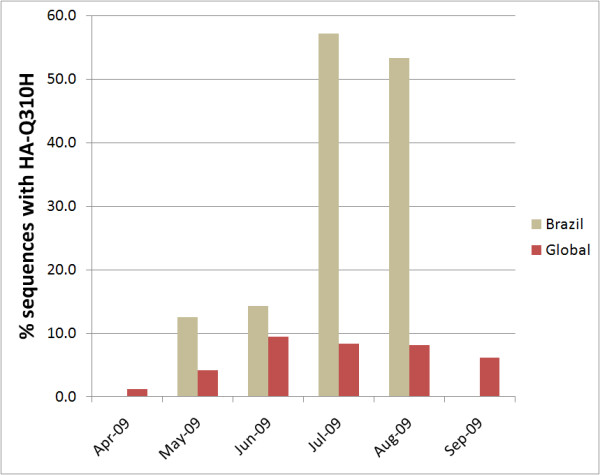
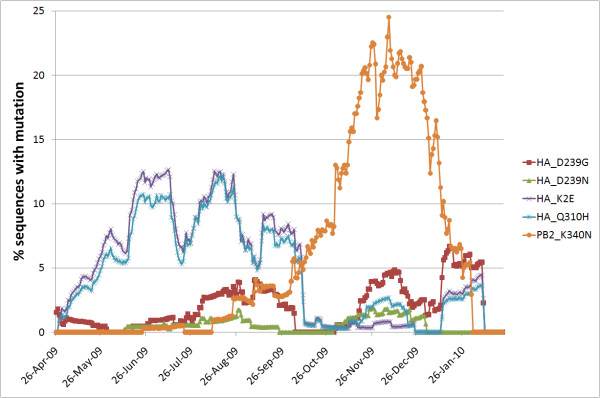
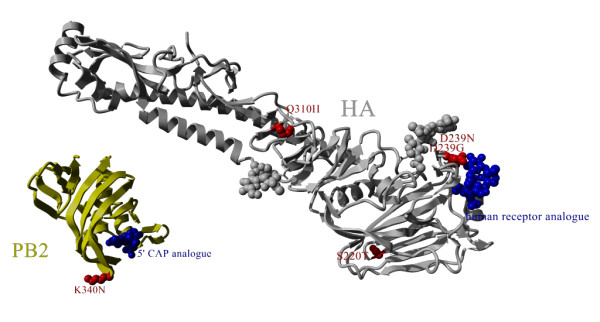
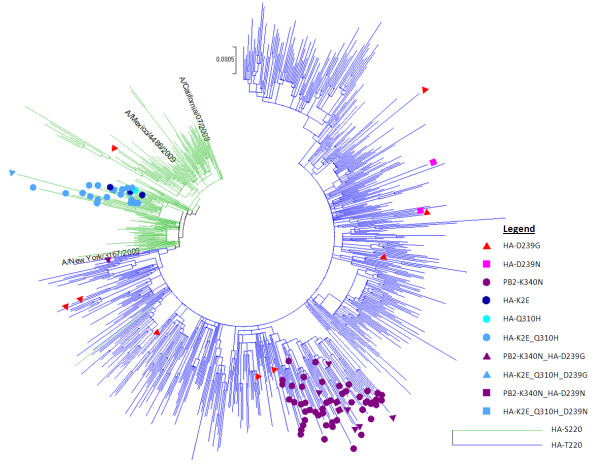
We compare the mutations HA-Q310 H, PB2-K340N, HA-D239N and HA-D239G using whole genome phylogenetic trees, structural modeling in their 3 D context and complete epidemiological data from sequences to clinical outcomes. HA-Q310 H and PB2-K340N appear as isolated subtrees in the phylogenetic analysis pointing to founder effects which is consistent with their clustered temporal appearance as well as the lack of an immediate structural basis that could explain a change of phenotypes. Considering the prevailing viral genomic background, shared origin of samples (all from the city of Sao Paulo) and narrow temporal window (all death case samples within 1 month), it becomes clear that HA-Q310 H was actually a generally common mutation in the region at that time which could readily explain its increased occurrence among the few analyzed fatal cases without requiring necessarily an association with severity. In further support of this, we highlight 3 mild cases with the HA-Q310 H mutation.

CONCLUSIONS

We argue that claims of severity of any current and future flu mutation need to be critically considered in the light of phylogenetic, structural and detailed epidemiological data to distinguish increased occurrence due to possible founder effects rather than real phenotypic changes.

摘要

背景

最近的 2009 年(H1N1)流感 A 大流行迅速蔓延到世界上几乎所有的地区。在其进化过程中,病毒发生了许多突变,其中一些突变由于在致死病例中高频发生而被认为与病毒严重性增加有关。例如,“在经实验室确诊的大流行(H1N1)病例中,有 42.9%的个体感染了具有血凝素(HA)Q310 H 突变的病毒。”这样的表述给人留下的印象是 HA-Q310 H 是高度危险或重要的,而仔细考虑所有现有数据表明,情况并非如此。

结果

我们使用全基因组系统进化树、三维结构建模和完整的流行病学数据将 HA-Q310 H、PB2-K340N、HA-D239N 和 HA-D239G 这四种突变进行比较,以分析其与临床结果的关系。HA-Q310 H 和 PB2-K340N 在系统进化分析中表现为孤立的分支,这指向了其起源于奠基者效应,这与它们在时间上的聚集出现以及缺乏可以解释表型变化的直接结构基础相一致。考虑到当时流行的病毒基因组背景、样本的共同来源(均来自圣保罗市)以及时间范围狭窄(所有死亡病例样本均在 1 个月内),HA-Q310 H 实际上是当时该地区普遍存在的一种常见突变,这可以很容易地解释为什么在少数分析的致死病例中它的出现频率更高,而无需必然与严重性相关联。进一步支持这一观点的是,我们强调了 3 例具有 HA-Q310 H 突变的轻症病例。

结论

我们认为,对于任何当前和未来流感突变的严重性的说法,需要根据系统进化、结构和详细的流行病学数据进行批判性地考虑,以区分由于可能的奠基者效应而导致的发生率增加,而不是真正的表型变化。
https://cdn.ncbi.nlm.nih.gov/pmc/blobs/4639/2989967/bdeda9d04449/1743-422X-7-297-4.jpg
https://cdn.ncbi.nlm.nih.gov/pmc/blobs/4639/2989967/bdb38f67d0a2/1743-422X-7-297-1.jpg
https://cdn.ncbi.nlm.nih.gov/pmc/blobs/4639/2989967/d72aabf9a05a/1743-422X-7-297-2.jpg
https://cdn.ncbi.nlm.nih.gov/pmc/blobs/4639/2989967/b9d9cda38178/1743-422X-7-297-3.jpg
https://cdn.ncbi.nlm.nih.gov/pmc/blobs/4639/2989967/bdeda9d04449/1743-422X-7-297-4.jpg
https://cdn.ncbi.nlm.nih.gov/pmc/blobs/4639/2989967/bdb38f67d0a2/1743-422X-7-297-1.jpg
https://cdn.ncbi.nlm.nih.gov/pmc/blobs/4639/2989967/d72aabf9a05a/1743-422X-7-297-2.jpg
https://cdn.ncbi.nlm.nih.gov/pmc/blobs/4639/2989967/b9d9cda38178/1743-422X-7-297-3.jpg
https://cdn.ncbi.nlm.nih.gov/pmc/blobs/4639/2989967/bdeda9d04449/1743-422X-7-297-4.jpg

相似文献

1
All that glitters is not gold--founder effects complicate associations of flu mutations to disease severity.并非所有发光的都是金子——创始人效应使流感突变与疾病严重程度的关联变得复杂。
Virol J. 2010 Nov 1;7:297. doi: 10.1186/1743-422X-7-297.
2
Genomic analysis of pandemic (H1N1) 2009 reveals association of increasing disease severity with emergence of novel hemagglutinin mutations.对大流行 (H1N1) 2009 的基因组分析显示,新型血凝素突变的出现与疾病严重程度的增加有关。
Cell Cycle. 2010 Mar 1;9(5):958-70. doi: 10.4161/cc.9.5.10913. Epub 2010 Mar 9.
3
A (H1N1) pdm09 HA D222 variants associated with severity and mortality in patients during a second wave in Mexico.与墨西哥第二波疫情中患者严重程度和死亡率相关的 A(H1N1)pdm09 HA D222 变异株。
Virol J. 2013 Jan 31;10:41. doi: 10.1186/1743-422X-10-41.
4
Genetic analysis of post-pandemic 2010-2011 influenza A(H1N1)pdm09 hemagglutinin virus variants that caused mild, severe, and fatal infections in Northern Greece.对 2010-2011 年大流行后在希腊北部引起轻度、重度和致命感染的甲型流感病毒(H1N1)pdm09 血凝素病毒变异株的遗传分析。
J Med Virol. 2015 Jan;87(1):57-67. doi: 10.1002/jmv.23990. Epub 2014 Jun 5.
5
Haemagglutinin D222G mutation found in a fatal case of pandemic (H1N1) flu in Tunisia.在突尼斯的一例致命性大流行性(H1N1)流感病例中发现血凝素 D222G 突变。
Arch Virol. 2012 Sep;157(9):1813-4. doi: 10.1007/s00705-012-1349-0. Epub 2012 Jun 9.
6
Mutations associated with severity of the pandemic influenza A(H1N1)pdm09 in humans: a systematic review and meta-analysis of epidemiological evidence.与甲型H1N1流感大流行(pdm09)在人类中的严重程度相关的突变:流行病学证据的系统评价和荟萃分析
Arch Virol. 2014 Dec;159(12):3167-83. doi: 10.1007/s00705-014-2179-z. Epub 2014 Jul 31.
7
Molecular findings from influenza A(H1N1)pdm09 detected in patients from a Brazilian equatorial region during the pandemic period.在大流行期间,对来自巴西赤道地区患者中检测到的甲型H1N1pdm09流感病毒进行的分子研究结果。
Mem Inst Oswaldo Cruz. 2014 Nov;109(7):912-7. doi: 10.1590/0074-0276140210. Epub 2014 Oct 14.
8
A single-amino-acid substitution in the HA protein changes the replication and pathogenicity of the 2009 pandemic A (H1N1) influenza viruses in vitro and in vivo.一个氨基酸的单点替换改变了 2009 年大流行 A(H1N1)流感病毒在体外和体内的复制和致病性。
Virol J. 2010 Nov 18;7:325. doi: 10.1186/1743-422X-7-325.
9
Molecular and phylogenetic analysis of the haemagglutinin gene of pandemic influenza H1N1 2009 viruses associated with severe and fatal infections.对与严重和致命感染相关的大流行性流感 H1N1 2009 病毒的血凝素基因进行分子和系统发育分析。
Virus Res. 2010 Aug;151(2):192-9. doi: 10.1016/j.virusres.2010.05.005. Epub 2010 May 20.
10
Genetic analysis of HA gene of pandemic H1N1 2009 influenza viruses circulating in India.对在印度传播的2009年甲型H1N1大流行性流感病毒血凝素(HA)基因的遗传分析。
Indian J Med Microbiol. 2012 Jul-Sep;30(3):346-9. doi: 10.4103/0255-0857.99500.

引用本文的文献

1
Decoding non-human mammalian adaptive signatures of 2.3.4.4b H5N1 to assess its human adaptive potential.解码2.3.4.4b H5N1禽流感病毒的非人类哺乳动物适应性特征以评估其对人类的适应潜力。
Microbiol Spectr. 2025 Sep 2;13(9):e0094825. doi: 10.1128/spectrum.00948-25. Epub 2025 Aug 11.
2
Comparative Analysis of Whole-Genome Sequences of Influenza A(H1N1)pdm09 Viruses Isolated from Hospitalized and Nonhospitalized Patients Identifies Missense Mutations That Might Be Associated with Patient Hospital Admissions in Finland during 2009 to 2014.对2009年至2014年期间从芬兰住院和非住院患者中分离出的甲型(H1N1)pdm09流感病毒全基因组序列进行比较分析,确定了可能与患者住院相关的错义突变。
Genome Announc. 2015 Jul 30;3(4):e00676-15. doi: 10.1128/genomeA.00676-15.
3

本文引用的文献

1
A new common mutation in the hemagglutinin of the 2009 (H1N1) influenza A virus.2009年甲型(H1N1)流感病毒血凝素中的一种新的常见突变。
PLoS Curr. 2010 Jun 1;2:RRN1162. doi: 10.1371/currents.rrn1162.
2
Occurrence of haemagglutinin mutation D222G in pandemic influenza A(H1N1) infected patients in the West of Scotland, United Kingdom, 2009-10.2009 - 2010年英国苏格兰西部甲型H1N1流感大流行感染患者中血凝素突变D222G的出现情况
Euro Surveill. 2010 Apr 22;15(16):19546.
3
Association of D222G substitution in haemagglutinin of 2009 pandemic influenza A (H1N1) with severe disease.
Molecular findings from influenza A(H1N1)pdm09 detected in patients from a Brazilian equatorial region during the pandemic period.在大流行期间,对来自巴西赤道地区患者中检测到的甲型H1N1pdm09流感病毒进行的分子研究结果。
Mem Inst Oswaldo Cruz. 2014 Nov;109(7):912-7. doi: 10.1590/0074-0276140210. Epub 2014 Oct 14.
4
Detection of the influenza A(H1N1)pdm09 virus carrying the K-15E, P83S and Q293H mutations in patients who have undergone bone marrow transplant.检测骨髓移植患者中携带 K-15E、P83S 和 Q293H 突变的甲型 H1N1pdm09 病毒。
PLoS One. 2014 Apr 16;9(4):e94822. doi: 10.1371/journal.pone.0094822. eCollection 2014.
5
Supersize me: how whole-genome sequencing and big data are transforming epidemiology.《超大号我:全基因组测序和大数据如何改变流行病学》。
Trends Microbiol. 2014 May;22(5):282-91. doi: 10.1016/j.tim.2014.02.011. Epub 2014 Mar 22.
6
Feature selection methods for identifying genetic determinants of host species in RNA viruses.用于鉴定 RNA 病毒宿主物种遗传决定因素的特征选择方法。
PLoS Comput Biol. 2013;9(10):e1003254. doi: 10.1371/journal.pcbi.1003254. Epub 2013 Oct 10.
7
Differing epidemiological dynamics of influenza B virus lineages in Guangzhou, southern China, 2009-2010.2009-2010 年中国南方广州地区乙型流感病毒谱系的流行病学动态差异。
J Virol. 2013 Nov;87(22):12447-56. doi: 10.1128/JVI.01039-13. Epub 2013 Sep 11.
8
Fecal influenza in mammals: selection of novel variants.哺乳动物中的粪类流感:新型变体的选择。
J Virol. 2013 Nov;87(21):11476-86. doi: 10.1128/JVI.01544-13. Epub 2013 Aug 21.
9
Genetic structure of human A/H1N1 and A/H3N2 influenza virus on Corsica Island: phylogenetic analysis and vaccine strain match, 2006-2010.2006-2010 年科西嘉岛人感染甲型 H1N1 和甲型 H3N2 流感病毒的遗传结构:系统进化分析和疫苗株匹配。
PLoS One. 2011;6(9):e24471. doi: 10.1371/journal.pone.0024471. Epub 2011 Sep 14.
10
"Boom" and "Bust" cycles in virus growth suggest multiple selective forces in influenza a evolution.病毒生长中的“繁荣”和“萧条”周期表明流感病毒进化中存在多种选择压力。
Virol J. 2011 Apr 18;8:180. doi: 10.1186/1743-422X-8-180.
2009年甲型H1N1大流行性流感血凝素中D222G替代与严重疾病的关联
Euro Surveill. 2010 Apr 8;15(14):19534; author reply pii/19535.
4
Structural basis of preexisting immunity to the 2009 H1N1 pandemic influenza virus.对 2009 年 H1N1 大流行流感病毒预先存在免疫的结构基础。
Science. 2010 Apr 16;328(5976):357-60. doi: 10.1126/science.1186430. Epub 2010 Mar 25.
5
Evolutionary pattern of pandemic influenza (H1N1) 2009 virus in the late phases of the 2009 pandemic.2009年大流行性流感(H1N1)病毒在2009年大流行后期的演变模式。
PLoS Curr. 2010 Mar 3;2:RRN1149. doi: 10.1371/currents.rrn1149.
6
Genomic signature and mutation trend analysis of pandemic (H1N1) 2009 influenza A virus.大流行(H1N1)2009 流感 A 病毒的基因组特征和突变趋势分析。
PLoS One. 2010 Mar 8;5(3):e9549. doi: 10.1371/journal.pone.0009549.
7
Observed association between the HA1 mutation D222G in the 2009 pandemic influenza A(H1N1) virus and severe clinical outcome, Norway 2009-2010.2009-2010 年挪威观察到 2009 年大流行性流感 A(H1N1)病毒 HA1 突变 D222G 与严重临床结局之间的关联。
Euro Surveill. 2010 Mar 4;15(9):19498. doi: 10.2807/ese.15.09.19498-en.
8
Large-scale evolutionary surveillance of the 2009 H1N1 influenza A virus using resequencing arrays.利用重测序芯片对 2009 年 H1N1 流感病毒进行大规模进化监测。
Nucleic Acids Res. 2010 May;38(9):e111. doi: 10.1093/nar/gkq089. Epub 2010 Feb 25.
9
Genomic analysis of pandemic (H1N1) 2009 reveals association of increasing disease severity with emergence of novel hemagglutinin mutations.对大流行 (H1N1) 2009 的基因组分析显示,新型血凝素突变的出现与疾病严重程度的增加有关。
Cell Cycle. 2010 Mar 1;9(5):958-70. doi: 10.4161/cc.9.5.10913. Epub 2010 Mar 9.
10
Replication, pathogenesis and transmission of pandemic (H1N1) 2009 virus in non-immune pigs.大流行(H1N1)2009 病毒在非免疫猪中的复制、发病机制和传播。
PLoS One. 2010 Feb 5;5(2):e9068. doi: 10.1371/journal.pone.0009068.