Key Laboratory of Animal Genetics and Breeding of the Ministry of Agriculture, College of Animal Science and Technology, China Agricultural University, Beijing, People's Republic of China.
PLoS One. 2010 Oct 27;5(10):e13661. doi: 10.1371/journal.pone.0013661.
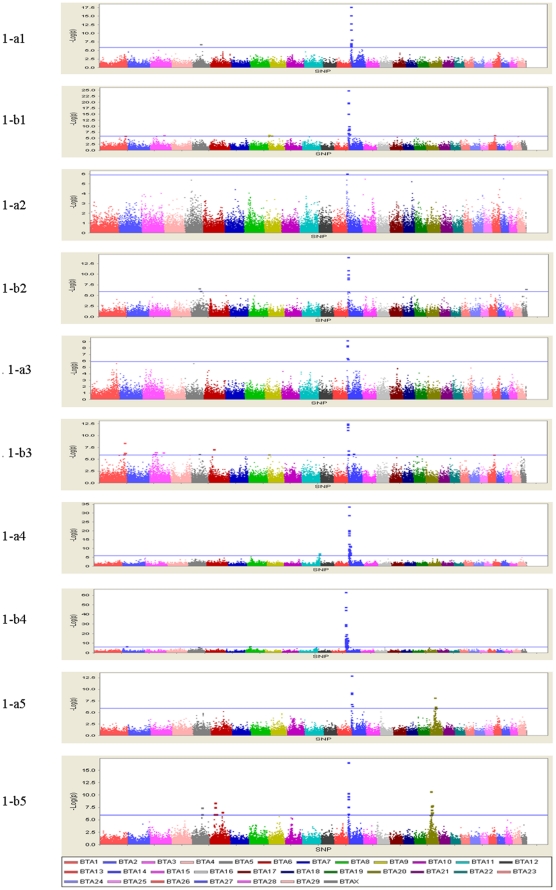
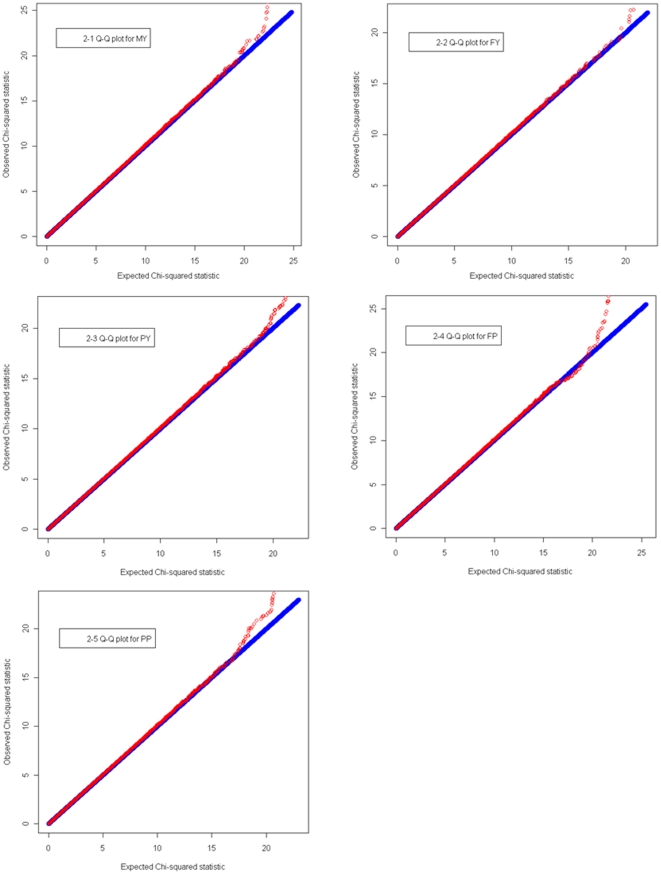
Genome-wide association studies (GWAS) based on high throughput SNP genotyping technologies open a broad avenue for exploring genes associated with milk production traits in dairy cattle. Motivated by pinpointing novel quantitative trait nucleotide (QTN) across Bos Taurus genome, the present study is to perform GWAS to identify genes affecting milk production traits using current state-of-the-art SNP genotyping technology, i.e., the Illumina BovineSNP50 BeadChip. In the analyses, the five most commonly evaluated milk production traits are involved, including milk yield (MY), milk fat yield (FY), milk protein yield (PY), milk fat percentage (FP) and milk protein percentage (PP). Estimated breeding values (EBVs) of 2,093 daughters from 14 paternal half-sib families are considered as phenotypes within the framework of a daughter design. Association tests between each trait and the 54K SNPs are achieved via two different analysis approaches, a paternal transmission disequilibrium test (TDT)-based approach (L1-TDT) and a mixed model based regression analysis (MMRA). In total, 105 SNPs were detected to be significantly associated genome-wise with one or multiple milk production traits. Of the 105 SNPs, 38 were commonly detected by both methods, while four and 63 were solely detected by L1-TDT and MMRA, respectively. The majority (86 out of 105) of the significant SNPs is located within the reported QTL regions and some are within or close to the reported candidate genes. In particular, two SNPs, ARS-BFGL-NGS-4939 and BFGL-NGS-118998, are located close to the DGAT1 gene (160bp apart) and within the GHR gene, respectively. Our findings herein not only provide confirmatory evidences for previously findings, but also explore a suite of novel SNPs associated with milk production traits, and thus form a solid basis for eventually unraveling the causal mutations for milk production traits in dairy cattle.
全基因组关联研究(GWAS)基于高通量 SNP 基因分型技术,为探索奶牛产奶性状相关基因开辟了广阔的途径。本研究旨在利用当前最先进的 SNP 基因分型技术(即 Illumina BovineSNP50 BeadChip),通过 GWAS 确定影响产奶性状的基因,从而精确确定牛 Taurus 基因组中的新型数量性状核苷酸(QTN)。在分析中,涉及了五个最常评估的产奶性状,包括产奶量(MY)、乳脂产量(FY)、乳蛋白产量(PY)、乳脂率(FP)和乳蛋白率(PP)。在女儿设计框架内,考虑了 14 个父系半同胞家系的 2093 头女儿的估计育种值(EBVs)作为表型。通过两种不同的分析方法,即父系传递不平衡测试(TDT)-基于方法(L1-TDT)和基于混合模型的回归分析(MMRA),实现了每个性状与 54K SNPs 之间的关联测试。总共检测到 105 个 SNP 与一个或多个产奶性状在全基因组范围内显著相关。在这 105 个 SNP 中,有 38 个 SNP 被两种方法共同检测到,而 L1-TDT 和 MMRA 分别单独检测到 4 个和 63 个 SNP。大多数(105 个中的 86 个)显著 SNP 位于已报道的 QTL 区域内,有些位于或接近已报道的候选基因内。特别是,两个 SNP,ARS-BFGL-NGS-4939 和 BFGL-NGS-118998,分别位于 DGAT1 基因(相隔 160bp)和 GHR 基因内。本研究不仅为先前的发现提供了确证证据,还探索了一系列与产奶性状相关的新型 SNP,为最终揭示奶牛产奶性状的因果突变奠定了坚实的基础。