Division of Biology, Imperial College London, UK.
J Insect Sci. 2010;10:155. doi: 10.1673/031.010.14115.
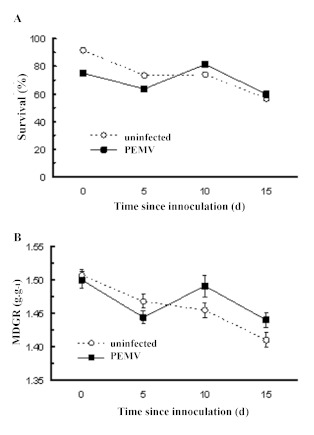
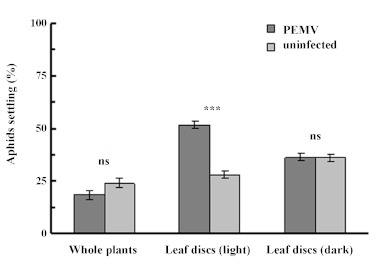
Plant pathogens can induce symptoms that affect the performance of insect herbivores utilizing the same host plant. Previous studies examining the effects of infection of tic bean, Vicia faba L. (Fabales: Fabaceae), by pea enation mosaic virus (PEMV), an important disease of legume crops, indicated there were no changes in the growth and reproductive rate of its primary vector the pea aphid, Acyrthosiphon pisum (Harris) (Hemiptera: Aphididae). Here, we report the results of laboratory experiments investigating how A. pisum responded to PEMV infection of a different host plant, Pisum sativum L., at different stages of symptom development. Aphid growth rate was negatively related to the age of the host plant, but when they were introduced onto older plants with well-developed PEMV symptoms they exhibited a higher growth rate compared to those developing on uninfected plants of the same age. In choice tests using leaf discs A. pisum showed a strong preference for discs from PEMV-infected peas, probably in response to visual cues from the yellowed and mottled infected leaves. When adults were crowded onto leaves using clip-cages they produced more winged progeny on PEMV-infected plants. The results indicate that PEMV produces symptoms in the host plant that can enhance the performance of A. pisum as a vector, modify the production of winged progeny and affect their spatial distribution. The findings provide further evidence that some insect vector/plant pathogen interactions could be regarded as mutualistic rather than commensal when certain conditions regarding the age, stage of infection and species of host plant are met.
植物病原体可以引起影响利用同一宿主植物的昆虫食草动物性能的症状。以前研究豆类作物的重要疾病豌豆花叶病毒(PEMV)感染豌豆时,检查感染对其主要载体豌豆蚜(Acyrthosiphon pisum(Harris))(半翅目:蚜科)的生长和繁殖率没有变化。在这里,我们报告了实验室实验的结果,该实验研究了豌豆蚜在不同症状发展阶段感染不同宿主植物豌豆时的反应。蚜虫的生长速度与宿主植物的年龄呈负相关,但当它们被引入到具有发达 PEMV 症状的较老植物上时,与在同一年龄的未感染植物上相比,它们表现出更高的生长速度。在使用叶盘进行的选择测试中,豌豆蚜对感染 PEMV 的豌豆叶盘表现出强烈的偏好,可能是对感染的黄化和斑驳叶片的视觉线索做出的反应。当使用夹笼将成虫挤到叶子上时,它们在感染 PEMV 的植物上产生更多有翅后代。结果表明,PEMV 在宿主植物中产生的症状可以增强豌豆蚜作为载体的性能,改变有翅后代的产生,并影响它们的空间分布。这些发现进一步证明,当满足某些条件(例如宿主植物的年龄、感染阶段和物种)时,某些昆虫载体/植物病原体的相互作用可以被视为互惠的,而不是共生的。