Hospital de Clínicas de Porto Alegre, Porto Alegre, Brazil.
BMC Infect Dis. 2010 Nov 14;10:328. doi: 10.1186/1471-2334-10-328.
There are few studies in Brazil that address baseline prevalence of MRSA colonization and associated risk factors at hospital admission, or the incidence of nosocomial colonization. We report a prospective study in a tertiary-care, university-affiliated hospital to implement a new MRSA control policy at the institution.
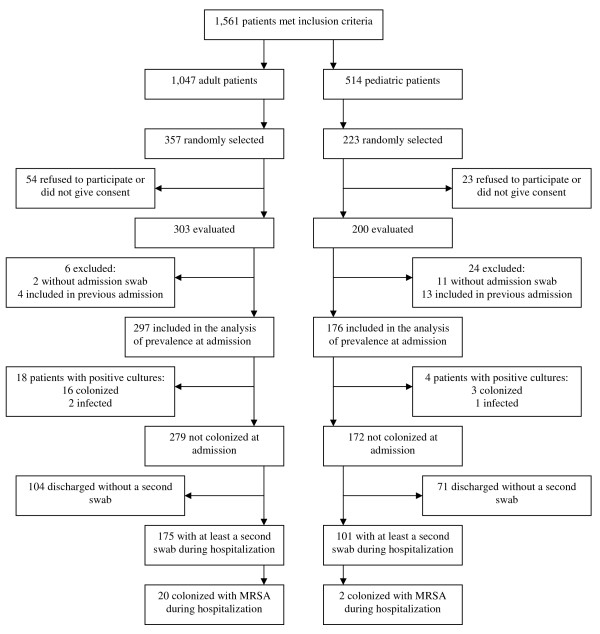
A cohort of randomly selected patients admitted to emergency and clinical wards at our hospital was followed until discharge. Nasal swabs were taken for identification of MRSA-colonized patients and detection of SCCmecA in positive cultures, at admission and weekly thereafter. Multivariate analysis using a log-binomial analysis was used to identify risk factors for colonization.
After screening 297 adult patients and 176 pediatric patients, the prevalence of MRSA at admission was 6.1% (95%CI, 3.6% to 9.4%), in the adult population and 2.3% (95%CI, 0.6% to 5.7%), for children. From multivariate analysis, the risk factors associated with colonization in adults were: age above 60 years (P = 0.019) and hospitalization in the previous year (P = 0.022). Incidence analysis was performed in 276 MRSA-negative patients (175 adults and 101 children). Acquisition rate was 5.5/1,000 patient-days for adults (95%CI, 3.4 to 8.5/1,000 patients-days), and 1.1/1,000 patient-days for children (95%CI, 0.1 to 4.0/1,000 patients-days).
The identification of MRSA carriers is a step towards establishing a control policy for MRSA, and helps to identify measures needed to reduce colonization pressure and to decrease the high acquisition rate in hospitalized patients.
巴西鲜有研究关注入院时耐甲氧西林金黄色葡萄球菌(MRSA)定植的基线流行率及其相关危险因素,也鲜有研究关注医院获得性定植。我们报告了一项在一家三级保健、大学附属医院开展的前瞻性研究,该研究旨在为该机构实施新的 MRSA 控制政策。
我们对随机选择的我院急诊和临床病房的住院患者进行了一项队列研究,直到出院。在入院时和此后每周采集鼻拭子,以确定 MRSA 定植患者,并对阳性培养物进行 SCCmecA 检测。使用对数二项式分析进行多变量分析,以确定定植的危险因素。
在筛查了 297 名成年患者和 176 名儿科患者后,成年患者的入院时 MRSA 流行率为 6.1%(95%CI,3.6%至 9.4%),儿童患者为 2.3%(95%CI,0.6%至 5.7%)。多变量分析显示,与成人定植相关的危险因素为:年龄大于 60 岁(P = 0.019)和入院前 1 年住院(P = 0.022)。对 276 例 MRSA 阴性患者(175 例成年患者和 101 例儿童患者)进行了发病率分析。成年患者的获得率为 5.5/1000 患者-天(95%CI,3.4 至 8.5/1000 患者-天),儿童患者为 1.1/1000 患者-天(95%CI,0.1 至 4.0/1000 患者-天)。
识别 MRSA 携带者是制定 MRSA 控制政策的重要一步,有助于确定降低定植压力和减少住院患者高获得率所需的措施。