CoRPS-Center of Research on Psychology in Somatic diseases, Dept, of Medical Psychology, Tilburg University, The Netherlands.
BMC Public Health. 2010 Nov 19;10:714. doi: 10.1186/1471-2458-10-714.
People with Type D-Distressed-personality have a general tendency towards increased negative affectivity (NA), while at the same time inhibiting these emotions in social situations (SI). Type D personality is associated with an increased risk of adverse outcomes in patients with cardiovascular disease. Whether Type D personality is a cardiovascular risk factor in healthy populations remains to be investigated. In the present study, the relations between Type D personality and classical cardiovascular risk factors, i.e. metabolic syndrome and lifestyle were investigated in a Dutch community sample.
In a cross-sectional study 1592 participants were included, aged 20-80 years. Metabolic syndrome was defined by self-report, following the International Diabetes Federation-IDF-guidelines including an increased waist circumference, dyslipidemia, hypertension, and diabetes. In addition lifestyle factors smoking, alcohol use, exercise and dietary habits were examined. Metabolic syndrome prevalence was stratified by Type D personality (a high score on both NA and SI), lifestyle and confounders age, gender, having a partner, higher education level, cardiac history, family history of cardiovascular disease.
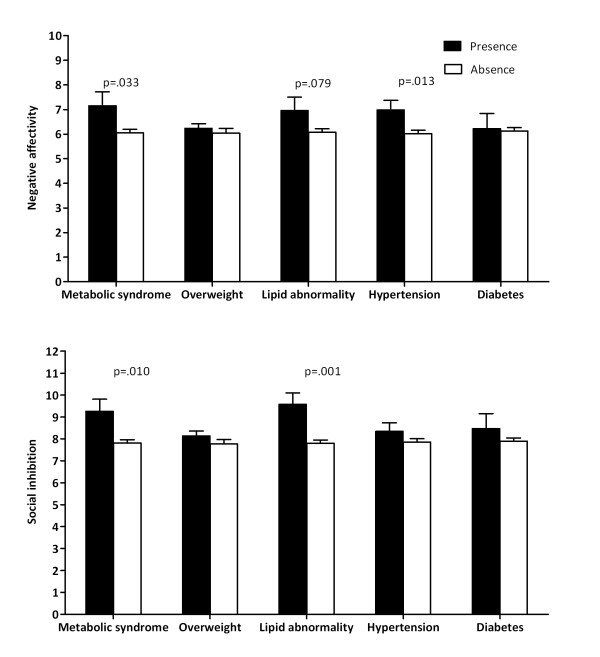
Metabolic syndrome was more prevalent in persons with a Type D personality (13% vs. 6%). Persons with Type D personality made poorer lifestyle choices, adhered less to the physical activity norm (OR = 1.5, 95%CI = 1.1-2.0, p = .02), had a less varied diet (OR = 0.50, 95%CI = 0.40-0.70, p < .0005), and were less likely to restrict their fat intake (OR = 0.70, 95%CI = 0.50-0.90, p = .01). Type D personality was related to a twofold increased risk of metabolic syndrome (OR = 2.2, 95%CI = 1.2-4.0, p = .011), independent of lifestyle factors and confounders.
Type D personality is related to an increased prevalence of metabolic syndrome and unhealthy lifestyle, which suggests both behavioral and biological vulnerability for development of cardiovascular disorders and diabetes.
具有 D 型人格特征(即情绪不稳定性和社交抑制性)的人通常表现出更高的负性情感,同时在社交情境中抑制这些情感。D 型人格与心血管疾病患者的不良预后风险增加有关。D 型人格是否是健康人群的心血管危险因素仍有待研究。本研究在荷兰社区样本中,调查了 D 型人格与经典心血管危险因素(即代谢综合征和生活方式)之间的关系。
在一项横断面研究中,纳入了 1592 名年龄在 20-80 岁的参与者。代谢综合征通过国际糖尿病联合会(IDF)指南的自我报告定义,包括腰围增加、血脂异常、高血压和糖尿病。此外,还检查了生活方式因素,如吸烟、饮酒、运动和饮食习惯。根据 D 型人格(即负性情感和社交抑制性得分高)、生活方式和混杂因素(年龄、性别、是否有伴侣、受教育程度、心脏病史、心血管疾病家族史)对代谢综合征的患病率进行分层。
具有 D 型人格的人患代谢综合征的比例更高(13%比 6%)。具有 D 型人格的人生活方式选择较差,较少遵循体力活动标准(OR = 1.5,95%CI = 1.1-2.0,p =.02),饮食种类较少(OR = 0.50,95%CI = 0.40-0.70,p <.0005),不太可能限制脂肪摄入(OR = 0.70,95%CI = 0.50-0.90,p =.01)。D 型人格与代谢综合征的风险增加两倍相关(OR = 2.2,95%CI = 1.2-4.0,p =.011),独立于生活方式因素和混杂因素。
D 型人格与代谢综合征和不健康的生活方式有关,这表明 D 型人格具有发生心血管疾病和糖尿病的行为和生物学脆弱性。