Ecology Centre, The University of Queensland, Brisbane, Queensland, Australia.
PLoS One. 2010 Nov 30;5(11):e15103. doi: 10.1371/journal.pone.0015103.
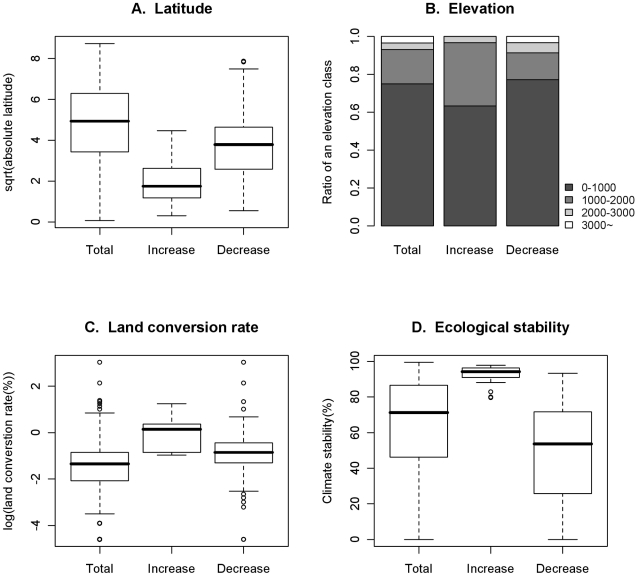
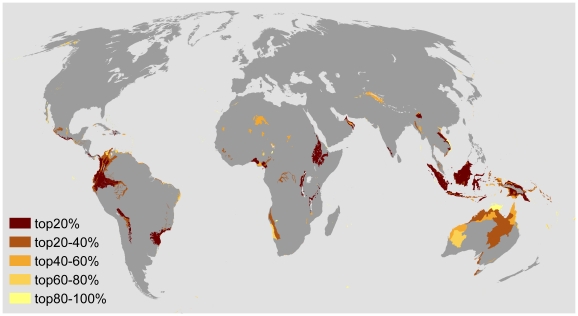
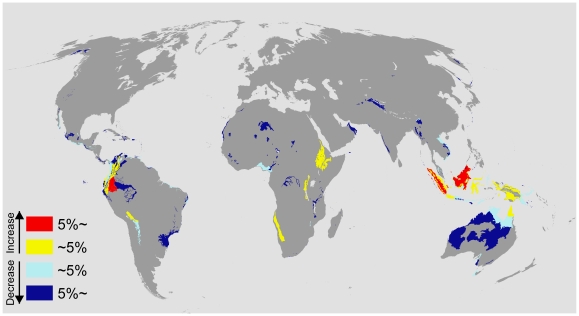
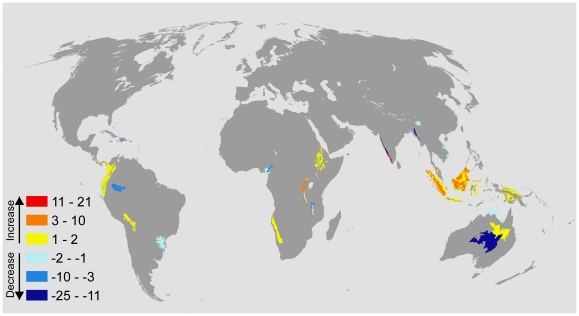
Climate change is impacting species and ecosystems globally. Many existing templates to identify the most important areas to conserve terrestrial biodiversity at the global scale neglect the future impacts of climate change. Unstable climatic conditions are predicted to undermine conservation investments in the future. This paper presents an approach to developing a resource allocation algorithm for conservation investment that incorporates the ecological stability of ecoregions under climate change. We discover that allocating funds in this way changes the optimal schedule of global investments both spatially and temporally. This allocation reduces the biodiversity loss of terrestrial endemic species from protected areas due to climate change by 22% for the period of 2002-2052, when compared to allocations that do not consider climate change. To maximize the resilience of global biodiversity to climate change we recommend that funding be increased in ecoregions located in the tropics and/or mid-elevation habitats, where climatic conditions are predicted to remain relatively stable. Accounting for the ecological stability of ecoregions provides a realistic approach to incorporating climate change into global conservation planning, with potential to save more species from extinction in the long term.
气候变化正在影响全球的物种和生态系统。许多现有的模板用于识别全球范围内保护陆地生物多样性的最重要区域,但它们忽略了气候变化的未来影响。不稳定的气候条件预计将破坏未来的保护投资。本文提出了一种方法,用于开发一种保护投资资源分配算法,该算法纳入了气候变化下生态区的生态稳定性。我们发现,以这种方式分配资金会在空间和时间上改变全球投资的最佳时间表。与不考虑气候变化的分配相比,这种分配方式可将 2002-2052 年期间保护区内因气候变化而导致的陆地特有物种的生物多样性损失减少 22%。为了使全球生物多样性对气候变化的适应能力最大化,我们建议增加位于热带和/或中海拔生境的生态区的资金,因为预计这些地区的气候条件将保持相对稳定。考虑生态区的生态稳定性为将气候变化纳入全球保护规划提供了一种现实的方法,从长远来看,有潜力使更多的物种免于灭绝。