St Luke's College of Nursing, 10-1 Akashi-cho, Chuo-ku, Tokyo 104-0044, Japan.
BMC Pregnancy Childbirth. 2010 Dec 24;10:84. doi: 10.1186/1471-2393-10-84.
Intimate partner violence (IPV) is a serious social issue in Japan. In order to start effective interventions for abused women, the appropriate method of screening for IPV in healthcare settings needs clarifying. The objective of this study was to compare the effectiveness of a face-to-face interview with a self-administered questionnaire. We used the Violence Against Women Screen (VAWS), a Japanese screening instrument for intimate partner violence (IPV), for identifying pregnant women who have experienced abuse.
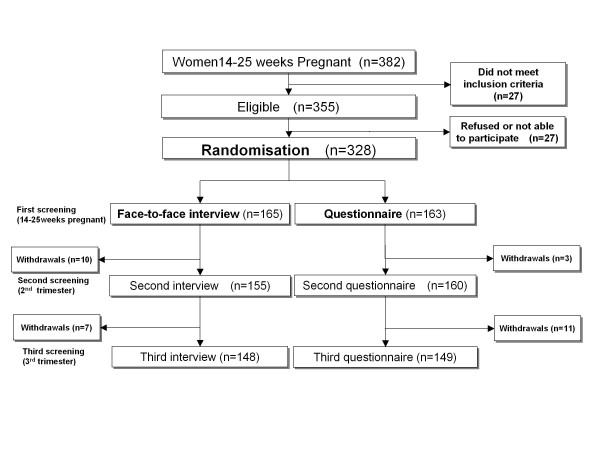
We conducted a randomised controlled trial to screen participants at three points in time in a prenatal clinic in Tokyo, Japan. There were 328 consenting women between 14 and 25 weeks of pregnancy who were consecutively selected and randomly assigned to either the interview or self-administered questionnaire group. Both groups completed the same screening instrument three times during their pregnancy. The primary outcome was the total number of women identified by each screening method and the secondary outcome was the effect of the screening as measured by the women's comfort level and their expressed need to consult with the nurse.
For all three screenings, the identification rate in the interview group was significantly lower than that for the self-administered questionnaire group (relative risk 0.66, 95% CI 0.46 to 0.97), even after controlling for smoking (adjusted odds ratio 0.59, 95% CI 0.35 to 0.98). The two groups did not differ for secondary outcomes.
The self-administered questionnaire identified more IPV than the face-to-face interview when screening pregnant women in a Japanese prenatal clinic.
UMIN-CTRC000000353.
亲密伴侣暴力(IPV)是日本的一个严重社会问题。为了对受虐妇女进行有效的干预,需要明确医疗环境中 IPV 的适当筛查方法。本研究的目的是比较面对面访谈和自我管理问卷的效果。我们使用了针对亲密伴侣暴力(IPV)的日本筛查工具——针对妇女的暴力行为筛查(VAWS),来识别有过虐待经历的孕妇。
我们在日本东京的产前诊所进行了一项随机对照试验,对三个时间点的参与者进行了筛查。有 328 名 14 至 25 周妊娠的同意参与者连续入选并随机分配到访谈组或自我管理问卷组。两组在妊娠期间均完成了三次相同的筛查。主要结局是两种筛查方法识别的妇女总数,次要结局是筛查的效果,通过妇女的舒适度和她们表达与护士咨询的意愿来衡量。
在所有三次筛查中,访谈组的识别率均明显低于自我管理问卷组(相对风险 0.66,95%CI 0.46 至 0.97),即使在控制了吸烟因素后也是如此(调整后的优势比 0.59,95%CI 0.35 至 0.98)。两组在次要结局方面没有差异。
在日本产前诊所筛查孕妇时,自我管理问卷比面对面访谈识别出更多的 IPV。
UMIN-CTRC000000353。