Institute of Arctic and Alpine Research,Environmental Studies Program,Department of Chemistry and BiochemistryDepartment of Computer ScienceDepartment of Ecology and Evolutionary BiologyCooperative Institute for Research in Environmental Sciences, University of Colorado, Boulder, CO 80309, USA.Center for Genome Sciences, Washington University School of Medicine, St. Louis, MO 63108, USA.School of Biology, Georgia Institute of Technology, Atlanta, GA 30332, USA.Department of Ecosystem and Conservation Sciences, University of Montana, Missoula, MT 59812.
Environ Microbiol. 2011 Jan;13(1):135-144. doi: 10.1111/j.1462-2920.2010.02315.x.
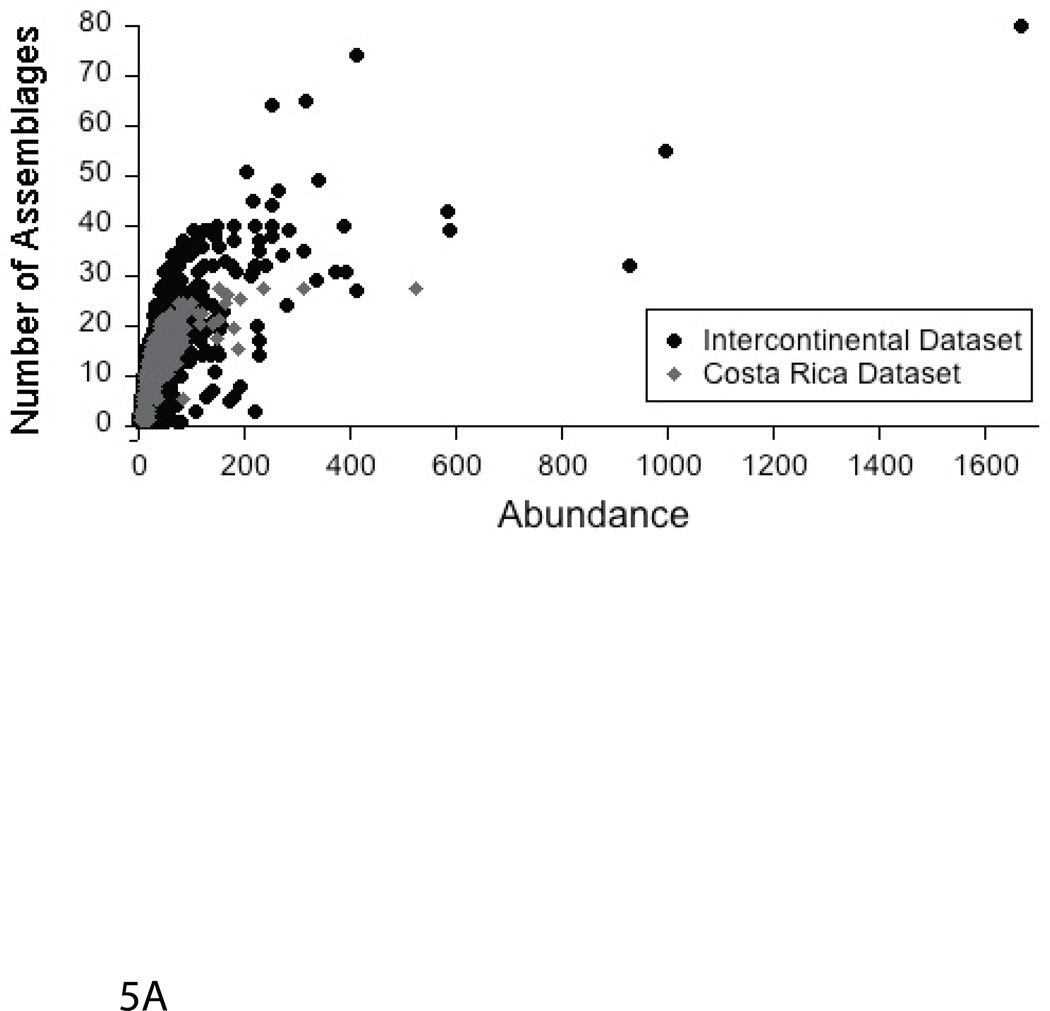
Bacteria control major nutrient cycles and directly influence plant, animal and human health. However, we know relatively little about the forces shaping their large-scale ecological ranges. Here, we reveal patterns in the distribution of individual bacterial taxa at multiple levels of phylogenetic resolution within and between Earth's major habitat types. Our analyses suggest that while macro-scale habitats structure bacterial distribution to some degree, abundant bacteria (i.e. detectable using 16S rRNA gene sequencing methods) are confined to single assemblages. Additionally, we show that the most cosmopolitan taxa are also the most abundant in individual assemblages. These results add to the growing body of data that support that the diversity of the overall bacterial metagenome is tremendous. The mechanisms governing microbial distribution remain poorly understood, but our analyses provide a framework with which to test the importance of macro-ecological environmental gradients, relative abundance, neutral processes and the ecological strategies of individual taxa in structuring microbial communities.
细菌控制着主要的营养循环,并直接影响植物、动物和人类的健康。然而,我们对于塑造它们大规模生态范围的力量相对知之甚少。在这里,我们揭示了在地球主要栖息类型内部和之间,在多个系统发育分辨率水平上,个体细菌分类群的分布模式。我们的分析表明,虽然宏观栖息地在一定程度上构建了细菌的分布,但丰富的细菌(即使用 16S rRNA 基因测序方法可检测到的细菌)局限于单个组合。此外,我们还表明,最世界性的分类群也是个体组合中最丰富的分类群。这些结果增加了越来越多的数据支持,即整个细菌宏基因组的多样性是巨大的。控制微生物分布的机制仍了解甚少,但我们的分析提供了一个框架,可以用来测试宏观生态环境梯度、相对丰度、中性过程以及个体分类群的生态策略在构建微生物群落中的重要性。