Department of Psychiatry and Behavioral Sciences, University of Texas Health Science Center at Houston, Houston, TX 77504, USA.
Am J Drug Alcohol Abuse. 2011 Mar;37(2):117-22. doi: 10.3109/00952990.2010.543204. Epub 2011 Jan 5.
Cocaine-dependent subjects show attentional bias to cocaine-related stimuli, increased impulsivity on questionnaires, and impaired inhibitory control (one component of impulsivity on behavioral tasks). However, the relationship between attentional bias, impulsivity, and inhibitory control in cocaine-dependent subjects is unknown.
To investigate the relationship between attentional bias to cocaine-related stimuli, impulsivity, and inhibitory control in cocaine dependence.
This study employed the cocaine Stroop task to measure attentional bias to cocaine-related stimuli, immediate memory task (IMT) to measure inhibitory control, and Barratt Impulsiveness Scale version 11 to measure impulsivity. Thirty-two controls and 37 cocaine-dependent subjects were recruited through newspaper advertisement.
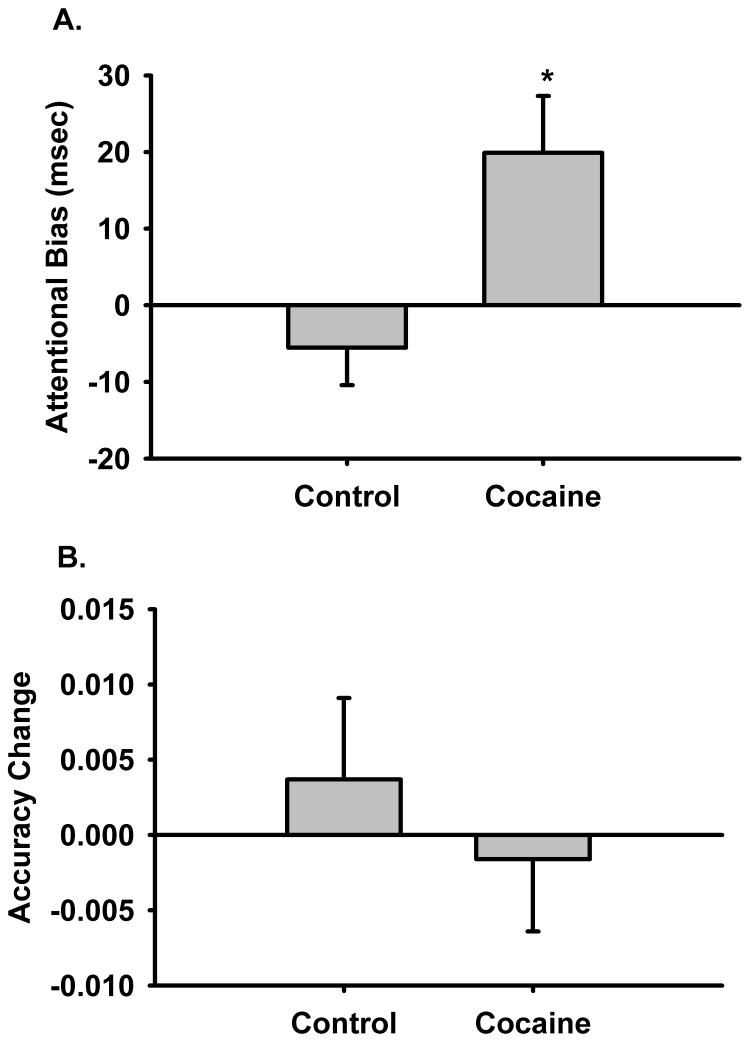
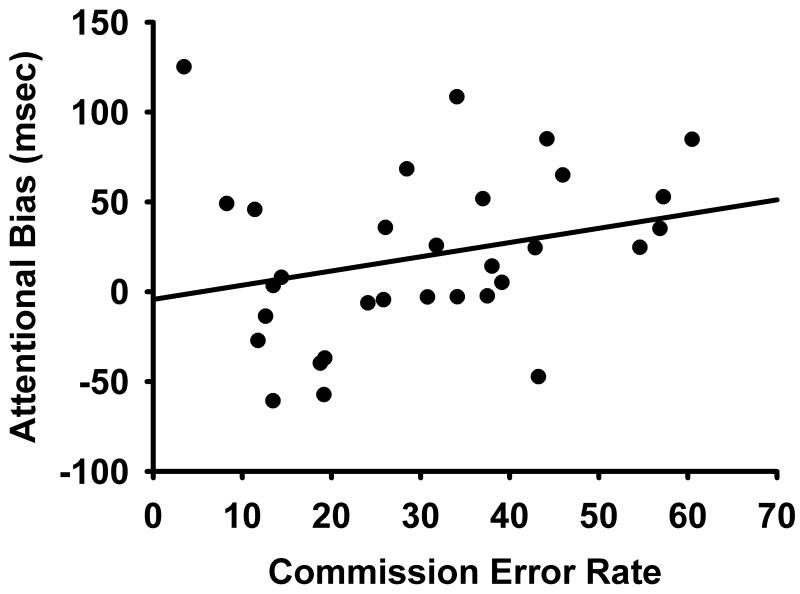
Cocaine-dependent subjects had higher attentional bias to cocaine-related words, higher scores for Barratt Impulsiveness Scale, and higher commission error rate on the IMT than controls. The attentional bias was positively correlated with the commission error rate on the IMT in the cocaine-dependent subjects but not in control subjects.
Cocaine-dependent subjects showed attentional bias to cocaine-related words, increased impulsivity, and poor inhibitory control compared with controls. The attentional bias was associated with inhibitory control in cocaine-dependent subjects but not in control subjects.
Our findings suggest that cocaine-dependent subjects with poor inhibitory control may show higher attentional bias to cocaine-related words compared with controls and those with better inhibitory control.
可卡因依赖者对与可卡因相关的刺激表现出注意力偏向,在问卷上表现出冲动性增加,以及抑制控制受损(行为任务中冲动性的一个组成部分)。然而,可卡因依赖者的注意力偏向、冲动性和抑制控制之间的关系尚不清楚。
探讨可卡因依赖者对可卡因相关刺激的注意力偏向、冲动性和抑制控制之间的关系。
本研究采用可卡因 Stroop 任务来测量对可卡因相关刺激的注意力偏向,采用即时记忆任务(IMT)来测量抑制控制,采用巴瑞特冲动量表第 11 版来测量冲动性。通过报纸广告招募了 32 名对照者和 37 名可卡因依赖者。
可卡因依赖者对可卡因相关词语的注意力偏向更高,巴瑞特冲动量表得分更高,即时记忆任务的错误率更高。在可卡因依赖者中,注意力偏向与即时记忆任务的错误率呈正相关,但在对照者中则没有。
与对照者相比,可卡因依赖者表现出对可卡因相关词语的注意力偏向、冲动性增加和抑制控制受损。在可卡因依赖者中,注意力偏向与抑制控制有关,而在对照者中则没有。
我们的发现表明,与抑制控制较好的个体相比,抑制控制较差的可卡因依赖者可能对可卡因相关词语表现出更高的注意力偏向。