Nursing and Patient Care Services, Clinical Center, National Institutes of Health, 10 Center Drive, Room 2B14, MSC-115, Bethesda, MD 20892-1151, USA.
Arthritis Res Ther. 2011 Jan 5;13(1):R1. doi: 10.1186/ar3219.
Rheumatic diseases are among the most common and debilitating health problems in the United States. These diseases are chronic, can result in severe decrements of physical and psychosocial functioning and affect patients' overall quality of life. A consensus regarding the best patient outcomes to be measured in randomized, controlled trials and prospective natural history studies is essential to provide best estimates of efficacy and safety of interventions across diverse patient populations.
Face-to-face English- and Spanish-language cognitive interviews were conducted among urban Hispanic and African American patients with rheumatic disease to develop a questionnaire booklet. Six measures validating patient-reported outcomes were included: the Arthritis Self-Efficacy Scale, the Stanford Health Assessment Questionnaire Disability Index, the Wong-Baker Faces Pain Scale, the Short Acculturation Scale, the Center for Epidemiologic Studies Depression Scale and the Inventory of Complementary and Alternative Medicine Practices. A sample of patients (n = 15) attending the National Institute of Arthritis and Musculoskeletal and Skin Diseases Community Health Center participated in the initial interviews. Revised measures were further tested for reliability in a separate sample of patients (n = 109) upon enrollment at the health center.
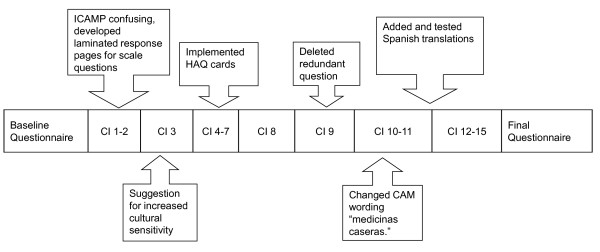
Cognitive interviews provided feedback for questionnaire modifications and methods to enhance content validity and data quality, including discarding redundant questions, providing visual aids and concrete examples when appropriate and increasing the use of racially and ethnically concordant interviewers. The cognitive interviews further elucidated that some contextual assumptions and language usage in the original questionnaires may not have taken each respondent's environmental and sociocultural context into consideration. Internal reliability for previously tested measures remained high (Cronbach's α = 0.87-0.94).
Cognitive interviewing techniques are useful in a diverse sample of racial and ethnic minority patients with rheumatic disease as a method to assess the content validity of the specific outcome measures selected. The data collection approaches and methods described here ultimately enhance data quality. Vigilance is required in the selection of outcome measures in studies or in practice, particularly with each new language translation and/or culturally unique or diverse sample.
风湿性疾病是美国最常见和最使人丧失能力的健康问题之一。这些疾病是慢性的,会导致身体和社会心理功能严重下降,并影响患者的整体生活质量。对于在随机对照试验和前瞻性自然史研究中要衡量的最佳患者结局达成共识,对于在不同患者群体中提供干预措施的疗效和安全性的最佳估计至关重要。
在城市西班牙裔和非裔美国风湿性疾病患者中进行了面对面的英语和西班牙语认知访谈,以开发问卷手册。纳入了 6 项验证患者报告结果的措施:关节炎自我效能量表、斯坦福健康评估问卷残疾指数、Wong-Baker 面部疼痛量表、简短文化适应量表、流行病学研究中心抑郁量表和补充和替代医学实践清单。参加国家关节炎和肌肉骨骼及皮肤病学社区健康中心的患者样本(n=15)参加了最初的访谈。在健康中心招募时,对修订后的措施在另一个患者样本(n=109)中进一步进行了可靠性测试。
认知访谈为问卷修改提供了反馈,并提供了增强内容有效性和数据质量的方法,包括丢弃冗余问题、在适当情况下提供视觉辅助和具体示例以及增加使用种族和民族一致的访谈者。认知访谈进一步阐明,原始问卷中的一些上下文假设和语言用法可能没有考虑到每个受访者的环境和社会文化背景。先前测试的措施的内部可靠性仍然很高(Cronbach's α=0.87-0.94)。
认知访谈技术在风湿性疾病的不同种族和族裔少数患者样本中是一种评估所选特定结局措施的内容有效性的有用方法。这里描述的数据收集方法和方法最终提高了数据质量。在研究或实践中选择结局措施时需要保持警惕,特别是在每个新的语言翻译和/或文化独特或多样化的样本中。