State Key Laboratory of Genetic Resources and Evolution, Kunming Institute of Zoology, Chinese Academy of Sciences, Kunming, China.
BMC Biol. 2011 Jan 10;9:2. doi: 10.1186/1741-7007-9-2.
Archaeological studies have revealed a series of cultural changes around the Last Glacial Maximum in East Asia; whether these changes left any signatures in the gene pool of East Asians remains poorly indicated. To achieve deeper insights into the demographic history of modern humans in East Asia around the Last Glacial Maximum, we extensively analyzed mitochondrial DNA haplogroup M9a'b, a specific haplogroup that was suggested to have some potential for tracing the migration around the Last Glacial Maximum in East Eurasia.
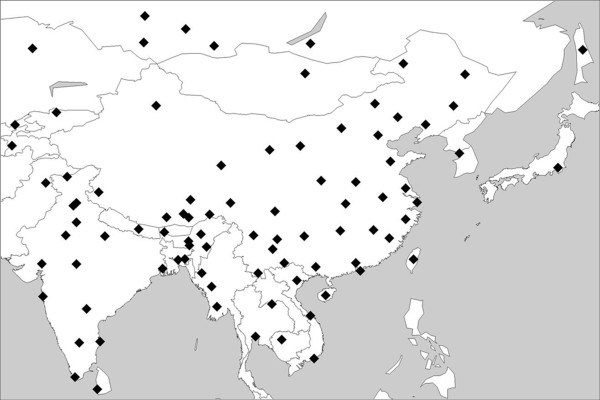
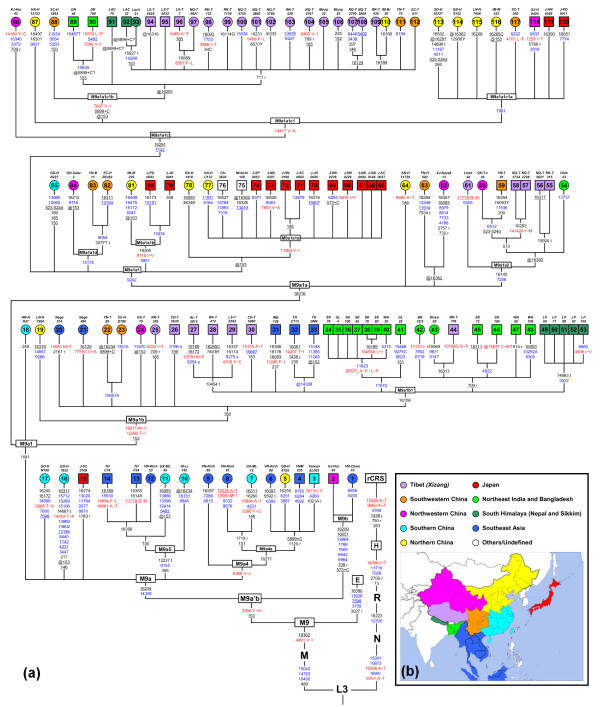
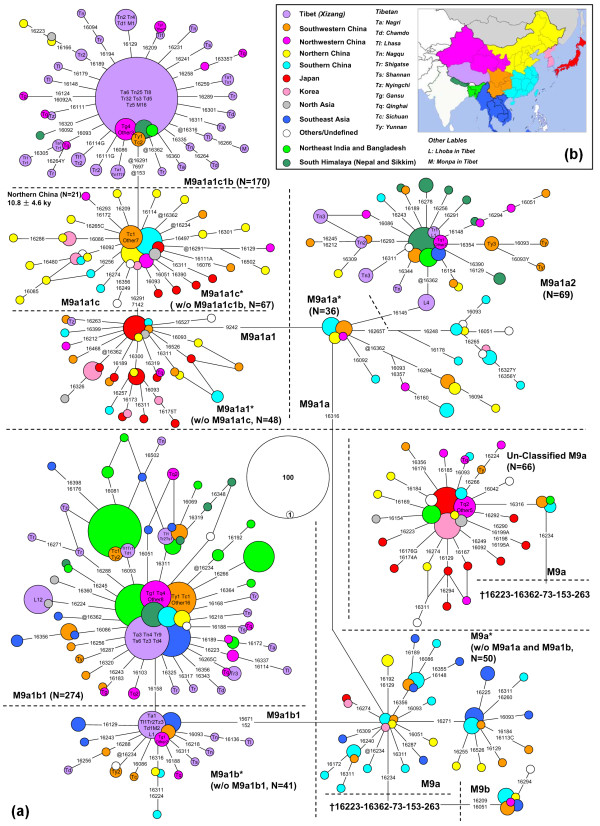
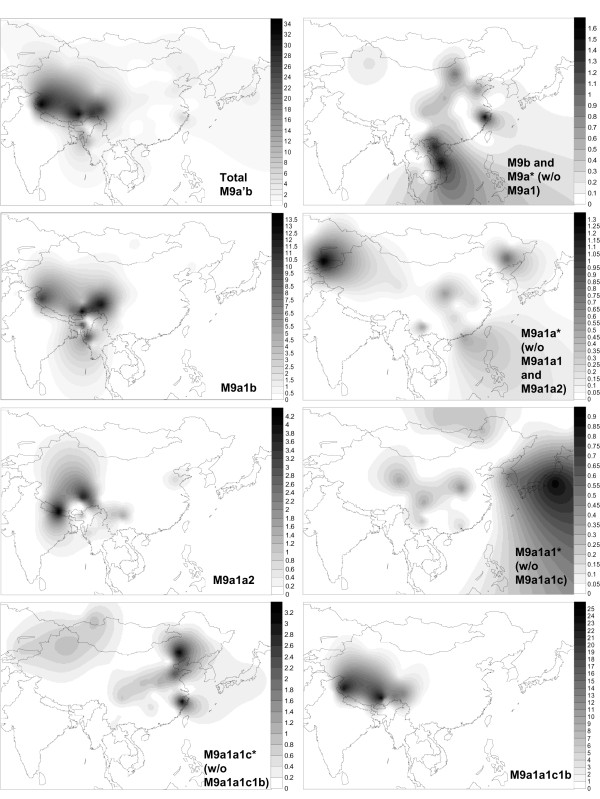
A total of 837 M9a'b mitochondrial DNAs (583 from the literature, while the remaining 254 were newly collected in this study) pinpointed from over 28,000 subjects residing across East Eurasia were studied here. Fifty-nine representative samples were further selected for total mitochondrial DNA sequencing so we could better understand the phylogeny within M9a'b. Based on the updated phylogeny, an extensive phylogeographic analysis was carried out to reveal the differentiation of haplogroup M9a'b and to reconstruct the dispersal histories.
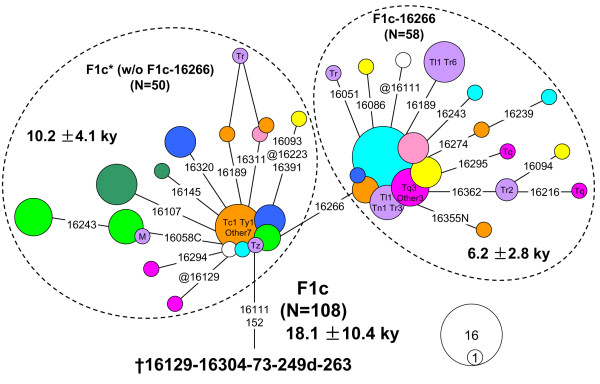
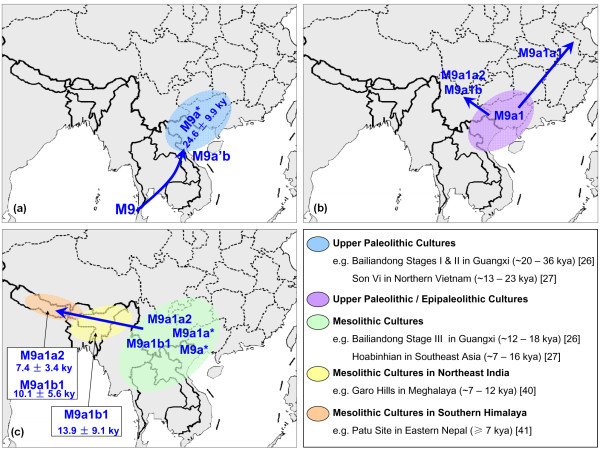
Our results indicated that southern China and/or Southeast Asia likely served as the source of some post-Last Glacial Maximum dispersal(s). The detailed dissection of haplogroup M9a'b revealed the existence of an inland dispersal in mainland East Asia during the post-glacial period. It was this dispersal that expanded not only to western China but also to northeast India and the south Himalaya region. A similar phylogeographic distribution pattern was also observed for haplogroup F1c, thus substantiating our proposition. This inland post-glacial dispersal was in agreement with the spread of the Mesolithic culture originating in South China and northern Vietnam.
考古研究揭示了东亚末次冰期前后的一系列文化变化;这些变化是否在东亚人群的基因库中留下了痕迹还不得而知。为了更深入地了解末次冰期前后东亚现代人的人口历史,我们广泛分析了线粒体 DNA 单倍群 M9a'b,这一单倍群被认为具有追溯末次冰期前后东亚人类迁徙的潜力。
我们从东亚超过 28000 名个体中研究了总共 837 个 M9a'b 线粒体 DNA(583 个来自文献,其余 254 个是本研究中新收集的)。我们进一步选择了 59 个有代表性的样本进行全线粒体 DNA 测序,以便更好地了解 M9a'b 内部的系统发育。基于更新的系统发育,我们进行了广泛的谱系地理分析,以揭示单倍群 M9a'b 的分化,并重建其扩散历史。
我们的结果表明,末次冰期后,中国南方和/或东南亚可能是一些扩散事件的来源地。M9a'b 单倍群的详细剖析揭示了末次冰期后东亚内陆的扩散。这次扩散不仅扩展到了中国西部,还扩展到了印度东北部和喜马拉雅山南麓地区。单倍群 F1c 也表现出类似的谱系地理分布模式,这也证实了我们的假设。这种内陆末次冰期后的扩散与起源于中国南方和越南北部的中石器时代文化的传播是一致的。