Computational Physiology Laboratory, Cornell University Ithaca, NY, USA.
Front Comput Neurosci. 2010 Dec 28;4:157. doi: 10.3389/fncom.2010.00157. eCollection 2010.
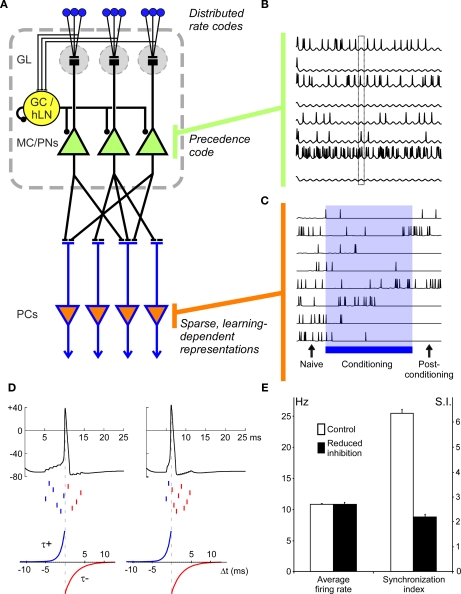
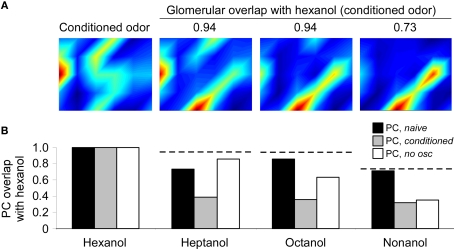
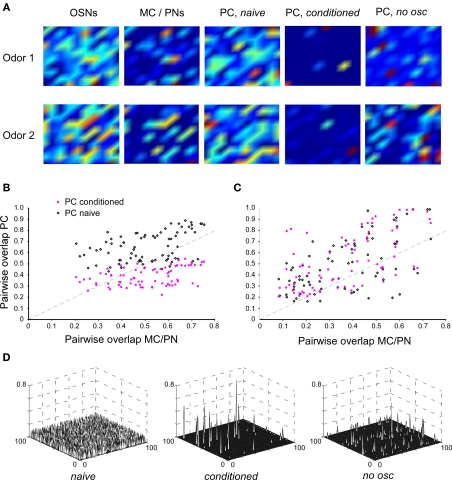
The non-topographical representation of odor quality space differentiates early olfactory representations from those in other sensory systems. Decorrelation among olfactory representations with respect to physical odorant similarities has been proposed to rely upon local feed-forward inhibitory circuits in the glomerular layer that decorrelate odor representations with respect to the intrinsically high-dimensional space of ligand-receptor potency relationships. A second stage of decorrelation is likely to be mediated by the circuitry of the olfactory bulb external plexiform layer. Computations in this layer, or in the analogous interneuronal network of the insect antennal lobe, are dependent on fast network oscillations that regulate the timing of mitral cell and projection neuron (MC/PN) action potentials; this suggests a largely spike timing-dependent metric for representing odor information, here proposed to be a precedence code. We first illustrate how the rate coding metric of the glomerular layer can be transformed into a spike precedence code in MC/PNs. We then show how this mechanism of representation, combined with spike timing-dependent plasticity at MC/PN output synapses, can progressively decorrelate high-dimensional, non-topographical odor representations in third-layer olfactory neurons. Reducing MC/PN oscillations abolishes the spike precedence code and blocks this progressive decorrelation, demonstrating the learning network's selectivity for these sparsely synchronized MC/PN spikes even in the presence of temporally disorganized background activity. Finally, we apply this model to odor representations derived from calcium imaging in the honeybee antennal lobe, and show how odor learning progressively decorrelates odor representations, and how the abolition of PN oscillations impairs odor discrimination.
嗅觉质量空间的非拓扑表示将早期嗅觉表示与其他感觉系统的表示区分开来。据推测,与物理气味相似性无关的嗅觉表示的去相关依赖于嗅球颗粒层中的局部前馈抑制回路,该回路与配体-受体效力关系的固有高维空间无关。去相关的第二阶段可能由嗅球外丛状层的电路介导。该层中的计算或昆虫触角叶中的类似中间神经元网络依赖于快速网络振荡,这些振荡调节着僧帽细胞和投射神经元(MC/PN)动作电位的时间;这表明存在一种主要基于尖峰时间的度量来表示气味信息,这里提出的是一种优先代码。我们首先说明如何将颗粒层的速率编码度量转换为 MC/PN 中的尖峰优先代码。然后,我们展示了这种表示机制如何与 MC/PN 输出突触的尖峰时间依赖性可塑性相结合,逐渐解相关第三层嗅觉神经元中的高维、非拓扑气味表示。降低 MC/PN 振荡会消除尖峰优先代码并阻止这种逐渐去相关,这表明学习网络即使在存在时间上无序的背景活动的情况下,也对这些稀疏同步的 MC/PN 尖峰具有选择性。最后,我们将该模型应用于从蜜蜂触角叶中的钙成像中得出的气味表示,并展示了气味学习如何逐渐解相关气味表示,以及 PN 振荡的消除如何损害气味辨别。