Division of Medical Physics, Department of Radiology, The Methodist Hospital-Weill Cornell Medical College and Center for Biotechnology and Informatics, The Methodist Hospital Research Institute, TX 77030, USA.
J Neurooncol. 2011 Sep;104(2):473-81. doi: 10.1007/s11060-010-0517-x. Epub 2011 Jan 15.
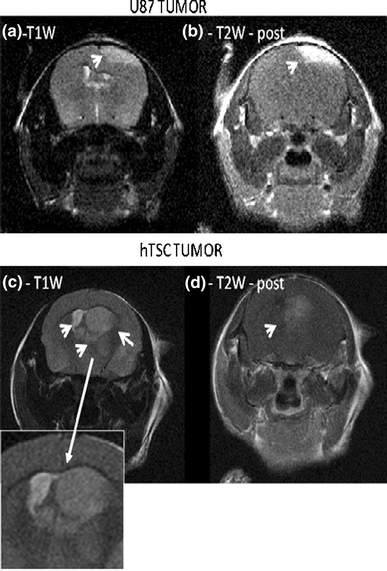
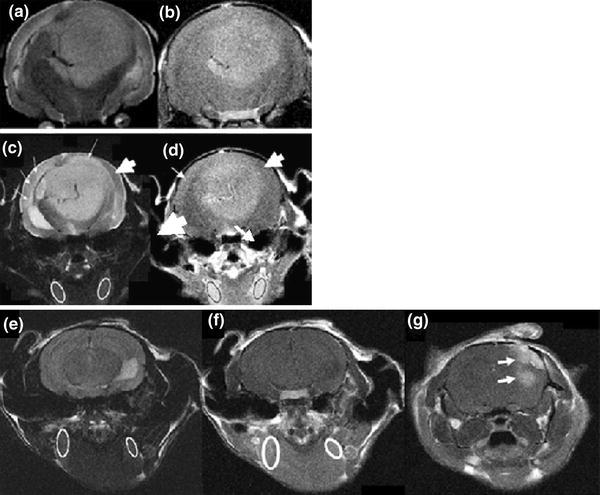
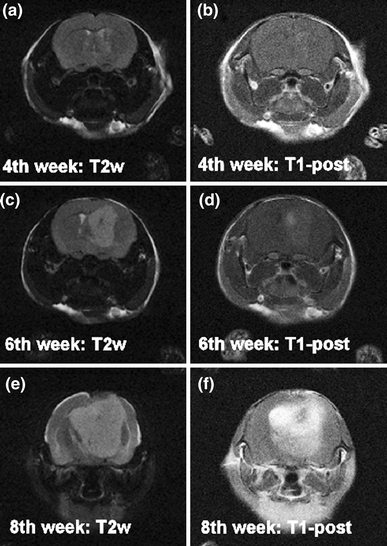
Magnetic resonance imaging (MRI) is the imaging modality of choice by which to monitor patient gliomas and treatment effects, and has been applied to murine models of glioma. However, a major obstacle to the development of effective glioma therapeutics has been that widely used animal models of glioma have not accurately recapitulated the morphological heterogeneity and invasive nature of this very lethal human cancer. This deficiency is being alleviated somewhat as more representative models are being developed, but there is still a clear need for relevant yet practical models that are well-characterized in terms of their MRI features. Hence we sought to chronicle the MRI profile of a recently developed, comparatively straightforward human tumor stem cell (hTSC) derived glioma model in mice using conventional MRI methods. This model reproduces the salient features of gliomas in humans, including florid neoangiogenesis and aggressive invasion of normal brain. Accordingly, the variable, invasive morphology of hTSC gliomas visualized on MRI duplicated that seen in patients, and it differed considerably from the widely used U87 glioma model that does not invade normal brain. After several weeks of tumor growth the hTSC model exhibited an MRI contrast enhancing phenotype having variable intensity and an irregular shape, which mimicked the heterogeneous appearance observed with human glioma patients. The MRI findings reported here support the use of the hTSC glioma xenograft model combined with MRI, as a test platform for assessing candidate therapeutics for glioma, and for developing novel MR methods.
磁共振成像(MRI)是监测患者脑胶质瘤和治疗效果的首选成像方式,已应用于脑胶质瘤的鼠模型。然而,开发有效的脑胶质瘤治疗方法的一个主要障碍是,广泛使用的脑胶质瘤动物模型未能准确再现这种非常致命的人类癌症的形态异质性和侵袭性。随着更具代表性的模型的开发,这种缺陷在一定程度上得到了缓解,但仍明显需要相关且实用的模型,这些模型在 MRI 特征方面具有良好的特征。因此,我们试图使用常规 MRI 方法来记录最近开发的、相对简单的人类肿瘤干细胞(hTSC)衍生的脑胶质瘤模型在小鼠中的 MRI 特征。该模型再现了人类脑胶质瘤的显著特征,包括丰富的新生血管形成和对正常大脑的侵袭性侵犯。因此,MRI 上可见的 hTSC 脑胶质瘤的可变、侵袭性形态与患者所见的形态相吻合,与广泛使用的不侵犯正常大脑的 U87 脑胶质瘤模型有很大不同。在肿瘤生长数周后,hTSC 模型表现出 MRI 对比增强表型,其强度和形状具有变异性,这与在人类脑胶质瘤患者中观察到的异质性表现相吻合。这里报道的 MRI 结果支持使用 hTSC 脑胶质瘤异种移植模型结合 MRI,作为评估脑胶质瘤候选治疗方法的测试平台,并开发新的 MRI 方法。