Kämpe Mary, Stolt Ingrid, Lampinen Maria, Janson Christer, Stålenheim Gunnemar, Carlson Marie
Department of Medical Sciences, Respiratory Medicine and Allergology, Uppsala University, Uppsala, Sweden.
Clin Mol Allergy. 2011 Jan 21;9(1):3. doi: 10.1186/1476-7961-9-3.
Patients with allergic rhinitis and allergic asthma demonstrate comparable local and systemic eosinophil inflammation, and yet they present with different clinical pictures. Less is even known about the contribution of neutrophil inflammation in allergic diseases. The aim of the study was to examine the propensity and selectivity of granule release from primed systemic eosinophils and neutrophils in allergic rhinitis and allergic asthma after seasonal and experimental allergen exposure. We hypothesize that the dissimilar clinical manifestations are due to diverse eosinophil and neutrophil degranulation.
Nine birch pollen allergic patients with rhinitis, eight with asthma and four controls were studied during pollen season and after nasal and bronchial allergen challenge. Eosinophils and neutrophils were incubated in vitro with assay buffer and opsonized Sephadex particles for spontaneous and C3b-induced granule protein release. The released amount of eosinophil cationic protein (ECP), eosinophil peroxidase (EPO) and myeloperoxidase (MPO) was measured by specific radioimmunoassay.
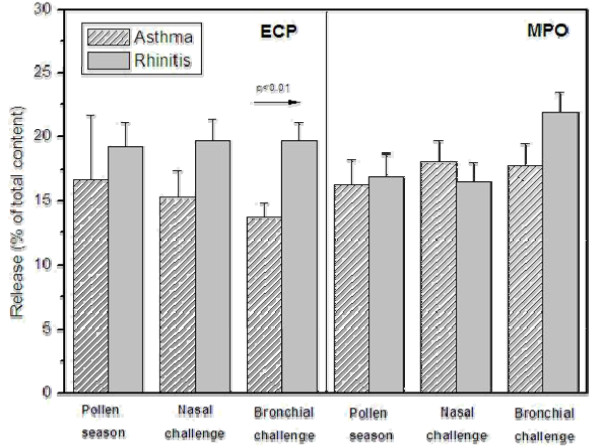
C3b-induced degranulation resulted in increased release of ECP and MPO from primed blood eosinophils and neutrophils in both allergic rhinitis and allergic asthma during pollen season and after both nasal and bronchial challenge (p-values 0.008 to 0.043). After bronchial challenge, the ECP release was significantly higher in the rhinitic group compared to the asthmatic group [19.8 vs. 13.2%, (p = 0.010)]. The propensity for EPO release was weak in all challenge models but followed the same pattern in both allergic groups.
Systemically activated eosinophils and neutrophils have similar patterns of degranulation after allergen exposure in allergic rhinitis and allergic asthma. The released amount of ECP, EPO and MPO was similar in all allergen challenge models in both allergic groups. Our results indicate that other mechanisms than the magnitude of eosinophil and neutrophil inflammation or the degranulation pattern of the inflammatory cells determines whether or not an allergic patient develops asthma.
过敏性鼻炎和过敏性哮喘患者表现出相似的局部和全身嗜酸性粒细胞炎症,但临床症状却有所不同。对于中性粒细胞炎症在过敏性疾病中的作用,人们了解得更少。本研究旨在探讨季节性和实验性过敏原暴露后,过敏性鼻炎和过敏性哮喘患者体内致敏的全身嗜酸性粒细胞和中性粒细胞颗粒释放的倾向和选择性。我们假设不同的临床表现是由于嗜酸性粒细胞和中性粒细胞脱颗粒情况不同所致。
在花粉季节以及鼻腔和支气管过敏原激发后,对9名患有鼻炎的桦树花粉过敏患者、8名患有哮喘的患者和4名对照者进行了研究。将嗜酸性粒细胞和中性粒细胞与测定缓冲液及调理过的葡聚糖凝胶颗粒在体外孵育,以检测自发和C3b诱导的颗粒蛋白释放。通过特异性放射免疫测定法测量嗜酸性粒细胞阳离子蛋白(ECP)、嗜酸性粒细胞过氧化物酶(EPO)和髓过氧化物酶(MPO)的释放量。
在花粉季节以及鼻腔和支气管激发后,C3b诱导的脱颗粒导致过敏性鼻炎和过敏性哮喘患者体内致敏血液中的嗜酸性粒细胞和中性粒细胞释放的ECP和MPO增加(p值为0.008至0.043)。支气管激发后,鼻炎组的ECP释放量显著高于哮喘组[19.8%对13.2%,(p = 0.010)]。在所有激发模型中,EPO释放倾向较弱,但在两个过敏组中遵循相同模式。
在过敏性鼻炎和过敏性哮喘中,过敏原暴露后全身活化的嗜酸性粒细胞和中性粒细胞具有相似的脱颗粒模式。在两个过敏组的所有过敏原激发模型中,ECP、EPO和MPO的释放量相似。我们的结果表明,除了嗜酸性粒细胞和中性粒细胞炎症的程度或炎症细胞的脱颗粒模式外,其他机制决定了过敏患者是否会发展为哮喘。