Department of Chemistry and International Institute of Nanotechnology, Northwestern University, Evanston, Illinois 60208, United States.
J Am Chem Soc. 2011 Feb 23;133(7):2120-3. doi: 10.1021/ja110833r. Epub 2011 Jan 26.
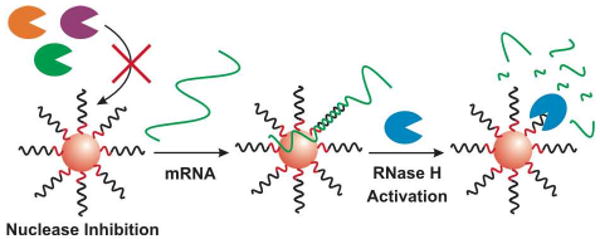
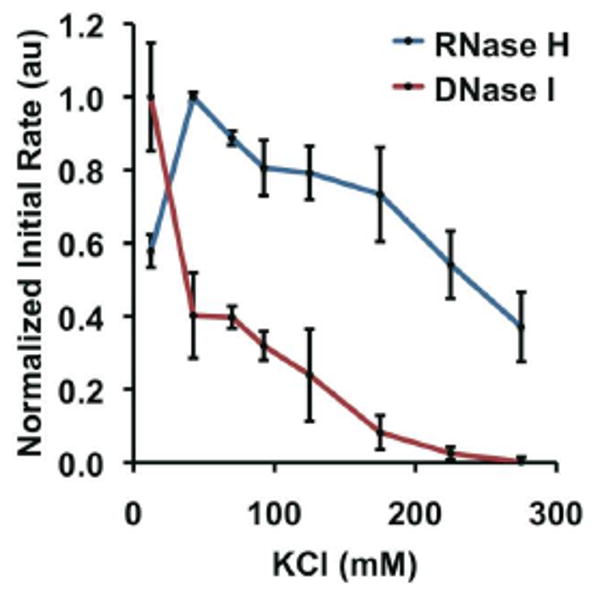
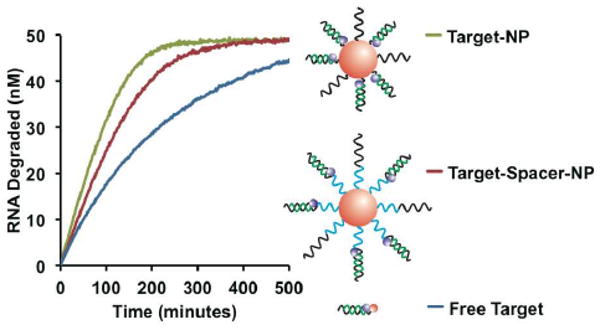
We demonstrate that polyvalent DNA-functionalized gold nanoparticles (DNA-Au NPs) selectively enhance ribonuclease H (RNase H) activity while inhibiting most biologically relevant nucleases. This combination of properties is particularly interesting in the context of gene regulation, since high RNase H activity results in rapid mRNA degradation and general nuclease inhibition results in high biological stability. We have investigated the mechanism of selective RNase H activation and found that the high DNA density of DNA-Au NPs is responsible for this unusual behavior. This work adds to our understanding of polyvalent DNA-Au NPs as gene regulation agents and suggests a new model for selectively controlling protein-nanoparticle interactions.
我们证明了多价 DNA 功能化金纳米粒子(DNA-Au NPs)能够选择性地增强核糖核酸酶 H(RNase H)的活性,同时抑制大多数与生物学相关的核酸酶。这种性质的结合在基因调控方面特别有趣,因为高 RNase H 活性会导致 mRNA 的快速降解,而普遍的核酸酶抑制会导致高生物稳定性。我们已经研究了选择性 RNase H 激活的机制,并发现 DNA-Au NPs 的高 DNA 密度是导致这种异常行为的原因。这项工作增加了我们对多价 DNA-Au NPs 作为基因调控剂的理解,并提出了一种新的模型来选择性地控制蛋白质-纳米颗粒相互作用。