University of Helsinki, Department of Food and Environmental Sciences, P,O, Box 27, FIN-00014, Helsinki, Finland.
Biotechnol Biofuels. 2011 Jan 26;4(1):2. doi: 10.1186/1754-6834-4-2.
Thermostable enzymes have several benefits in lignocellulose processing. In particular, they potentially allow the use of increased substrate concentrations (because the substrate viscosity decreases as the temperature increases), resulting in improved product yields and reduced capital and processing costs. A short pre-hydrolysis step at an elevated temperature using thermostable enzymes aimed at rapid liquefaction of the feedstock is seen as an attractive way to overcome the technical problems (such as poor mixing and mass transfer properties) connected with high initial solid loadings in the lignocellulose to ethanol process.
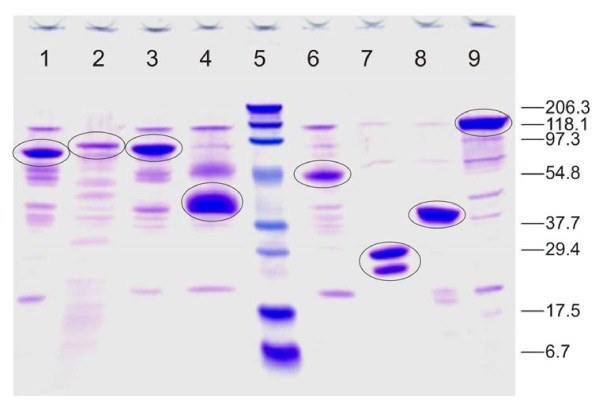
The capability of novel thermostable enzymes to reduce the viscosity of high-solid biomass suspensions using a real-time viscometric measurement method was investigated. Heterologously expressed enzymes from various thermophilic organisms were compared for their ability to liquefy the lignocellulosic substrate, hydrothermally pretreated wheat straw. Once the best enzymes were identified, the optimal temperatures for these enzymes to decrease substrate viscosity were compared. The combined hydrolytic properties of the thermostable preparations were tested in hydrolysis experiments. The studied mixtures were primarily designed to have good liquefaction potential, and therefore contained an enhanced proportion of the key liquefying enzyme, EGII/Cel5A.
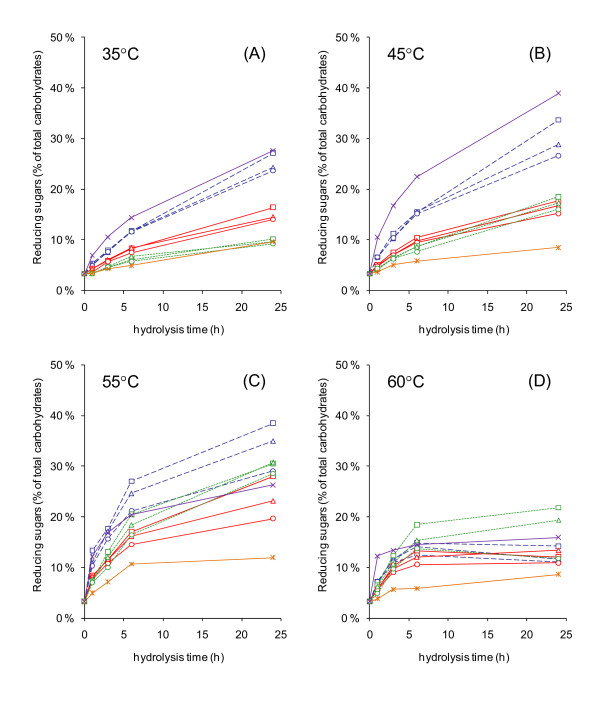
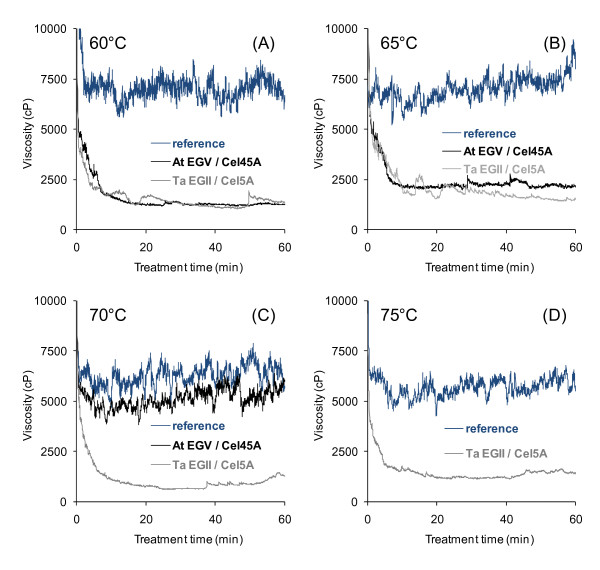
Endoglucanases were shown to have a superior ability to rapidly reduce the viscosity of the 15% (w/w; dry matter) hydrothermally pretreated wheat straw. Based on temperature profiling studies, Thermoascus aurantiacus EGII/Cel5A was the most promising enzyme for biomass liquefaction. Even though they were not optimized for saccharification, many of the thermostable enzyme mixtures had superior hydrolytic properties compared with the commercial reference enzymes at 55°C.
在木质纤维素处理中,热稳定性酶具有多种优势。特别是,它们可能允许使用更高的底物浓度(因为随着温度的升高,底物的粘度会降低),从而提高产品产量并降低资本和加工成本。使用热稳定酶在高温下进行短时间的预水解步骤,旨在快速液化原料,被认为是克服与木质纤维素到乙醇工艺中高初始固体负荷相关的技术问题(例如混合不良和传质性能差)的一种有吸引力的方法。
使用实时粘度测量方法研究了新型热稳定酶降低高固体生物质悬浮液粘度的能力。比较了来自各种嗜热生物体的异源表达酶液化木质纤维素底物——水热预处理的小麦秸秆的能力。一旦确定了最佳的酶,就比较了这些酶降低底物粘度的最佳温度。在水解实验中测试了热稳定制剂的组合水解特性。所研究的混合物主要设计为具有良好的液化潜力,因此包含增强比例的关键液化酶 EGII/Cel5A。
内切葡聚糖酶被证明具有快速降低 15%(w/w;干物质)水热预处理小麦秸秆粘度的优异能力。根据温度分析研究,Thermoascus aurantiacus EGII/Cel5A 是生物质液化最有前途的酶。尽管它们不是为糖化而优化的,但许多热稳定酶混合物在 55°C 时与商业参考酶相比具有优越的水解特性。