National Taiwan University College of Medicine, Taipei, Taiwan.
Diabetes Care. 2011 Mar;34(3):616-21. doi: 10.2337/dc10-1640. Epub 2011 Jan 27.
The link between diabetes and prostate cancer is rarely studied in Asians.
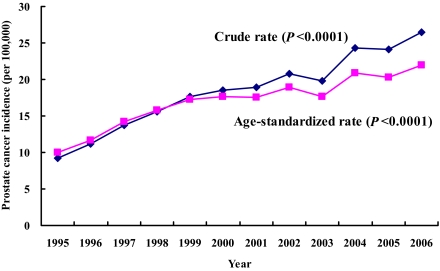
The trend of age-standardized prostate cancer incidence in 1995-2006 in the Taiwanese general population was calculated. A random sample of 1,000,000 subjects covered by the National Health Insurance in 2005 was recruited. A total of 494,630 men for all ages and 204,741 men ≥ 40 years old and without prostate cancer at the beginning of 2003 were followed to the end of 2005. Cumulative incidence and risk ratio between diabetic and nondiabetic men were calculated. Logistic regression estimated the adjusted odds ratios for risk factors.
The trend of prostate cancer incidence increased significantly (P < 0.0001). The cumulative incidence markedly increased with age in either the diabetic or nondiabetic men. The respective risk ratio (95% CI) for all ages and age 40-64, 65-74, and ≥ 75 years was 5.83 (5.10-6.66), 2.09 (1.60-2.74), 1.35 (1.07-1.71), and 1.39 (1.12-1.71). In logistic regression for all ages or for age ≥ 40 years, age, diabetes, nephropathy, ischemic heart disease, dyslipidemia, living region, and occupation were significantly associated with increased risk, but medications including insulin and oral antidiabetic agents were not.
Prostate cancer incidence is increasing in Taiwan. A positive link between diabetes and prostate cancer is observed, which is more remarkable in the youngest age of 40-64 years. The association between prostate cancer and comorbidities commonly seen in diabetic patients suggests a more complicated scenario in the link between prostate cancer and diabetes at different disease stages.
糖尿病与前列腺癌之间的关联在亚洲人群中鲜有研究。
计算了 1995-2006 年台湾普通人群中年龄标准化前列腺癌发病率的趋势。2005 年,以全民健康保险涵盖的 100 万随机抽样人群为研究对象,招募了所有年龄的 494630 名男性和 204741 名年龄≥40 岁且在 2003 年初无前列腺癌的男性,并随访至 2005 年底。计算了糖尿病和非糖尿病男性的累积发病率和风险比。采用 logistic 回归估计了危险因素的调整比值比。
前列腺癌发病率呈显著上升趋势(P<0.0001)。糖尿病或非糖尿病男性的累积发病率均随年龄显著增加。所有年龄组及年龄 40-64、65-74、≥75 岁组的风险比(95%CI)分别为 5.83(5.10-6.66)、2.09(1.60-2.74)、1.35(1.07-1.71)和 1.39(1.12-1.71)。在所有年龄组或年龄≥40 岁组的 logistic 回归中,年龄、糖尿病、肾病、缺血性心脏病、血脂异常、居住地区和职业与风险增加显著相关,但包括胰岛素和口服降糖药在内的药物治疗无此关联。
台湾的前列腺癌发病率正在上升。观察到糖尿病与前列腺癌之间存在正相关,在 40-64 岁的最年轻年龄组更为显著。前列腺癌与糖尿病患者常见合并症之间的关联表明,在不同疾病阶段,前列腺癌与糖尿病之间的关联更为复杂。