ORIE Program, University of Texas at Austin, Austin, Texas, United States of America.
PLoS One. 2011 Jan 19;6(1):e16094. doi: 10.1371/journal.pone.0016094.
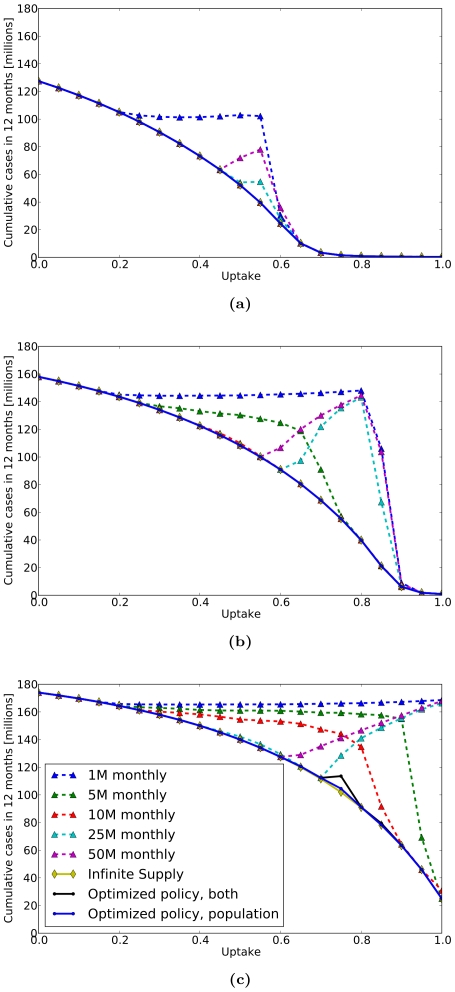
In 2009, public health agencies across the globe worked to mitigate the impact of the swine-origin influenza A (pH1N1) virus. These efforts included intensified surveillance, social distancing, hygiene measures, and the targeted use of antiviral medications to prevent infection (prophylaxis). In addition, aggressive antiviral treatment was recommended for certain patient subgroups to reduce the severity and duration of symptoms. To assist States and other localities meet these needs, the U.S. Government distributed a quarter of the antiviral medications in the Strategic National Stockpile within weeks of the pandemic's start. However, there are no quantitative models guiding the geo-temporal distribution of the remainder of the Stockpile in relation to pandemic spread or severity. We present a tactical optimization model for distributing this stockpile for treatment of infected cases during the early stages of a pandemic like 2009 pH1N1, prior to the wide availability of a strain-specific vaccine. Our optimization method efficiently searches large sets of intervention strategies applied to a stochastic network model of pandemic influenza transmission within and among U.S. cities. The resulting optimized strategies depend on the transmissability of the virus and postulated rates of antiviral uptake and wastage (through misallocation or loss). Our results suggest that an aggressive community-based antiviral treatment strategy involving early, widespread, pro-rata distribution of antivirals to States can contribute to slowing the transmission of mildly transmissible strains, like pH1N1. For more highly transmissible strains, outcomes of antiviral use are more heavily impacted by choice of distribution intervals, quantities per shipment, and timing of shipments in relation to pandemic spread. This study supports previous modeling results suggesting that appropriate antiviral treatment may be an effective mitigation strategy during the early stages of future influenza pandemics, increasing the need for systematic efforts to optimize distribution strategies and provide tactical guidance for public health policy-makers.
2009 年,全球公共卫生机构努力减轻猪源甲型流感(pH1N1)病毒的影响。这些努力包括加强监测、社交距离、卫生措施以及有针对性地使用抗病毒药物预防感染(预防)。此外,还建议对某些患者亚组进行积极的抗病毒治疗,以减轻症状的严重程度和持续时间。为了帮助各州和其他地方满足这些需求,美国政府在大流行开始后的几周内分发了战略国家储备中四分之一的抗病毒药物。然而,对于储备的其余部分,没有定量模型来指导其与大流行传播或严重程度相关的地理时间分布。我们提出了一种战术优化模型,用于在大流行(如 2009 年 pH1N1)早期分发储备药物,以治疗感染病例,而此时还没有针对特定菌株的疫苗。我们的优化方法有效地搜索了应用于大流行流感在美国城市内部和之间传播的随机网络模型的大量干预策略。由此产生的优化策略取决于病毒的传染性以及假定的抗病毒药物利用率和浪费率(通过分配不当或损失)。我们的研究结果表明,一种积极的基于社区的抗病毒治疗策略,包括早期、广泛、按比例向各州分配抗病毒药物,可以有助于减缓轻度传染性菌株(如 pH1N1)的传播。对于传染性更强的菌株,抗病毒药物使用的结果受分配间隔、每批货物的数量以及与大流行传播相关的货物运输时间的选择影响更大。这项研究支持了之前的建模结果,表明适当的抗病毒治疗可能是未来流感大流行早期的一种有效缓解策略,因此需要系统地努力优化分配策略,并为公共卫生政策制定者提供战术指导。