• 文献检索
  • 文档翻译
  • 深度研究
  • 学术资讯
  • Suppr Zotero 插件Zotero 插件
  • 邀请有礼
  • 套餐&价格
  • 历史记录
应用&插件
Suppr Zotero 插件Zotero 插件浏览器插件Mac 客户端Windows 客户端微信小程序
定价
高级版会员购买积分包购买API积分包
服务
文献检索文档翻译深度研究API 文档MCP 服务
关于我们
关于 Suppr公司介绍联系我们用户协议隐私条款
关注我们

Suppr 超能文献

核心技术专利:CN118964589B侵权必究
粤ICP备2023148730 号-1Suppr @ 2026

文献检索

告别复杂PubMed语法,用中文像聊天一样搜索,搜遍4000万医学文献。AI智能推荐,让科研检索更轻松。

立即免费搜索

文件翻译

保留排版,准确专业,支持PDF/Word/PPT等文件格式,支持 12+语言互译。

免费翻译文档

深度研究

AI帮你快速写综述,25分钟生成高质量综述,智能提取关键信息,辅助科研写作。

立即免费体验

病例诊断覆盖率和诊断延迟对减轻大流行性流感 A/H1N1 2009 的抗病毒策略效果的影响。

The impact of case diagnosis coverage and diagnosis delays on the effectiveness of antiviral strategies in mitigating pandemic influenza A/H1N1 2009.

机构信息

School of Computer Science and Software Engineering, University of Western Australia, Crawley, Australia.

出版信息

PLoS One. 2010 Nov 3;5(11):e13797. doi: 10.1371/journal.pone.0013797.

DOI:10.1371/journal.pone.0013797
PMID:21072188
原文链接:https://pmc.ncbi.nlm.nih.gov/articles/PMC2972206/
Abstract

BACKGROUND

Neuraminidase inhibitors were used to reduce the transmission of pandemic influenza A/H1N1 2009 at the early stages of the 2009/2010 pandemic. Policies for diagnosis of influenza for the purposes of antiviral intervention differed markedly between and within countries, leading to differences in the timing and scale of antiviral usage.

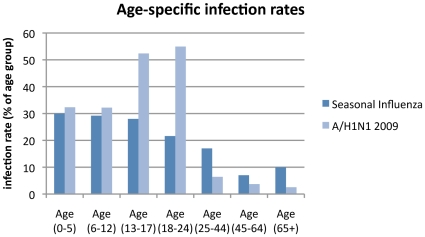
METHODOLOGY/PRINCIPAL FINDINGS: The impact of the percentage of symptomatic infected individuals who were diagnosed, and of delays to diagnosis, for three antiviral intervention strategies (each with and without school closure) were determined using a simulation model of an Australian community. Epidemic characteristics were based on actual data from the A/H1N1 2009 pandemic including reproduction number, serial interval and age-specific infection rate profile. In the absence of intervention an illness attack rate (AR) of 24.5% was determined from an estimated R(0) of 1.5; this was reduced to 21%, 16.5% or 13% by treatment-only, treatment plus household prophylaxis, or treatment plus household plus extended prophylaxis antiviral interventions respectively, assuming that diagnosis occurred 24 hours after symptoms arose and that 50% of symptomatic cases were diagnosed. If diagnosis occurred without delay, ARs decreased to 17%, 12.2% or 8.8% respectively. If 90% of symptomatic cases were diagnosed (with a 24 hour delay), ARs decreased to 17.8%, 11.1% and 7.6%, respectively.

CONCLUSION

The ability to rapidly diagnose symptomatic cases and to diagnose a high proportion of cases was shown to improve the effectiveness of all three antiviral strategies. For epidemics with R(0)< = 1.5 our results suggest that when the case diagnosis coverage exceeds ∼70% the size of the antiviral stockpile required to implement the extended prophylactic strategy decreases. The addition of at least four weeks of school closure was found to further reduce cumulative and peak attack rates and the size of the required antiviral stockpile.

摘要

背景

神经氨酸酶抑制剂曾被用于降低 2009 年大流行性流感 A/H1N1 的传播,在 2009/2010 年大流行的早期阶段使用。各国之间和各国之内用于诊断流感以进行抗病毒干预的政策有很大差异,导致抗病毒药物使用的时机和规模不同。

方法/主要发现:利用澳大利亚社区模拟模型,确定了三种抗病毒干预策略(每种策略都包括和不包括学校停课)中,被诊断出患有症状的感染者百分比以及诊断延误的影响。根据包括繁殖数、序列间隔和特定年龄组感染率特征在内的实际数据,确定了大流行性流感 A/H1N1 的流行特征。在没有干预的情况下,根据估计的 R(0)为 1.5,确定发病率(AR)为 24.5%;仅治疗、治疗加家庭预防或治疗加家庭加延长预防的抗病毒干预分别将发病率降低至 21%、16.5%或 13%,假设诊断发生在症状出现后 24 小时,并且 50%的有症状病例被诊断。如果没有延迟进行诊断,则发病率分别降至 17%、12.2%或 8.8%。如果 90%的有症状病例被诊断(有 24 小时的延迟),则发病率分别降至 17.8%、11.1%和 7.6%。

结论

迅速诊断出有症状的病例并诊断出较高比例的病例的能力被证明可以提高所有三种抗病毒策略的有效性。对于 R(0)<=1.5 的疫情,我们的结果表明,当病例诊断覆盖率超过约 70%时,实施延长预防策略所需的抗病毒储备量就会减少。增加至少四周的学校停课被发现可以进一步降低累计和峰值发病率以及所需抗病毒储备量。
https://cdn.ncbi.nlm.nih.gov/pmc/blobs/9e0e/2972206/65deea4a3041/pone.0013797.g005.jpg
https://cdn.ncbi.nlm.nih.gov/pmc/blobs/9e0e/2972206/6dc8bb3f9986/pone.0013797.g001.jpg
https://cdn.ncbi.nlm.nih.gov/pmc/blobs/9e0e/2972206/22cc00c73edc/pone.0013797.g002.jpg
https://cdn.ncbi.nlm.nih.gov/pmc/blobs/9e0e/2972206/0e3ddd5c5b38/pone.0013797.g003.jpg
https://cdn.ncbi.nlm.nih.gov/pmc/blobs/9e0e/2972206/d9ac832e8141/pone.0013797.g004.jpg
https://cdn.ncbi.nlm.nih.gov/pmc/blobs/9e0e/2972206/65deea4a3041/pone.0013797.g005.jpg
https://cdn.ncbi.nlm.nih.gov/pmc/blobs/9e0e/2972206/6dc8bb3f9986/pone.0013797.g001.jpg
https://cdn.ncbi.nlm.nih.gov/pmc/blobs/9e0e/2972206/22cc00c73edc/pone.0013797.g002.jpg
https://cdn.ncbi.nlm.nih.gov/pmc/blobs/9e0e/2972206/0e3ddd5c5b38/pone.0013797.g003.jpg
https://cdn.ncbi.nlm.nih.gov/pmc/blobs/9e0e/2972206/d9ac832e8141/pone.0013797.g004.jpg
https://cdn.ncbi.nlm.nih.gov/pmc/blobs/9e0e/2972206/65deea4a3041/pone.0013797.g005.jpg

相似文献

1
The impact of case diagnosis coverage and diagnosis delays on the effectiveness of antiviral strategies in mitigating pandemic influenza A/H1N1 2009.病例诊断覆盖率和诊断延迟对减轻大流行性流感 A/H1N1 2009 的抗病毒策略效果的影响。
PLoS One. 2010 Nov 3;5(11):e13797. doi: 10.1371/journal.pone.0013797.
2
Analysis of the effectiveness of interventions used during the 2009 A/H1N1 influenza pandemic.分析 2009 年甲型 H1N1 流感大流行期间使用的干预措施的效果。
BMC Public Health. 2010 Mar 29;10:168. doi: 10.1186/1471-2458-10-168.
3
Secondary attack rate of pandemic influenza A(H1N1) 2009 in Western Australian households, 29 May-7 August 2009.2009 年 5 月 29 日至 8 月 7 日,西澳大利亚州家庭中甲型 H1N1 流感大流行的二次发病率。
Euro Surveill. 2011 Jan 20;16(3):19765.
4
Cost-effective strategies for mitigating a future influenza pandemic with H1N1 2009 characteristics.具有 H1N1 2009 特征的未来流感大流行的成本效益缓解策略。
PLoS One. 2011;6(7):e22087. doi: 10.1371/journal.pone.0022087. Epub 2011 Jul 8.
5
Impact of antiviral treatment and hospital admission delay on risk of death associated with 2009 A/H1N1 pandemic influenza in Mexico.抗病毒治疗和住院延迟对墨西哥与 2009 年 A/H1N1 大流行流感相关死亡风险的影响。
BMC Infect Dis. 2012 Apr 20;12:97. doi: 10.1186/1471-2334-12-97.
6
Developing guidelines for school closure interventions to be used during a future influenza pandemic.制定未来流感大流行期间学校关闭干预措施的指南。
BMC Infect Dis. 2010 Jul 27;10:221. doi: 10.1186/1471-2334-10-221.
7
Optimizing tactics for use of the U.S. antiviral strategic national stockpile for pandemic influenza.优化美国抗病毒战略国家储备库在大流行性流感中的使用策略。
PLoS One. 2011 Jan 19;6(1):e16094. doi: 10.1371/journal.pone.0016094.
8
Epidemiological characteristics of novel influenza A (H1N1) in antiviral drug users in Korea.韩国抗病毒药物使用者中新型甲型 H1N1 流感的流行病学特征。
PLoS One. 2012;7(10):e47634. doi: 10.1371/journal.pone.0047634. Epub 2012 Oct 17.
9
Estimated impact of aggressive empirical antiviral treatment in containing an outbreak of pandemic influenza H1N1 in an isolated First Nations community.大流行流感 H1N1 在一个与世隔绝的第一民族社区暴发时强化经验性抗病毒治疗的估计影响。
Influenza Other Respir Viruses. 2013 Nov;7(6):1409-15. doi: 10.1111/irv.12141. Epub 2013 Jul 23.
10
Increased symptom severity but unchanged neuraminidase inhibitor effectiveness for A(H1N1)pdm09 in the 2010-2011 season: comparison with the previous season and with seasonal A(H3N2) and B.2010-2011 年度甲型 H1N1pdm09 病毒所致流感症状严重程度增加但神经氨酸酶抑制剂效果不变:与前一季节以及季节性甲型 H3N2 和乙型流感的比较
Influenza Other Respir Viruses. 2013 May;7(3):448-55. doi: 10.1111/j.1750-2659.2012.00421.x. Epub 2012 Aug 16.

引用本文的文献

1
Development and application of sensitive, specific, and rapid CRISPR-Cas13-based diagnosis.基于 CRISPR-Cas13 的敏感、特异、快速诊断方法的开发与应用。
J Med Virol. 2021 Jul;93(7):4198-4204. doi: 10.1002/jmv.26889. Epub 2021 Mar 25.
2
Control Measures for Human Respiratory Viral Infection.人类呼吸道病毒感染的控制措施
Semin Respir Crit Care Med. 2016 Aug;37(4):631-9. doi: 10.1055/s-0036-1584792. Epub 2016 Aug 3.
3
Efficient Vaccine Distribution Based on a Hybrid Compartmental Model.基于混合分区模型的高效疫苗分配

本文引用的文献

1
Opioid abuse in the United States and Department of Health and Human Services actions to address opioid-drug-related overdoses and deaths.美国的阿片类药物滥用情况以及美国卫生与公众服务部为应对与阿片类药物相关的过量用药和死亡所采取的行动。
J Pain Palliat Care Pharmacother. 2015 Jun;29(2):133-9. doi: 10.3109/15360288.2015.1037530.
2
Design and Evaluation of Prophylactic Interventions Using Infectious Disease Incidence Data from Close Contact Groups.利用密切接触群体的传染病发病率数据进行预防性干预措施的设计与评估。
J R Stat Soc Ser C Appl Stat. 2006 May;55(3):317-330. doi: 10.1111/j.1467-9876.2006.00539.x.
3
Developing guidelines for school closure interventions to be used during a future influenza pandemic.
PLoS One. 2016 May 27;11(5):e0155416. doi: 10.1371/journal.pone.0155416. eCollection 2016.
4
Estimating the United States demand for influenza antivirals and the effect on severe influenza disease during a potential pandemic.评估美国在潜在大流行期间对流感抗病毒药物的需求以及对重症流感疾病的影响。
Clin Infect Dis. 2015 May 1;60 Suppl 1(0 1):S30-41. doi: 10.1093/cid/civ084.
5
A spatial simulation model for dengue virus infection in urban areas.城市地区登革热病毒感染的空间模拟模型。
BMC Infect Dis. 2014 Aug 20;14:447. doi: 10.1186/1471-2334-14-447.
6
A model-based economic analysis of pre-pandemic influenza vaccination cost-effectiveness.基于模型的大流行前流感疫苗接种成本效益经济分析。
BMC Infect Dis. 2014 May 16;14:266. doi: 10.1186/1471-2334-14-266.
7
A review of the evidence to support influenza vaccine introduction in countries and areas of WHO's Western Pacific Region.支持在世界卫生组织西太平洋区域国家和地区引入流感疫苗的证据综述。
PLoS One. 2013 Jul 16;8(7):e70003. doi: 10.1371/journal.pone.0070003. Print 2013.
8
Can informal social distancing interventions minimize demand for antiviral treatment during a severe pandemic?在严重疫情期间,非正式社交距离干预措施能否将对抗病毒治疗的需求降至最低?
BMC Public Health. 2013 Jul 18;13:669. doi: 10.1186/1471-2458-13-669.
9
Using a Dynamic Model to Consider Optimal Antiviral Stockpile Size in the Face of Pandemic Influenza Uncertainty.使用动态模型考虑面对大流行性流感不确定性时的最佳抗病毒药物储备规模。
PLoS One. 2013 Jun 21;8(6):e67253. doi: 10.1371/journal.pone.0067253. Print 2013.
10
The cost effectiveness of pandemic influenza interventions: a pandemic severity based analysis.大流行性流感干预措施的成本效益:基于大流行严重程度的分析。
PLoS One. 2013 Apr 9;8(4):e61504. doi: 10.1371/journal.pone.0061504. Print 2013.
制定未来流感大流行期间学校关闭干预措施的指南。
BMC Infect Dis. 2010 Jul 27;10:221. doi: 10.1186/1471-2334-10-221.
4
Pandemic influenza testing at the coalface: time for reassessment? Comment.基层的大流行性流感检测:是时候重新评估了吗?评论
Med J Aust. 2010 May 3;192(9):541-2. doi: 10.5694/j.1326-5377.2010.tb03625.x.
5
Contagious period for pandemic (H1N1) 2009.大流行(H1N1)2009 病毒的传染期。
Emerg Infect Dis. 2010 May;16(5):783-8. doi: 10.3201/eid1605.091894.
6
Analysis of the effectiveness of interventions used during the 2009 A/H1N1 influenza pandemic.分析 2009 年甲型 H1N1 流感大流行期间使用的干预措施的效果。
BMC Public Health. 2010 Mar 29;10:168. doi: 10.1186/1471-2458-10-168.
7
Incidence of 2009 pandemic influenza A H1N1 infection in England: a cross-sectional serological study.2009 年甲型 H1N1 流感大流行在英格兰的感染发病率:一项横断面血清学研究。
Lancet. 2010 Mar 27;375(9720):1100-8. doi: 10.1016/S0140-6736(09)62126-7. Epub 2010 Jan 21.
8
Pros and cons of estimating the reproduction number from early epidemic growth rate of influenza A (H1N1) 2009.根据2009年甲型H1N1流感早期流行增长率估算繁殖数的利弊
Theor Biol Med Model. 2010 Jan 7;7:1. doi: 10.1186/1742-4682-7-1.
9
How necessary is a fast testkit for mitigation of pandemic flu?快速检测试剂盒对于缓解大流行性流感有多必要?
J R Soc Interface. 2010 Jul 6;7(48):1033-47. doi: 10.1098/rsif.2009.0471. Epub 2009 Dec 18.
10
Early transmission characteristics of influenza A(H1N1)v in Australia: Victorian state, 16 May - 3 June 2009.2009年5月16日至6月3日澳大利亚甲型H1N1流感病毒的早期传播特征:维多利亚州
Euro Surveill. 2009 Oct 22;14(42):19363. doi: 10.2807/ese.14.42.19363-en.