The Weintraub Center for Reconstructive Biotechnology, Division of Advanced Prosthodontics, Biomaterials and Hospital Dentistry, University of California Los Angeles School of Dentistry, Los Angeles, California, United States of America.
PLoS One. 2011 Jan 19;6(1):e16204. doi: 10.1371/journal.pone.0016204.
After dental extraction, the external surface of alveolar bone undergoes resorption at various rates, and a group of patients develop excessive jawbone atrophy. Oral mucosa overlying the atrophied jawbone is unusually thin; therefore, we have hypothesized that excessive jawbone atrophy may be associated with abnormal oral mucosa contraction. FGFR1OP2/wit3.0, a cytoskeleton molecule initially identified in oral wound fibroblasts, has been shown to induce oral mucosa contraction after dental extraction. This study examined the genetic association between single nucleotide polymorphisms (SNPs) of FGFR1OP2/wit3.0 and excessive atrophy of edentulous mandible.
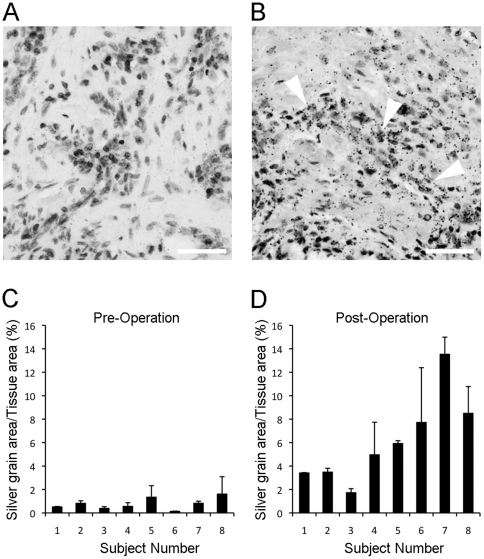
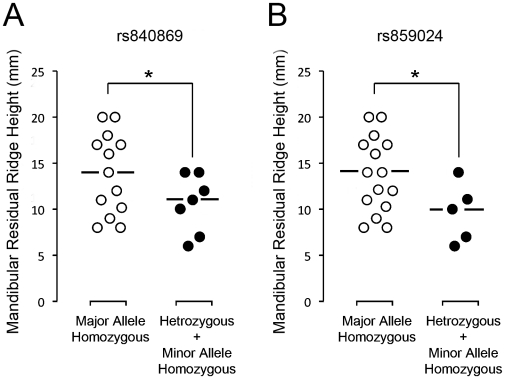
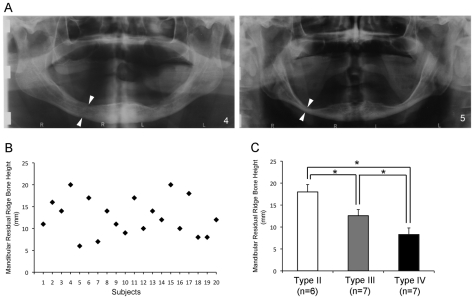
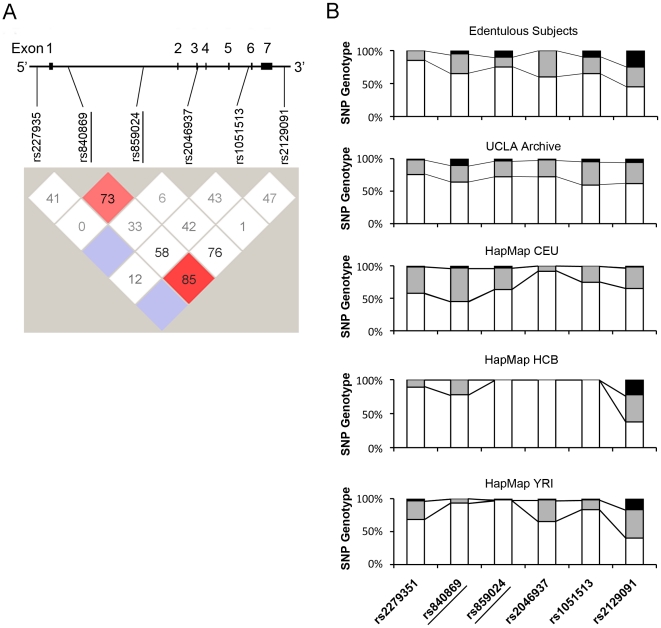
First, the expression of FGFR1OP2/wit3.0 was determined in gingival tissues of 8 subjects before and after dental extraction. In situ hybridization revealed that all subject increased FGFR1OP2/wit3.0 expression in the post-operative oral mucosa tissues; however, significantly high levels of FGFR1OP2/wit3.0 were observed in 3 out of 8 subjects. In a separate study, 20 long-term edentulous subjects (66.4 ± 9.4 years) were recruited. Tag-SNPs in the FGFR1OP2/wit3.0 allele were determined by Taqman-based polymerase chain reaction. The mandibular bone height was determined following the American College of Prosthodontists (ACP) protocol. Subjects with minor allele of rs840869 or rs859024 were found in the highly atrophied group by the ACP classification (Chi square test, p = 0.0384 and p = 0.0565, respectively; Fisher's Exact, p= 0.0515 and p = 0.2604, respectively). The linear regression analysis indicated a suggestive association between rs859024 and the decreased bone heights (Mann-Whitney, p = 0.06). The average bone height of the subjects with rs840869 or rs859024 minor alleles (10.6 ± 3.2 mm and 9.6 ± 3.2 mm, respectively) was significantly smaller than that of those subjects with the major alleles (14.2 ± 4.5 mm, p<0.05).
The patients with the minor allele of rs840869 or rs859024 were associated with excessive atrophy of edentulous mandible. This study may provide the basis for a genetic marker identifying susceptible individuals to develop jawbone atrophy after dental extraction.
拔牙后,牙槽骨的外表面以不同的速度发生吸收,一部分患者出现过度的颌骨萎缩。覆盖在萎缩颌骨上的口腔黏膜异常薄;因此,我们假设过度的颌骨萎缩可能与异常的口腔黏膜收缩有关。FGFR1OP2/wit3.0 是一种最初在口腔伤口成纤维细胞中发现的细胞骨架分子,已被证明可在拔牙后诱导口腔黏膜收缩。本研究探讨了 FGFR1OP2/wit3.0 的单核苷酸多态性(SNP)与无牙颌骨过度萎缩之间的遗传关联。
首先,在 8 名受试者拔牙前后的牙龈组织中确定 FGFR1OP2/wit3.0 的表达。原位杂交显示,所有受试者在术后口腔黏膜组织中均增加了 FGFR1OP2/wit3.0 的表达;然而,在 8 名受试者中有 3 名观察到 FGFR1OP2/wit3.0 的水平显著升高。在另一项研究中,招募了 20 名长期无牙的受试者(66.4±9.4 岁)。通过 Taqman 聚合酶链反应确定 FGFR1OP2/wit3.0 等位基因中的标记 SNP。根据美国修复牙科学会(ACP)方案确定下颌骨高度。根据 ACP 分类,在 rs840869 或 rs859024 等位基因的次要等位基因的受试者中发现了高度萎缩组(卡方检验,p=0.0384 和 p=0.0565,分别;Fisher 精确检验,p=0.0515 和 p=0.2604,分别)。线性回归分析表明 rs859024 与骨高度降低之间存在提示性关联(Mann-Whitney,p=0.06)。rs840869 或 rs859024 次要等位基因的受试者的平均骨高度(分别为 10.6±3.2mm 和 9.6±3.2mm)明显小于主要等位基因的受试者(14.2±4.5mm,p<0.05)。
rs840869 或 rs859024 等位基因的患者与无牙颌骨过度萎缩有关。本研究可为拔牙后颌骨萎缩易感个体的遗传标记提供依据。