Department of Laboratory Medicine, University of Washington, Seattle, Washington, United States of America.
PLoS One. 2011 Jan 28;6(1):e16464. doi: 10.1371/journal.pone.0016464.
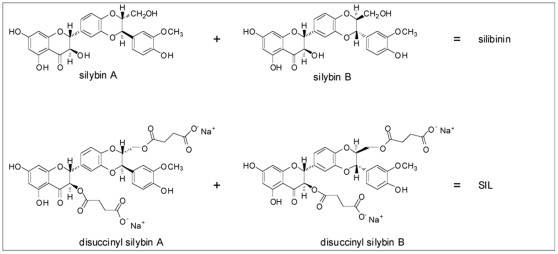
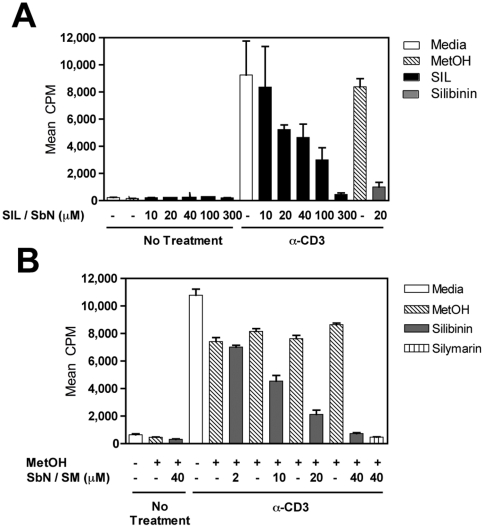
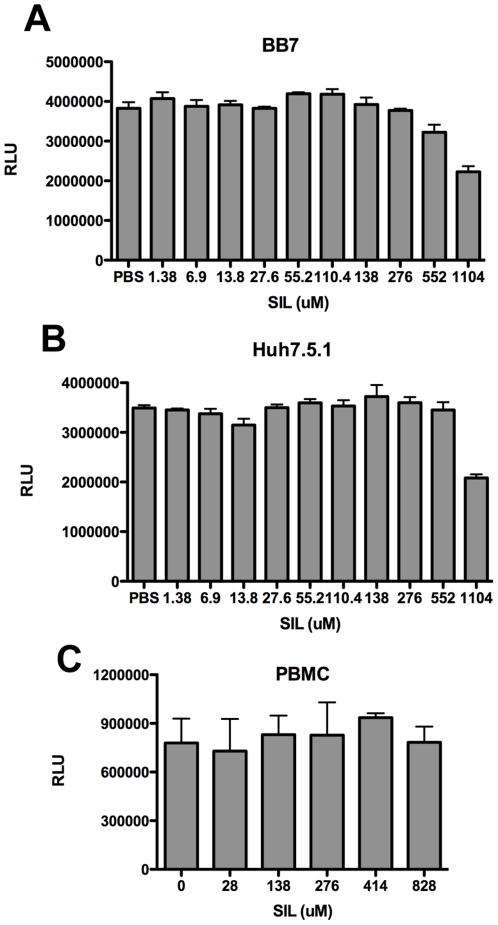
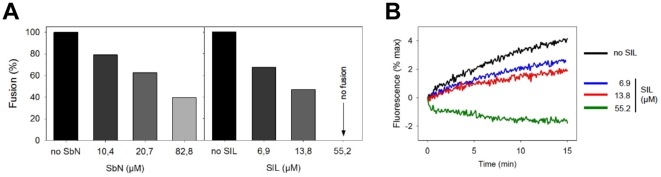
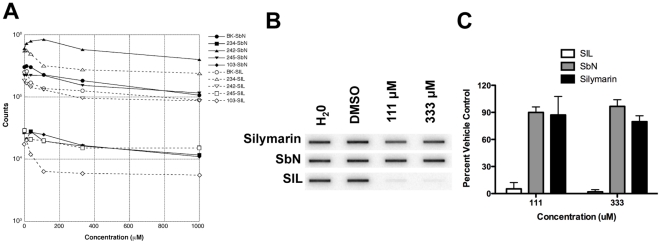
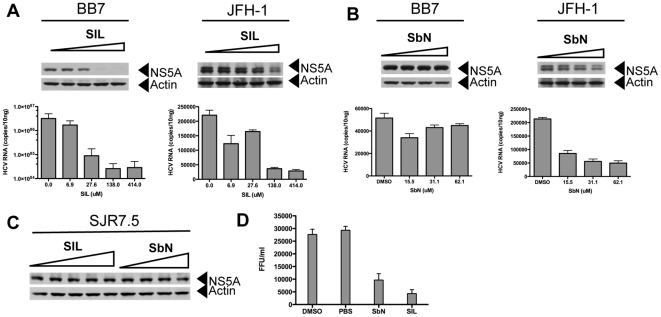
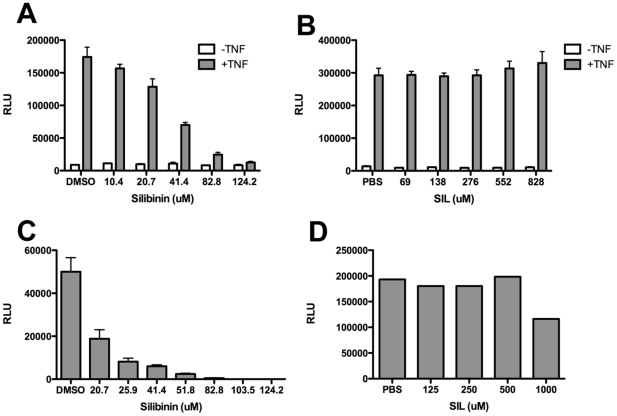
Silymarin prevents liver disease in many experimental rodent models, and is the most popular botanical medicine consumed by patients with hepatitis C. Silibinin is a major component of silymarin, consisting of the flavonolignans silybin A and silybin B, which are insoluble in aqueous solution. A chemically modified and soluble version of silibinin, SIL, has been shown to potently reduce hepatitis C virus (HCV) RNA levels in vivo when administered intravenously. Silymarin and silibinin inhibit HCV infection in cell culture by targeting multiple steps in the virus lifecycle. We tested the hepatoprotective profiles of SIL and silibinin in assays that measure antiviral and anti-inflammatory functions. Both mixtures inhibited fusion of HCV pseudoparticles (HCVpp) with fluorescent liposomes in a dose-dependent fashion. SIL inhibited 5 clinical genotype 1b isolates of NS5B RNA dependent RNA polymerase (RdRp) activity better than silibinin, with IC50 values of 40-85 µM. The enhanced activity of SIL may have been in part due to inhibition of NS5B binding to RNA templates. However, inhibition of the RdRps by both mixtures plateaued at 43-73%, suggesting that the products are poor overall inhibitors of RdRp. Silibinin did not inhibit HCV replication in subgenomic genotype 1b or 2a replicon cell lines, but it did inhibit JFH-1 infection. In contrast, SIL inhibited 1b but not 2a subgenomic replicons and also inhibited JFH-1 infection. Both mixtures inhibited production of progeny virus particles. Silibinin but not SIL inhibited NF-κB- and IFN-B-dependent transcription in Huh7 cells. However, both mixtures inhibited T cell proliferation to similar degrees. These data underscore the differences and similarities between the intravenous and oral formulations of silibinin, which could influence the clinical effects of this mixture on patients with chronic liver diseases.
水飞蓟素在许多实验性啮齿动物模型中预防肝病,是丙型肝炎患者最常服用的植物药。水飞蓟宾是水飞蓟素的主要成分,由黄酮木脂素水飞蓟宾 A 和水飞蓟宾 B 组成,不溶于水溶液。化学修饰和可溶性的水飞蓟宾 SIL 已被证明在静脉内给药时能有效地降低体内丙型肝炎病毒 (HCV) RNA 水平。水飞蓟素和水飞蓟宾通过靶向病毒生命周期中的多个步骤来抑制细胞培养中的 HCV 感染。我们在测量抗病毒和抗炎功能的测定中测试了 SIL 和水飞蓟宾的肝保护谱。两种混合物均以剂量依赖性方式抑制 HCV 假病毒 (HCVpp) 与荧光脂质体的融合。SIL 抑制 5 种临床基因型 1b HCV NS5B RNA 依赖性 RNA 聚合酶 (RdRp) 活性优于水飞蓟宾,IC50 值为 40-85µM。SIL 的增强活性部分可能是由于抑制了 NS5B 与 RNA 模板的结合。然而,两种混合物对 RdRp 的抑制均在 43-73%时达到平台期,表明产物对 RdRp 的总体抑制作用较差。水飞蓟宾不能抑制亚基因组基因型 1b 或 2a 复制子细胞系中的 HCV 复制,但它抑制 JFH-1 感染。相比之下,SIL 抑制 1b 但不抑制 2a 亚基因组复制子,也抑制 JFH-1 感染。两种混合物均抑制子代病毒颗粒的产生。水飞蓟宾而不是 SIL 抑制 Huh7 细胞中 NF-κB 和 IFN-B 依赖性转录。然而,两种混合物均以相似程度抑制 T 细胞增殖。这些数据突出了 SIL 静脉内和口服制剂之间的差异和相似之处,这可能影响该混合物对慢性肝病患者的临床效果。