Department of Community Medicine, Faculty of Health Sciences, University of Tromsø, N-9037 Tromsø, Norway.
J Epidemiol Community Health. 2012 Jul;66(7):611-7. doi: 10.1136/jech.2010.123232. Epub 2011 Feb 14.
The impact of body mass index (BMI; kg/m(2)) and waist circumference (WC) on mortality in elderly individuals is controversial and previous research has largely focused on obesity.
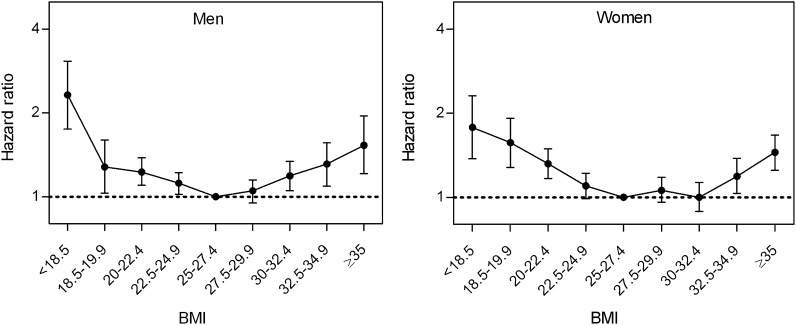
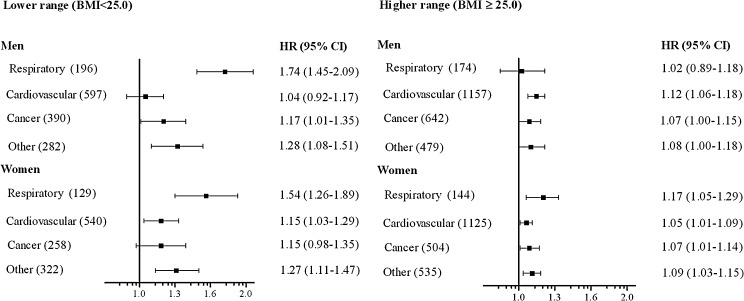
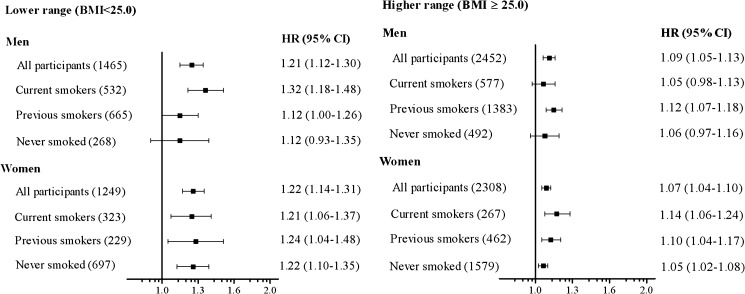
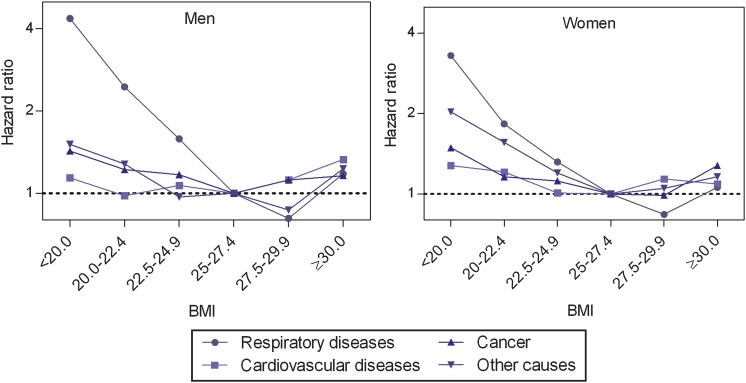
With special attention to the lower BMI categories, associations between BMI and both total and cause-specific mortality were explored in 7604 men and 9107 women aged ≥ 65 years who participated in the Tromsø Study (1994-1995) or the North-Trøndelag Health Study (1995-1997). A Cox proportional hazards model adjusted for age, marital status, education and smoking was used to estimate HRs for mortality in different BMI categories using the BMI range of 25-27.5 as a reference. The impact of each 2.5 kg/m(2) difference in BMI on mortality in individuals with BMI < 25.0 and BMI ≥ 25.0 was also explored. Furthermore, the relations between WC and mortality were assessed.
We identified 7474 deaths during a mean follow-up of 9.3 years. The lowest mortality was found in the BMI range 25-29.9 and 25-32.4 in men and women, respectively. Mortality was increased in all BMI categories below 25 and was moderately increased in obese individuals. U-shaped relationships were also found between WC and total mortality. About 40% of the excess mortality in the lower BMI range in men was explained by mortality from respiratory diseases.
BMI below 25 in elderly men and women was associated with increased mortality. A modest increase in mortality was found with increasing BMI among obese men and women. Overweight individuals (BMI 25-29.9) had the lowest mortality.
身体质量指数(BMI;kg/m(2))和腰围(WC)对老年人死亡率的影响存在争议,以往的研究主要集中在肥胖上。
特别关注较低的 BMI 类别,在 7604 名年龄≥65 岁的男性和 9107 名年龄≥65 岁的女性中,探讨了 BMI 与总死亡率和死因特异性死亡率之间的关系,他们参加了特罗姆瑟研究(1994-1995 年)或北特伦德拉格健康研究(1995-1997 年)。使用 Cox 比例风险模型,根据年龄、婚姻状况、教育程度和吸烟状况进行调整,使用 BMI 范围为 25-27.5 作为参考,估计不同 BMI 类别死亡率的 HR。还探讨了 BMI 每增加 2.5kg/m(2)对 BMI<25.0 和 BMI≥25.0 的个体死亡率的影响。此外,评估了 WC 与死亡率之间的关系。
在平均 9.3 年的随访期间,我们确定了 7474 例死亡。男性 BMI 范围为 25-29.9,女性 BMI 范围为 25-32.4,死亡率最低。所有 BMI 类别均低于 25 时死亡率增加,肥胖个体死亡率中度增加。也发现 WC 与总死亡率之间存在 U 形关系。男性较低 BMI 范围内的死亡率增加约 40%可归因于呼吸系统疾病导致的死亡率。
老年男性和女性 BMI<25 与死亡率增加相关。肥胖男性和女性 BMI 增加与死亡率适度增加相关。超重个体(BMI 25-29.9)的死亡率最低。