Clinic for Ruminants LMU Munich, Oberschleissheim, Germany.
BMC Vet Res. 2011 Feb 18;7:10. doi: 10.1186/1746-6148-7-10.
Since 2006, cases of haemorrhagic diathesis in young calves have been observed with a much higher incidence than previously known. The syndrome, now uniformly called Bovine Neonatal Pancytopenia (BNP), is characterized by multiple (external and internal) haemorrhages, thrombocytopenia, leukocytopenia, and bone marrow depletion. Although various infectious and toxicological causes of bleeding disorders in calves have been ruled out, the aetiology of BNP remains unknown. However, field observations have led to the hypothesis that the aetiological principle may be transmitted to calves via colostrum.The objective of the present study was to verify whether ingestion of colostrum from dams of known BNP calves can elicit signs of BNP and typical haematological findings in conveniently selected neonatal calves. Six such calves received one feeding of colostrum (or a mixture of colostrum batches) from dams of known BNP calves. As controls, another six conveniently selected calves from herds which had never had a BNP case received one feeding of colostrum from their own dams. Haematological and clinical parameters were monitored.
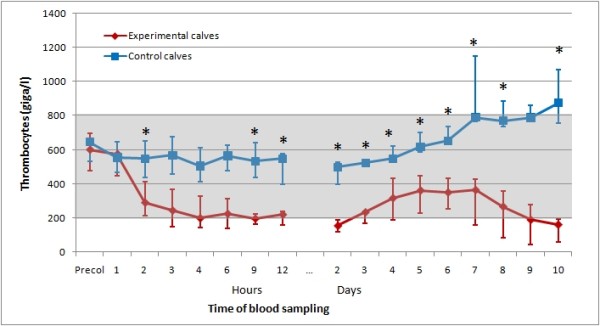
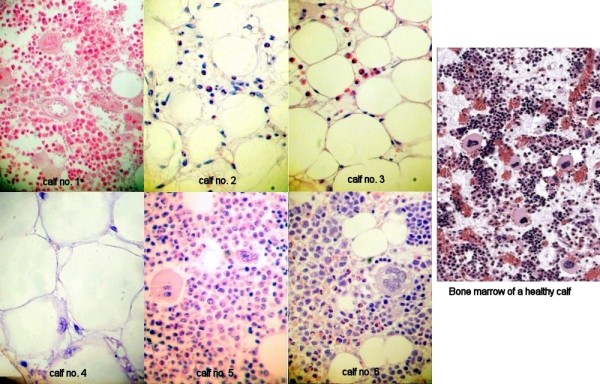
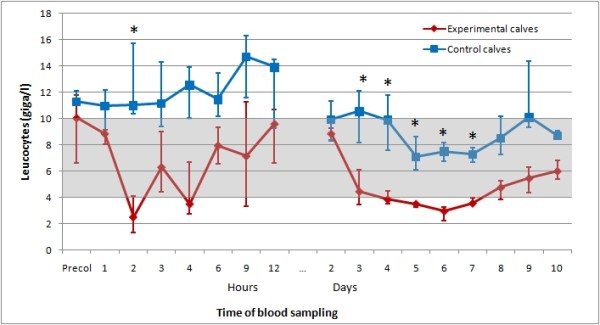
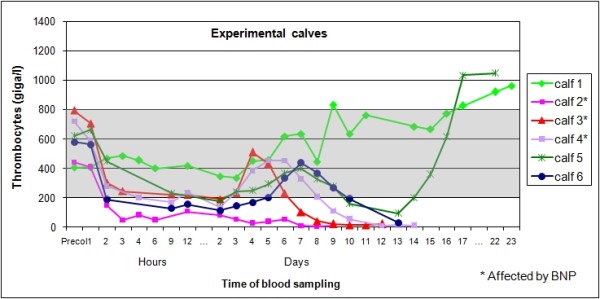
One of the six experimental calves never showed any haematological, clinical or pathological evidence of BNP. In the other five calves, thrombocyte and leukocyte counts dropped within a few hours following ingestion of colostrum. Of those, three calves developed clinical signs of BNP, their post-mortem examination revealed bone marrow depletion. Of the remaining two calves, a pair of mixed twins, marked thrombocytopenia and recurrent leukocytopenia was evident in one, in which only slight changes in the bone marrow were detected, while in the other thrombocyte counts dropped, but rebounded later, and no bone marrow changes were noted. Thrombocyte counts of the experimental calves were statistically significantly lower than those of the control calves at 2 hours post ingestion of colostrum and at every sampling point between 9 hours and 8 days postcolostral. Leucocyte counts of the experimental calves were statistically significantly lower than those of control calves at 2 hours post ingestion of colostrum and 3-7 days postcolostral.
BNP can be induced in some calves by ingestion of colostrum from cows that have given birth to BNP calves.
自 2006 年以来,年轻牛犊中出现了出血性素质的病例,其发病率比以前所知的要高得多。该综合征现统称为牛新生全血细胞减少症(BNP),其特征为多种(外部和内部)出血、血小板减少、白细胞减少和骨髓耗竭。尽管已排除了各种导致牛犊出血性疾病的传染性和毒性原因,但 BNP 的病因仍不清楚。然而,实地观察得出的假设是,病因可能通过初乳传播给牛犊。本研究的目的是验证从已知 BNP 牛犊的母牛那里摄入初乳是否会在方便选择的新生牛犊中引起 BNP 症状和典型的血液学发现。六头这样的牛犊从已知 BNP 牛犊的母牛那里接受了一次初乳(或初乳批次的混合物)喂养。作为对照,从从未发生过 BNP 病例的牛群中另外选择了六头方便的小牛,从它们自己的母牛那里接受了一次初乳喂养。监测血液学和临床参数。
六头实验牛犊中有一头从未出现过任何 BNP 的血液学、临床或病理证据。在其余五头牛犊中,在摄入初乳后的几个小时内,血小板和白细胞计数下降。其中三头牛犊出现了 BNP 的临床症状,其死后检查显示骨髓耗竭。在其余两头牛犊中,一对混合双胞胎中的一头明显存在血小板减少和反复白细胞减少,骨髓只有轻微变化,而另一头牛犊的血小板计数下降,但后来反弹,骨髓无变化。在摄入初乳后 2 小时和摄入初乳后 9 小时至 8 天之间的每个采样点,实验牛犊的血小板计数均明显低于对照组牛犊。在摄入初乳后 2 小时和摄入初乳后 3-7 天,实验牛犊的白细胞计数明显低于对照组牛犊。
从患有 BNP 的母牛那里摄入初乳可在某些牛犊中引起 BNP。