Spooner Ralee, Yilmaz Ozlem
Department of Periodontology, University of Florida, Gainesville, FL 32610, USA; E-Mail:
Int J Mol Sci. 2011 Jan 13;12(1):334-52. doi: 10.3390/ijms12010334.
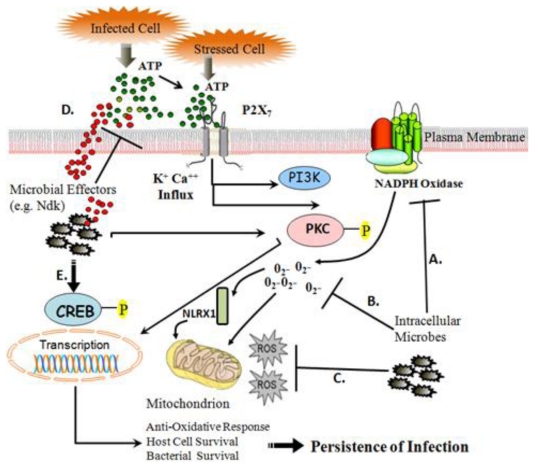
The mechanisms of chronic infections caused by opportunistic pathogens are of keen interest to both researchers and health professionals globally. Typically, chronic infectious disease can be characterized by an elevation in immune response, a process that can often lead to further destruction. Reactive-Oxygen-Species (ROS) have been strongly implicated in the aforementioned detrimental response by host that results in self-damage. Unlike excessive ROS production resulting in robust cellular death typically induced by acute infection or inflammation, lower levels of ROS produced by host cells are increasingly recognized to play a critical physiological role for regulating a variety of homeostatic cellular functions including growth, apoptosis, immune response, and microbial colonization. Sources of cellular ROS stimulation can include "danger-signal-molecules" such as extracellular ATP (eATP) released by stressed, infected, or dying cells. Particularly, eATP-P2X(7) receptor mediated ROS production has been lately found to be a key modulator for controlling chronic infection and inflammation. There is growing evidence that persistent microbes can alter host cell ROS production and modulate eATP-induced ROS for maintaining long-term carriage. Though these processes have yet to be fully understood, exploring potential positive traits of these "injurious" molecules could illuminate how opportunistic pathogens maintain persistence through physiological regulation of ROS signaling.
全球范围内,研究人员和健康专家都对由机会性病原体引起的慢性感染机制有着浓厚兴趣。通常,慢性传染病的特征是免疫反应增强,而这一过程往往会导致进一步的破坏。活性氧(ROS)与宿主上述导致自身损伤的有害反应密切相关。与急性感染或炎症通常诱导的大量细胞死亡所导致的过量ROS产生不同,宿主细胞产生的较低水平的ROS越来越被认为在调节包括生长、凋亡、免疫反应和微生物定植在内的各种稳态细胞功能中发挥关键的生理作用。细胞ROS刺激的来源可以包括“危险信号分子”,如应激、感染或垂死细胞释放的细胞外ATP(eATP)。特别是,最近发现eATP-P2X(7)受体介导的ROS产生是控制慢性感染和炎症的关键调节因子。越来越多的证据表明,持续性微生物可以改变宿主细胞ROS的产生,并调节eATP诱导的ROS以维持长期携带。尽管这些过程尚未完全被理解,但探索这些“有害”分子的潜在积极特性可能会阐明机会性病原体如何通过ROS信号的生理调节来维持持久性。