Department of Health Technology and Informatics, The Hong Kong Polytechnic University, Hong Kong SAR, China.
PLoS One. 2011 Feb 8;6(2):e16643. doi: 10.1371/journal.pone.0016643.
Stroke rehabilitation with different exercise paradigms has been investigated, but which one is more effective in facilitating motor recovery and up-regulating brain neurotrophic factor (BDNF) after brain ischemia would be interesting to clinicians and patients. Voluntary exercise, forced exercise, and involuntary muscle movement caused by functional electrical stimulation (FES) have been individually demonstrated effective as stroke rehabilitation intervention. The aim of this study was to investigate the effects of these three common interventions on brain BDNF changes and motor recovery levels using a rat ischemic stroke model.
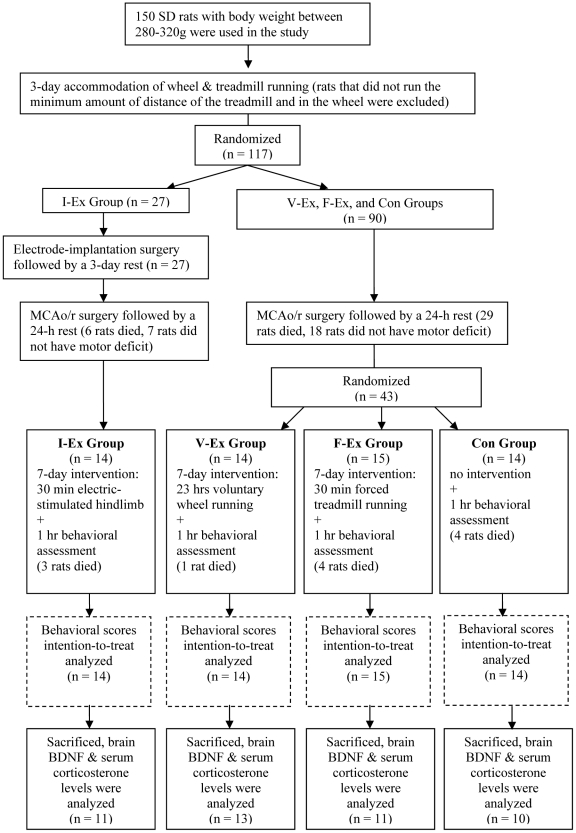
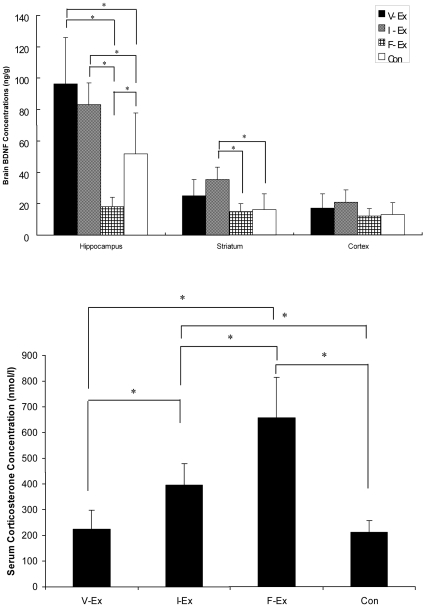
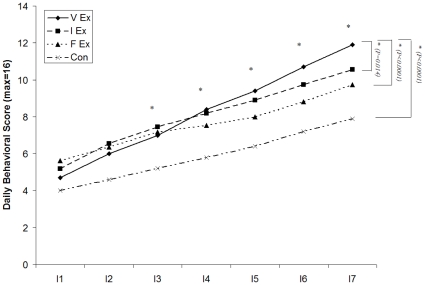
METHODOLOGY/PRINCIPAL FINDINGS: One hundred and seventeen Sprague-Dawley rats were randomly distributed into four groups: Control (Con), Voluntary exercise of wheel running (V-Ex), Forced exercise of treadmill running (F-Ex), and Involuntary exercise of FES (I-Ex) with implanted electrodes placed in two hind limb muscles on the affected side to mimic gait-like walking pattern during stimulation. Ischemic stroke was induced in all rats with the middle cerebral artery occlusion/reperfusion model and fifty-seven rats had motor deficits after stroke. Twenty-four hours after reperfusion, rats were arranged to their intervention programs. De Ryck's behavioral test was conducted daily during the 7-day intervention as an evaluation tool of motor recovery. Serum corticosterone concentration and BDNF levels in the hippocampus, striatum, and cortex were measured after the rats were sacrificed. V-Ex had significantly better motor recovery in the behavioral test. V-Ex also had significantly higher hippocampal BDNF concentration than F-Ex and Con. F-Ex had significantly higher serum corticosterone level than other groups.
CONCLUSION/SIGNIFICANCE: Voluntary exercise is the most effective intervention in upregulating the hippocampal BDNF level, and facilitating motor recovery. Rats that exercised voluntarily also showed less corticosterone stress response than other groups. The results also suggested that the forced exercise group was the least preferred intervention with high stress, low brain BDNF levels and less motor recovery.
不同的运动模式在中风康复方面已经得到了研究,但哪种模式在促进脑缺血后运动功能恢复和上调脑源性神经营养因子(BDNF)方面更有效,这对临床医生和患者来说是很有趣的。自愿运动、强制运动和功能性电刺激(FES)引起的非自愿肌肉运动已被证明分别是有效的中风康复干预措施。本研究旨在使用大鼠缺血性中风模型,研究这三种常见干预措施对脑 BDNF 变化和运动恢复水平的影响。
方法/主要发现:117 只 Sprague-Dawley 大鼠被随机分为四组:对照组(Con)、自愿轮跑运动(V-Ex)、强制跑步机跑运动(F-Ex)和植入电极的非自愿 FES 运动(I-Ex),电极放置在受影响侧的两条后肢肌肉上,以模拟刺激时的类似步态的行走模式。所有大鼠均采用大脑中动脉闭塞/再灌注模型诱导缺血性中风,中风后 57 只大鼠出现运动功能障碍。再灌注后 24 小时,将大鼠安排到各自的干预方案中。在 7 天的干预过程中,每天进行 De Ryck 行为测试,作为运动恢复的评估工具。在大鼠被处死时测量血清皮质酮浓度和海马、纹状体和皮质中的 BDNF 水平。V-Ex 在行为测试中的运动恢复明显更好。V-Ex 组的海马 BDNF 浓度也明显高于 F-Ex 和 Con 组。F-Ex 组的血清皮质酮水平明显高于其他组。
结论/意义:自愿运动是上调海马 BDNF 水平和促进运动恢复最有效的干预措施。自愿运动的大鼠皮质酮应激反应也低于其他组。结果还表明,强制运动组是最不受欢迎的干预措施,因为它应激反应高、脑 BDNF 水平低、运动恢复差。