Department of Surgical Sciences, Haukeland University Hospital, University of Bergen, Bergen, Norway.
Scand J Trauma Resusc Emerg Med. 2011 Feb 28;19:13. doi: 10.1186/1757-7241-19-13.
Children can be the only persons present in an emergency situation. Aim of the study was to evaluate the effects of a first aid course for 4-5-year-old kindergarten children given by a first aid instructor and kindergarten teachers.
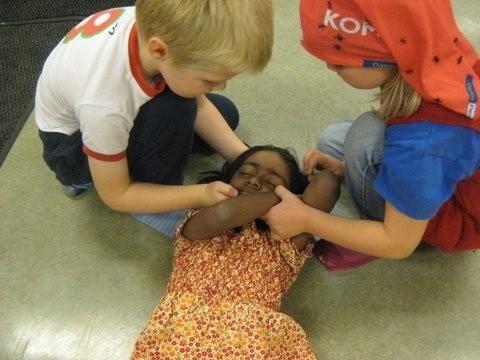
A mixed methods approach using both quantitative and qualitative methods was used to investigate the effects of teaching first aid in the kindergarten in the present study. 10 kindergarten children at the age of 4-5 years were included in a pilot-study, 5 girls and 5 boys. Three of them were four years and seven were five years old. Two months after completion of the first aid course children were tested in a scenario where the children had to provide first aid to an unconscious victim after a cycle accident. The next seven months the children were followed by participant observation.
The findings suggest that 4-5-year-old children are able to learn and apply basic first aid. Tested two months after course completion 70% of the children assessed consciousness correctly and knew the correct emergency telephone number; 60% showed correct assessment of breathing and 40% of the participants accomplished the other tasks (giving correct emergency call information, knowledge of correct recovery position, correct airway management) correctly. Many of the children showed their capabilities to do so in a first aid scenario although some participants showed fear of failure in the test scenario. In an informal group testing most of these children could perform first aid measures, too. Teaching first aid also lead to more active helping behaviour and increased empathy in the children.
Kindergarten children aged 4-5 years can learn basic fist aid. First aid training should start in the kindergarten.
儿童可能是紧急情况下唯一在场的人。本研究的目的是评估由急救指导员和幼儿园教师为 4-5 岁幼儿园儿童教授急救课程的效果。
本研究采用混合方法,结合定量和定性方法,调查在幼儿园教授急救的效果。在试点研究中纳入了 10 名 4-5 岁的幼儿园儿童,其中 5 名女孩和 5 名男孩。他们中有 3 人 4 岁,7 人 5 岁。在急救课程完成两个月后,孩子们在一个场景中接受测试,在这个场景中,孩子们必须在自行车事故后为一名失去意识的受害者提供急救。接下来的 7 个月,对这些儿童进行了参与式观察。
研究结果表明,4-5 岁的儿童能够学习和应用基本的急救知识。在课程完成两个月后进行测试,70%的儿童正确评估了意识,并知道正确的紧急电话号码;60%的儿童正确评估了呼吸,40%的参与者正确完成了其他任务(提供正确的紧急呼叫信息、正确的复苏体位知识、正确的气道管理)。尽管一些参与者在测试场景中表现出对失败的恐惧,但许多儿童在急救场景中展示了他们的能力。在非正式的小组测试中,大多数孩子也能够实施急救措施。教授急救还导致儿童的帮助行为更加积极,同理心增强。
4-5 岁的幼儿园儿童可以学习基本的急救知识。急救培训应在幼儿园开始。