Johann Friedrich Blumenbach Institute of Zoology and Anthropology, University of Goettingen, Goettingen, Germany.
Curr Neuropharmacol. 2010 Sep;8(3):168-81. doi: 10.2174/157015910792246244.
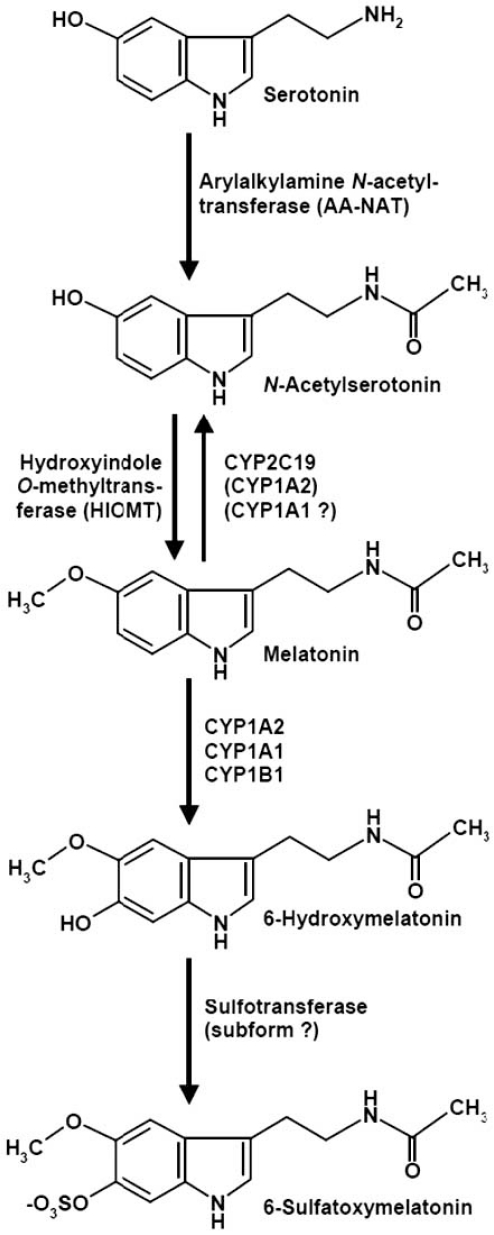
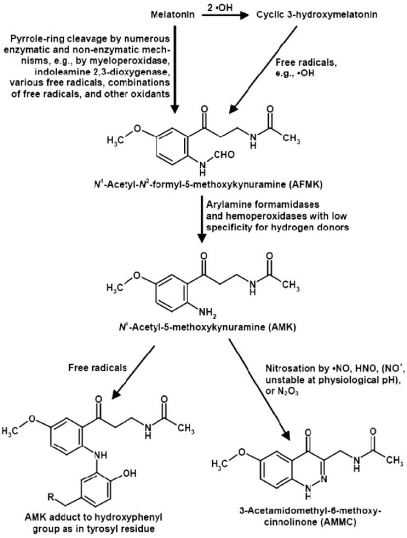
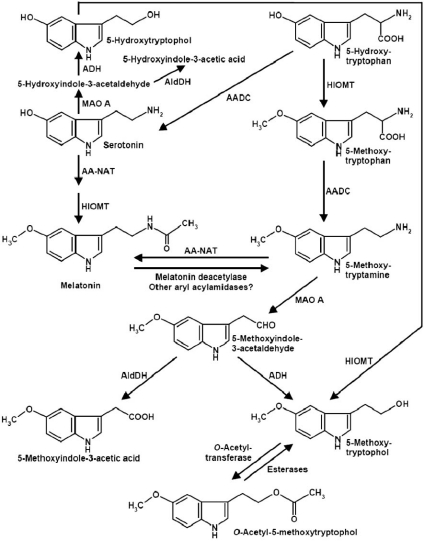
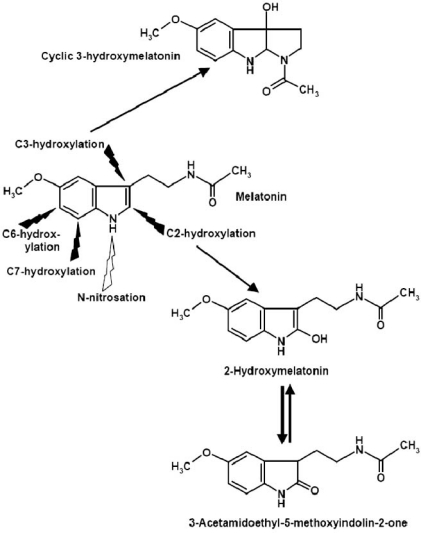
The metabolism of melatonin in the central nervous system is of interest for several reasons. Melatonin enters the brain either via the pineal recess or by uptake from the blood. It has been assumed to be also formed in some brain areas. Neuroprotection by melatonin has been demonstrated in numerous model systems, and various attempts have been undertaken to counteract neurodegeneration by melatonin treatment. Several concurrent pathways lead to different products. Cytochrome P(450) subforms have been demonstrated in the brain. They either demethylate melatonin to N-acetylserotonin, or produce 6-hydroxymelatonin, which is mostly sulfated already in the CNS. Melatonin is deacetylated, at least in pineal gland and retina, to 5-methoxytryptamine. N(1)-acetyl-N(2)-formyl-5-methoxykynuramine is formed by pyrrole-ring cleavage, by myeloperoxidase, indoleamine 2,3-dioxygenase and various non-enzymatic oxidants. Its product, N(1)-acetyl-5-methoxykynuramine, is of interest as a scavenger of reactive oxygen and nitrogen species, mitochondrial modulator, downregulator of cyclooxygenase-2, inhibitor of cyclooxygenase, neuronal and inducible NO synthases. Contrary to other nitrosated aromates, the nitrosated kynuramine metabolite, 3-acetamidomethyl-6-methoxycinnolinone, does not re-donate NO. Various other products are formed from melatonin and its metabolites by interaction with reactive oxygen and nitrogen species. The relative contribution of the various pathways to melatonin catabolism seems to be influenced by microglia activation, oxidative stress and brain levels of melatonin, which may be strongly changed in experiments on neuroprotection. Many of the melatonin metabolites, which may appear in elevated concentrations after melatonin administration, possess biological or pharmacological properties, including N-acetylserotonin, 5-methoxytryptamine and some of its derivatives, and especially the 5-methoxylated kynuramines.
褪黑素在中枢神经系统中的代谢有几个原因引起关注。褪黑素通过松果体隐窝或从血液中摄取进入大脑。人们认为它也在一些脑区形成。褪黑素在许多模型系统中已被证明具有神经保护作用,并且已经进行了各种尝试通过褪黑素治疗来对抗神经退行性变。有几个并发途径导致不同的产物。已经在大脑中证明了细胞色素 P(450)亚型的存在。它们要么将褪黑素脱甲基化为 N-乙酰血清素,要么产生 6-羟褪黑素,后者在中枢神经系统中主要已被硫酸化。褪黑素在至少松果体和视网膜中被脱乙酰化为 5-甲氧基色胺。通过过氧化物酶、吲哚胺 2,3-双加氧酶和各种非酶促氧化剂,吡咯环裂解形成 N(1)-乙酰-N(2)-甲酰-5-甲氧基犬尿氨酸。其产物 N(1)-乙酰-5-甲氧基犬尿氨酸作为活性氧和氮物种的清除剂、线粒体调节剂、环加氧酶-2 的下调物、环加氧酶抑制剂、神经元和诱导型一氧化氮合酶抑制剂而受到关注。与其他亚硝化芳族化合物不同,亚硝化犬尿氨酸代谢物 3-乙酰氨基甲基-6-甲氧基肉桂酰基酮不会重新供体 NO。褪黑素及其代谢物与活性氧和氮物种相互作用形成各种其他产物。各种途径对褪黑素代谢的相对贡献似乎受小胶质细胞激活、氧化应激和大脑中褪黑素水平的影响,这些水平在神经保护实验中可能会发生强烈变化。许多褪黑素代谢物,在褪黑素给药后可能以升高的浓度出现,具有生物或药理学特性,包括 N-乙酰血清素、5-甲氧基色胺及其一些衍生物,特别是 5-甲氧基犬尿氨酸。