Karlsruhe Institute of Technology, Institute for Meteorology and Climate Research, Garmisch-Partenkirchen, Germany.
PLoS One. 2011 Feb 28;6(2):e17393. doi: 10.1371/journal.pone.0017393.
Globally plants are the primary sink of atmospheric CO(2), but are also the major contributor of a large spectrum of atmospheric reactive hydrocarbons such as terpenes (e.g. isoprene) and other biogenic volatile organic compounds (BVOC). The prediction of plant carbon (C) uptake and atmospheric oxidation capacity are crucial to define the trajectory and consequences of global environmental changes. To achieve this, the biosynthesis of BVOC and the dynamics of C allocation and translocation in both plants and ecosystems are important.
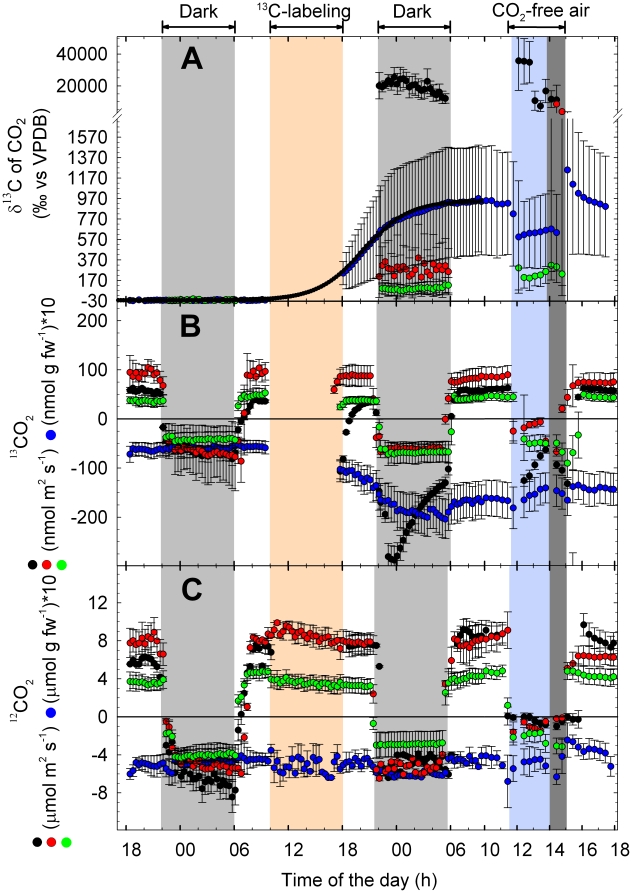
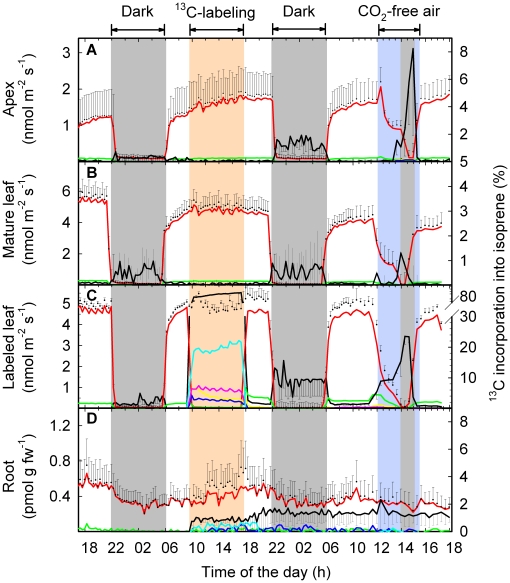
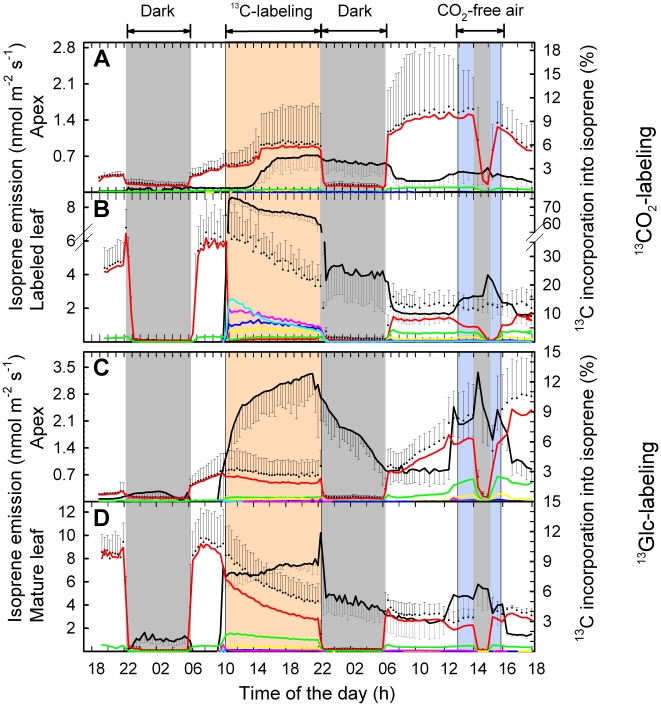
We combined tunable diode laser absorption spectrometry (TDLAS) and proton transfer reaction mass spectrometry (PTR-MS) for studying isoprene biosynthesis and following C fluxes within grey poplar (Populus x canescens) saplings. This was achieved by feeding either (13)CO(2) to leaves or (13)C-glucose to shoots via xylem uptake. The translocation of (13)CO(2) from the source to other plant parts could be traced by (13)C-labeled isoprene and respiratory (13)CO(2) emission.
In intact plants, assimilated (13)CO(2) was rapidly translocated via the phloem to the roots within 1 hour, with an average phloem transport velocity of 20.3±2.5 cm h(-1). (13)C label was stored in the roots and partially reallocated to the plants' apical part one day after labeling, particularly in the absence of photosynthesis. The daily C loss as BVOC ranged between 1.6% in mature leaves and 7.0% in young leaves. Non-isoprene BVOC accounted under light conditions for half of the BVOC C loss in young leaves and one-third in mature leaves. The C loss as isoprene originated mainly (76-78%) from recently fixed CO(2), to a minor extent from xylem-transported sugars (7-11%) and from photosynthetic intermediates with slower turnover rates (8-11%).
We quantified the plants' C loss as respiratory CO(2) and BVOC emissions, allowing in tandem with metabolic analysis to deepen our understanding of ecosystem C flux.
全球范围内,植物是大气 CO(2) 的主要汇,但也是大量大气反应性烃类物质(如萜烯(例如异戊二烯)和其他生物源挥发性有机化合物(BVOC))的主要来源。预测植物碳(C)吸收和大气氧化能力对于确定全球环境变化的轨迹和后果至关重要。为此,BVOC 的生物合成以及植物和生态系统中 C 分配和转移的动态是重要的。
我们结合可调谐二极管激光吸收光谱(TDLAS)和质子转移反应质谱(PTR-MS)来研究异戊二烯的生物合成,并跟踪灰杨(Populus x canescens)幼树叶片内的 C 通量。这是通过木质部吸收将(13)CO(2) 喂给叶片或(13)C-葡萄糖喂给枝条来实现的。(13)CO(2) 从源到其他植物部分的转移可以通过(13)C 标记的异戊二烯和呼吸(13)CO(2) 排放来追踪。
在完整的植物中,同化的(13)CO(2) 在 1 小时内通过韧皮部快速转移到根部,平均韧皮部运输速度为 20.3±2.5 cm h(-1)。(13)C 标记在根部储存,并在标记后一天部分重新分配到植物的顶端部分,特别是在没有光合作用的情况下。作为 BVOC 的每日 C 损失在成熟叶片中为 1.6%,在幼叶中为 7.0%。在光照条件下,非异戊二烯 BVOC 占幼叶 BVOC C 损失的一半,占成熟叶片的三分之一。作为异戊二烯的 C 损失主要(76-78%)来自最近固定的 CO(2),次要程度上来自木质部运输的糖(7-11%)和周转率较慢的光合作用中间体(8-11%)。
我们量化了植物作为呼吸 CO(2) 和 BVOC 排放的 C 损失,这与代谢分析相结合,使我们能够更深入地了解生态系统的 C 通量。