Instituto de Bioquímica Médica, Universidade Federal do Rio de Janeiro, Rio de Janeiro, Brazil.
PLoS One. 2011 Mar 9;6(3):e17789. doi: 10.1371/journal.pone.0017789.
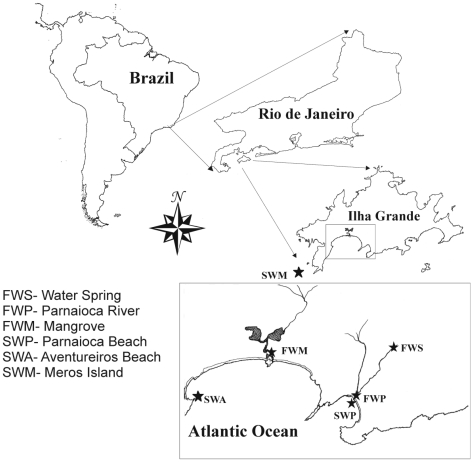
Planktonic bacteria are recognized as important drivers of biogeochemical processes in all aquatic ecosystems, however, the taxa that make up these communities are poorly known. The aim of this study was to investigate bacterial communities in aquatic ecosystems at Ilha Grande, Rio de Janeiro, Brazil, a preserved insular environment of the Atlantic rain forest and how they correlate with a salinity gradient going from terrestrial aquatic habitats to the coastal Atlantic Ocean.
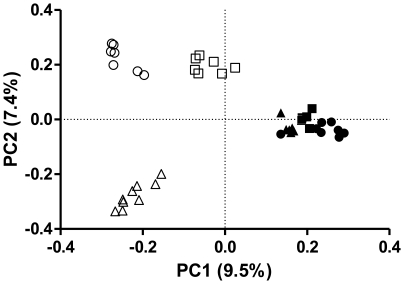
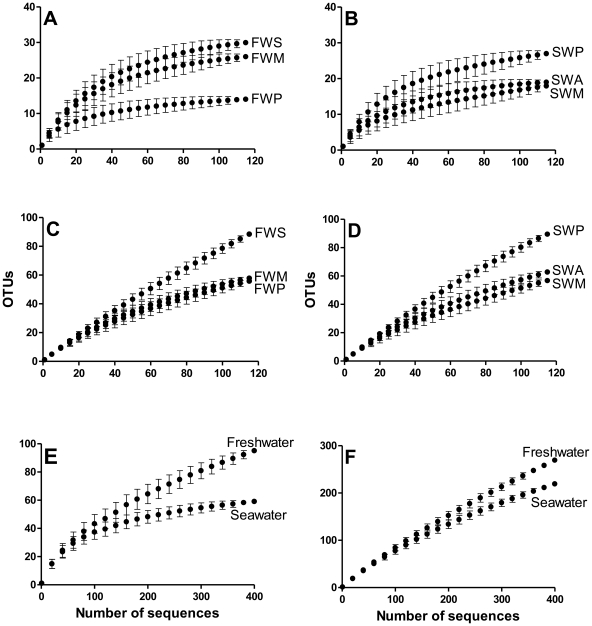
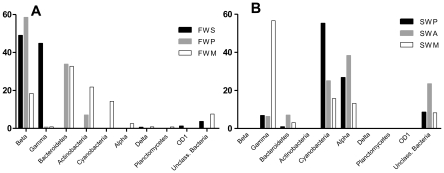
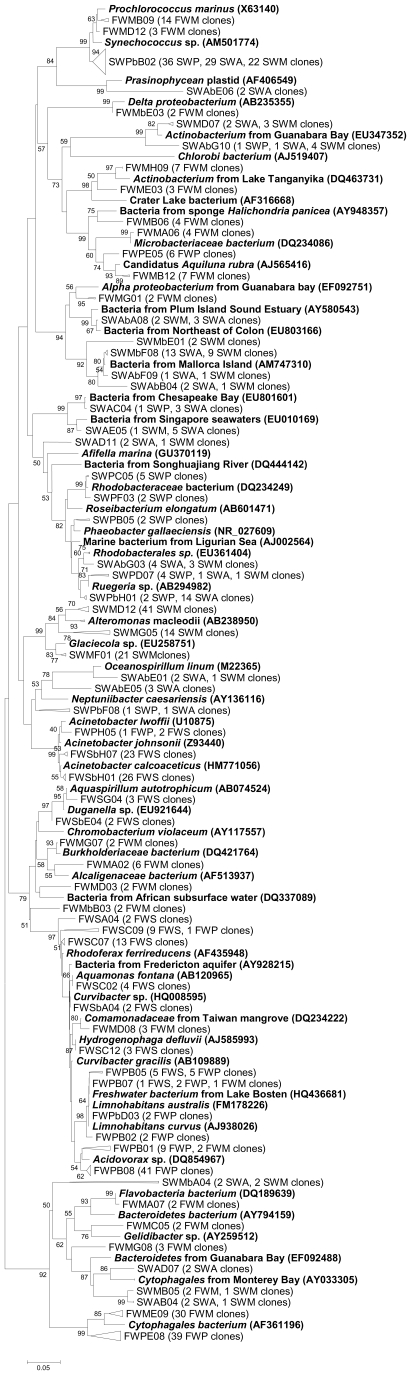
METHODOLOGY/PRINCIPAL FINDINGS: We analyzed chemical and microbiological parameters of water samples and constructed 16S rRNA gene libraries of free living bacteria obtained at three marine (two coastal and one offshore) and three freshwater (water spring, river, and mangrove) environments. A total of 836 sequences were analyzed by MOTHUR, yielding 269 freshwater and 219 marine operational taxonomic units (OTUs) grouped at 97% stringency. Richness and diversity indexes indicated that freshwater environments were the most diverse, especially the water spring. The main bacterial group in freshwater environments was Betaproteobacteria (43.5%), whereas Cyanobacteria (30.5%), Alphaproteobacteria (25.5%), and Gammaproteobacteria (26.3%) dominated the marine ones. Venn diagram showed no overlap between marine and freshwater OTUs at 97% stringency. LIBSHUFF statistics and PCA analysis revealed marked differences between the freshwater and marine libraries suggesting the importance of salinity as a driver of community composition in this habitat. The phylogenetic analysis of marine and freshwater libraries showed that the differences in community composition are consistent.
CONCLUSIONS/SIGNIFICANCE: Our data supports the notion that a divergent evolutionary scenario is driving community composition in the studied habitats. This work also improves the comprehension of microbial community dynamics in tropical waters and how they are structured in relation to physicochemical parameters. Furthermore, this paper reveals for the first time the pristine bacterioplankton communities in a tropical island at the South Atlantic Ocean.
浮游细菌被认为是所有水生生态系统中生物地球化学过程的重要驱动因素,然而,这些群落的组成类群知之甚少。本研究的目的是调查巴西里约热内卢格兰德岛(Ilha Grande)水生生态系统中的细菌群落,该岛是大西洋雨林的一个保存完好的岛屿环境,以及它们如何与从陆地水生生境到沿海水域的大西洋的盐度梯度相关。
方法/主要发现:我们分析了水样的化学和微生物参数,并构建了从三个海洋(两个沿海和一个近海)和三个淡水(泉水、河流和红树林)环境中获得的自由生活细菌的 16S rRNA 基因文库。总共分析了 836 个序列,通过 MOTHUR 获得了 269 个淡水和 219 个海洋操作分类单元(OTUs),在 97%的严格性下分组。丰富度和多样性指数表明,淡水环境最为多样化,尤其是泉水。淡水环境中的主要细菌群是β变形菌(43.5%),而海洋环境中的蓝藻(30.5%)、α变形菌(25.5%)和γ变形菌(26.3%)占主导地位。Venn 图显示,在 97%的严格性下,海洋和淡水 OTUs 之间没有重叠。LIBSHUFF 统计和 PCA 分析表明,淡水和海洋文库之间存在显著差异,表明盐度是该生境群落组成的重要驱动因素。海洋和淡水文库的系统发育分析表明,群落组成的差异是一致的。
结论/意义:我们的数据支持了这样一种观点,即不同的进化情景正在驱动所研究生境中的群落组成。这项工作还提高了对热带水域微生物群落动态及其与理化参数结构关系的理解。此外,本文首次揭示了南大西洋热带岛屿原始的细菌浮游群落。