Agriculture and Agri-Food Canada, Greenhouse and Processing Crops Research Centre, Harrow, ON, N0R 1G0, Canada.
BMC Plant Biol. 2011 Mar 24;11:52. doi: 10.1186/1471-2229-11-52.
Common bacterial blight (CBB), incited by Xanthomonas axonopodis pv. phaseoli (Xap), is a major yield-limiting factor of common bean (Phaseolus vulgaris L.) production around the world. Host resistance is practically the most effective and environmentally-sound approach to control CBB. Unlike conventional QTL discovery strategies, in which bi-parental populations (F2, RIL, or DH) need to be developed, association mapping-based strategies can use plant breeding populations to synchronize QTL discovery and cultivar development.
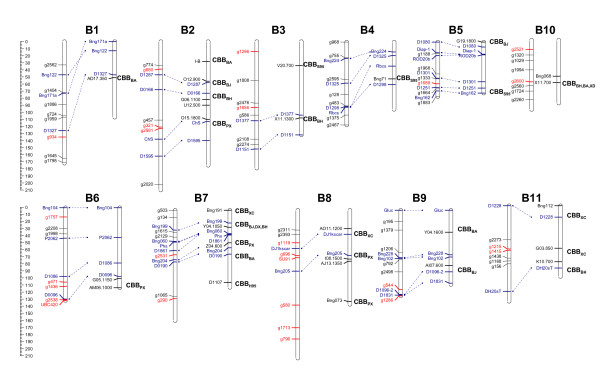
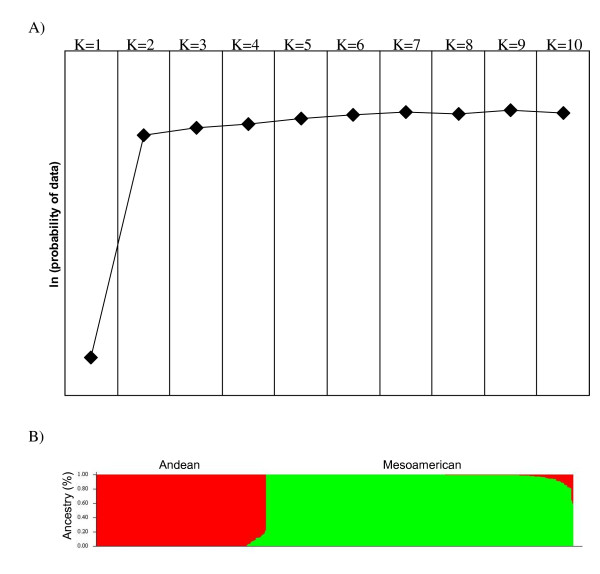
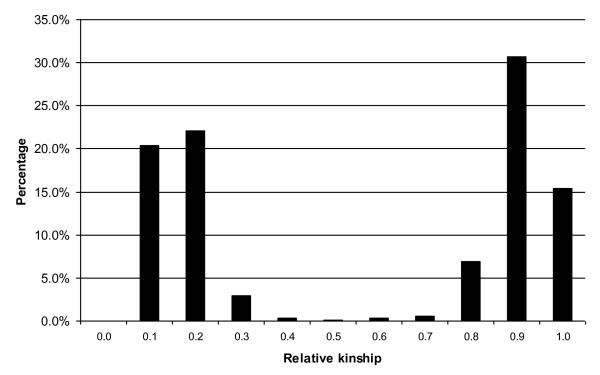
A population of 469 dry bean lines of different market classes representing plant materials routinely developed in a bean breeding program were used. Of them, 395 lines were evaluated for CBB resistance at 14 and 21 DAI (Days After Inoculation) in the summer of 2009 in an artificially inoculated CBB nursery in south-western Ontario. All lines were genotyped using 132 SNPs (Single Nucleotide Polymorphisms) evenly distributed across the genome. Of the 132 SNPs, 26 SNPs had more than 20% missing data, 12 SNPs were monomorphic, and 17 SNPs had a MAF (Minor Allelic Frequency) of less than 0.20, therefore only 75 SNPs were used for association study, based on one SNP per locus. The best possible population structure was to assign 36% and 64% of the lines into Andean and Mesoamerican subgroups, respectively. Kinship analysis also revealed complex familial relationships among all lines, which corresponds with the known pedigree history. MLM (Mixed Linear Model) analysis, including population structure and kinship, was used to discover marker-trait associations. Eighteen and 22 markers were significantly associated with CBB rating at 14 and 21 DAI, respectively. Fourteen markers were significant for both dates and the markers UBC420, SU91, g321, g471, and g796 were highly significant (p ≤ 0.001). Furthermore, 12 significant SNP markers were co-localized with or close to the CBB-QTLs identified previously in bi-parental QTL mapping studies.
This study demonstrated that association mapping using a reasonable number of markers, distributed across the genome and with application of plant materials that are routinely developed in a plant breeding program can detect significant QTLs for traits of interest.
由黄单胞菌野油菜致病变种(Xap)引起的普通细菌性疫病(CBB)是全世界普通菜豆(Phaseolus vulgaris L.)生产的主要产量限制因素。与需要开发双亲群体(F2、RIL 或 DH)的传统 QTL 发现策略不同,基于关联图谱的策略可以利用植物育种群体来同步 QTL 发现和品种开发。
使用了来自一个菜豆育种计划中常规开发的不同市场类别的 469 个干豆品系群体。其中,在 2009 年夏季,在安大略省西南部的一个人工接种 CBB 苗圃中,395 个品系在接种后 14 和 21 天(DAI)时评估了对 CBB 的抗性。所有品系均使用均匀分布在基因组上的 132 个 SNP(单核苷酸多态性)进行基因分型。在 132 个 SNP 中,有 26 个 SNP 的缺失数据超过 20%,12 个 SNP 是单态的,17 个 SNP 的 MAF(次要等位基因频率)小于 0.20,因此仅使用 75 个 SNP 进行关联研究,每个位点一个 SNP。最好的群体结构是将 36%和 64%的品系分别分配到安第斯和中美洲亚群。亲缘关系分析也揭示了所有品系之间复杂的家族关系,这与已知的系谱历史相对应。包含群体结构和亲缘关系的 MLM(混合线性模型)分析用于发现标记与性状的关联。在 14 和 21 DAI 时,分别有 18 和 22 个标记与 CBB 评分显著相关。14 个标记在两个日期都显著,标记 UBC420、SU91、g321、g471 和 g796 高度显著(p ≤ 0.001)。此外,12 个显著的 SNP 标记与之前在双亲 QTL 图谱研究中鉴定的 CBB-QTL 共定位或接近。
本研究表明,使用分布在基因组上的合理数量的标记,并应用在植物育种计划中常规开发的植物材料进行关联图谱分析,可以检测到对感兴趣性状的显著 QTL。