Department of Behavioural Sciences in Medicine, Institute of Basic Medical Sciences, Faculty of Medicine, University of Oslo, PO Box 1111 Blindern, NO-0317 Oslo, Norway.
J Occup Med Toxicol. 2011 Mar 31;6(1):10. doi: 10.1186/1745-6673-6-10.
To address the relative importance of general job-related stressors, ambulance specific stressors and individual characteristics in relation to job satisfaction and health complaints (emotional exhaustion, psychological distress and musculoskeletal pain) among ambulance personnel.
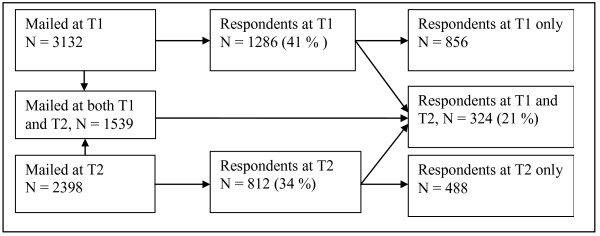
A nationwide prospective questionnaire survey of ambulance personnel in operational duty at two time points (n = 1180 at baseline, T1 and n = 298 at one-year follow up, T2). The questionnaires included the Maslach Burnout Inventory, The Job Satisfaction Scale, Hopkins Symptom Checklist (SCL-10), Job Stress Survey, the Norwegian Ambulance Stress Survey and the Basic Character Inventory.
Overall, 42 out of the possible 56 correlations between job stressors at T1 and job satisfaction and health complaints at T2 were statistically significant. Lower job satisfaction at T2 was predicted by frequency of lack of leader support and severity of challenging job tasks. Emotional exhaustion at T2 was predicted by neuroticism, frequency of lack of support from leader, time pressure, and physical demands. Adjusted for T1 levels, emotional exhaustion was predicted by neuroticism (beta = 0.15, p < .05) and time pressure (beta = 0.14, p < 0.01). Psychological distress at T2 was predicted by neuroticism and lack of co-worker support. Adjusted for T1 levels, psychological distress was predicted by neuroticism (beta = 0.12, p < .05). Musculoskeletal pain at T2 was predicted by, higher age, neuroticism, lack of co-worker support and severity of physical demands. Adjusted for T1 levels, musculoskeletal pain was predicted neuroticism, and severity of physical demands (beta = 0.12, p < .05).
Low job satisfaction at T2 was predicted by general work-related stressors, whereas health complaints at T2 were predicted by both general work-related stressors and ambulance specific stressors. The personality variable neuroticism predicted increased complaints across all health outcomes.
探讨一般工作压力源、救护车特定压力源和个体特征与救护车人员工作满意度和健康问题(情绪衰竭、心理困扰和肌肉骨骼疼痛)之间的相对重要性。
对两个时间点(基线时 n = 1180,T1;一年后随访时 n = 298,T2)处于执勤状态的救护车人员进行全国范围的前瞻性问卷调查。问卷包括 Maslach 职业倦怠量表、工作满意度量表、霍普金斯症状检查表(SCL-10)、工作压力调查、挪威救护车压力调查和基本特征量表。
在 T1 时,工作压力源与 T2 时的工作满意度和健康问题之间共有 56 个可能的相关性,其中 42 个相关性具有统计学意义。T2 时工作满意度较低与领导支持缺乏频率和挑战性工作任务严重程度相关。T2 时情绪衰竭与神经质、领导支持缺乏频率、时间压力和体力要求相关。调整 T1 水平后,情绪衰竭与神经质(β=0.15,p <.05)和时间压力(β=0.14,p < 0.01)相关。T2 时心理困扰与神经质和同事支持缺乏相关。调整 T1 水平后,心理困扰与神经质相关(β=0.12,p <.05)。T2 时肌肉骨骼疼痛与年龄较大、神经质、同事支持缺乏和体力要求严重程度相关。调整 T1 水平后,肌肉骨骼疼痛与神经质和体力要求严重程度相关(β=0.12,p <.05)。
T2 时的低工作满意度由一般工作压力源预测,而 T2 时的健康问题由一般工作压力源和救护车特定压力源共同预测。神经质这一人格变量预测了所有健康结果的抱怨增加。