• 文献检索
  • 文档翻译
  • 深度研究
  • 学术资讯
  • Suppr Zotero 插件Zotero 插件
  • 邀请有礼
  • 套餐&价格
  • 历史记录
应用&插件
Suppr Zotero 插件Zotero 插件浏览器插件Mac 客户端Windows 客户端微信小程序
定价
高级版会员购买积分包购买API积分包
服务
文献检索文档翻译深度研究API 文档MCP 服务
关于我们
关于 Suppr公司介绍联系我们用户协议隐私条款
关注我们

Suppr 超能文献

核心技术专利:CN118964589B侵权必究
粤ICP备2023148730 号-1Suppr @ 2026

文献检索

告别复杂PubMed语法,用中文像聊天一样搜索,搜遍4000万医学文献。AI智能推荐,让科研检索更轻松。

立即免费搜索

文件翻译

保留排版,准确专业,支持PDF/Word/PPT等文件格式,支持 12+语言互译。

免费翻译文档

深度研究

AI帮你快速写综述,25分钟生成高质量综述,智能提取关键信息,辅助科研写作。

立即免费体验

相似文献

1
Tell Us™: a Web-based tool for improving communication among patients, families, and providers in hospice and palliative care through systematic data specification, collection, and use.Tell UsTM:一种基于网络的工具,通过系统的数据规范、收集和使用,改善临终关怀和姑息治疗中的患者、家庭和提供者之间的沟通。
J Pain Symptom Manage. 2011 Oct;42(4):526-34. doi: 10.1016/j.jpainsymman.2010.12.006. Epub 2011 Mar 31.
2
Internet use by hospice families and providers: a review.临终关怀患者家属及医护人员使用互联网情况综述
J Med Syst. 2007 Apr;31(2):97-101. doi: 10.1007/s10916-006-9033-0.
3
A technical solution to improving palliative and hospice care.提高姑息治疗和临终关怀的技术解决方案。
Support Care Cancer. 2012 Jan;20(1):167-74. doi: 10.1007/s00520-011-1086-z. Epub 2011 Jan 16.
4
Palliative care experiences of adult cancer patients from ethnocultural groups: a qualitative systematic review protocol.不同种族文化群体成年癌症患者的姑息治疗体验:一项定性系统评价方案
JBI Database System Rev Implement Rep. 2015 Jan;13(1):99-111. doi: 10.11124/jbisrir-2015-1809.
5
Hospices' preparation and practices for quality measurement.临终关怀机构的质量测量准备和实践。
J Pain Symptom Manage. 2010 Jan;39(1):1-8. doi: 10.1016/j.jpainsymman.2009.09.003.
6
Hospice experiences and approaches to support and assess family caregivers in managing medications for home hospice patients: a providers survey.临终关怀体验以及为管理居家临终关怀患者药物治疗提供支持和评估家庭照护者的方法:提供者调查。
Palliat Med. 2013 Apr;27(4):329-38. doi: 10.1177/0269216312465650. Epub 2012 Nov 21.
7
Can short hospice enrollment be long enough? Comparing the perspectives of hospice professionals and family caregivers.短期临终关怀登记时间够长吗?比较临终关怀专业人员和家庭照顾者的观点。
Palliat Support Care. 2009 Mar;7(1):37-47. doi: 10.1017/S1478951509000066.
8
Implementing the first regional hospice palliative care program in Ontario: the Champlain region as a case study.在安大略省实施首个地区临终关怀与姑息治疗项目:以尚普兰地区为例
BMC Palliat Care. 2016 Jul 26;15:65. doi: 10.1186/s12904-016-0131-6.
9
Who Are Hospice Patients and What Care Is Provided in Hospices? A Pilot Study.谁是临终关怀患者,临终关怀机构提供哪些服务?一项试点研究。
Am J Hosp Palliat Care. 2020 Jun;37(6):448-454. doi: 10.1177/1049909119889004. Epub 2019 Dec 13.
10
A multimethod analysis of shared decision-making in hospice interdisciplinary team meetings including family caregivers.一项包括家庭护理人员在内的临终关怀跨学科团队会议中共同决策的多方法分析。
Palliat Med. 2016 Mar;30(3):270-8. doi: 10.1177/0269216315601545. Epub 2015 Aug 17.

引用本文的文献

1
Electronic patient-reported outcome (ePRO) application for patients with prostate cancer.电子患者报告结局(ePRO)应用于前列腺癌患者。
PLoS One. 2023 Aug 11;18(8):e0289974. doi: 10.1371/journal.pone.0289974. eCollection 2023.
2
Measurement equivalence of the paper-based and electronic version of the Integrated Palliative care Outcome Scale (IPOS): A randomised crossover trial.基于纸质版和电子版的综合性姑息治疗结局量表(IPOS)的测量等效性:一项随机交叉试验。
Palliat Med. 2023 May;37(5):760-770. doi: 10.1177/02692163231157871. Epub 2023 Mar 1.
3
Electronic patient-reported outcomes (e-PROMs) in palliative cancer care: a scoping review.姑息性癌症护理中的电子患者报告结局(e-PROMs):一项范围综述
J Patient Rep Outcomes. 2022 Sep 23;6(1):102. doi: 10.1186/s41687-022-00509-z.
4
Co-created Mobile Apps for Palliative Care Using Community-Partnered Participatory Research: Development and Usability Study.通过社区合作参与式研究共同创建的姑息治疗移动应用程序:开发与可用性研究
JMIR Form Res. 2022 Jun 23;6(6):e33849. doi: 10.2196/33849.
5
Evaluation of a Remote Symptom Assessment and Management (SAM) System for People Receiving Adjuvant Chemotherapy for Breast or Colorectal Cancer: Mixed Methods Study.乳腺癌或结直肠癌辅助化疗患者远程症状评估与管理(SAM)系统的评估:混合方法研究
JMIR Cancer. 2020 Dec 7;6(2):e22825. doi: 10.2196/22825.
6
Electronic Patient-Reported Outcome-Based Interventions for Palliative Cancer Care: A Systematic and Mapping Review.基于电子患者报告结局的癌症姑息治疗干预措施:系统评价和映射综述。
JCO Clin Cancer Inform. 2020 Jul;4:647-656. doi: 10.1200/CCI.20.00015.
7
The Feasibility and Effectiveness of Web-Based Advance Care Planning Programs: Scoping Review.基于网络的预先护理计划项目的可行性与有效性:范围综述
J Med Internet Res. 2020 Mar 17;22(3):e15578. doi: 10.2196/15578.
8
A systematic review of the use of the electronic health record for patient identification, communication, and clinical support in palliative care.对电子健康记录在姑息治疗中用于患者识别、沟通和临床支持的系统评价。
JAMIA Open. 2018 Oct 1;1(2):294-303. doi: 10.1093/jamiaopen/ooy028. Epub 2018 Jul 6.
9
End-of-life Care: Beliefs, Attitudes, and Experiences of Iranian Physicians.临终关怀:伊朗医生的信仰、态度与经历
Indian J Palliat Care. 2018 Oct-Dec;24(4):431-435. doi: 10.4103/IJPC.IJPC_74_18.
10
Use of an electronic patient-reported outcome measure in the management of patients with advanced chronic kidney disease: the RePROM pilot trial protocol.电子患者报告结局指标在晚期慢性肾脏病患者管理中的应用:RePROM试点试验方案
BMJ Open. 2018 Oct 28;8(10):e026080. doi: 10.1136/bmjopen-2018-026080.

本文引用的文献

1
Effect of telecare management on pain and depression in patients with cancer: a randomized trial.远程关爱管理对癌症患者疼痛和抑郁的影响:一项随机试验。
JAMA. 2010 Jul 14;304(2):163-71. doi: 10.1001/jama.2010.944.
2
In-clinic use of electronic pain diaries: barriers of implementation among pain physicians.临床电子疼痛日记的使用:疼痛医师实施过程中的障碍。
J Pain Symptom Manage. 2010 Sep;40(3):391-404. doi: 10.1016/j.jpainsymman.2009.12.021. Epub 2010 Jun 30.
3
Electronic patient-reported data capture as a foundation of rapid learning cancer care.电子患者报告数据采集作为快速学习癌症护理的基础。
Med Care. 2010 Jun;48(6 Suppl):S32-8. doi: 10.1097/MLR.0b013e3181db53a4.
4
The missing voice of patients in drug-safety reporting.药物安全报告中患者缺失的声音。
N Engl J Med. 2010 Mar 11;362(10):865-9. doi: 10.1056/NEJMp0911494.
5
Computer-based assessment of symptoms and mobility in palliative care: feasibility and challenges.基于计算机的姑息治疗症状和移动性评估:可行性和挑战。
J Pain Symptom Manage. 2009 Dec;38(6):827-36. doi: 10.1016/j.jpainsymman.2009.05.015.
6
Benefits and challenges in use of a standardized symptom assessment instrument in hospice.在临终关怀中使用标准化症状评估工具的益处和挑战。
J Palliat Med. 2010 Feb;13(2):155-9. doi: 10.1089/jpm.2009.0245.
7
Use of patient-reported outcomes in clinical practice.患者报告结局在临床实践中的应用。
Lancet. 2009 Aug 1;374(9687):369-70. doi: 10.1016/S0140-6736(09)61400-8.
8
Medicare and Medicaid programs: hospice conditions of participation. Final rule.医疗保险和医疗补助计划:临终关怀参与条件。最终规则。
Fed Regist. 2008 Jun 5;73(109):32087-220.
9
Issues in the design of Internet-based systems for collecting patient-reported outcomes.用于收集患者报告结局的基于互联网的系统的设计问题。
Qual Life Res. 2007 Oct;16(8):1407-17. doi: 10.1007/s11136-007-9235-z. Epub 2007 Aug 1.
10
A system for interactive assessment and management in palliative care.一种姑息治疗中的交互式评估与管理系统。
J Pain Symptom Manage. 2007 Jun;33(6):745-55. doi: 10.1016/j.jpainsymman.2006.09.018. Epub 2007 Mar 23.

Tell UsTM:一种基于网络的工具,通过系统的数据规范、收集和使用,改善临终关怀和姑息治疗中的患者、家庭和提供者之间的沟通。

Tell Us™: a Web-based tool for improving communication among patients, families, and providers in hospice and palliative care through systematic data specification, collection, and use.

机构信息

Department of Health Policy and Management, Johns Hopkins University, Baltimore, Maryland, USA.

出版信息

J Pain Symptom Manage. 2011 Oct;42(4):526-34. doi: 10.1016/j.jpainsymman.2010.12.006. Epub 2011 Mar 31.

DOI:10.1016/j.jpainsymman.2010.12.006
PMID:21458214
原文链接:https://pmc.ncbi.nlm.nih.gov/articles/PMC4453929/
Abstract

CONTEXT

Routine electronic patient-reported outcome collection in patients with advanced disease could improve communication among patients, caregivers, and providers, the timeliness of identifying problems, and effectiveness of follow-up.

OBJECTIVES

To develop a Web-based tool to collect symptoms and needed data and provide feedback to hospice and palliative care patients, caregivers, and providers.

METHODS

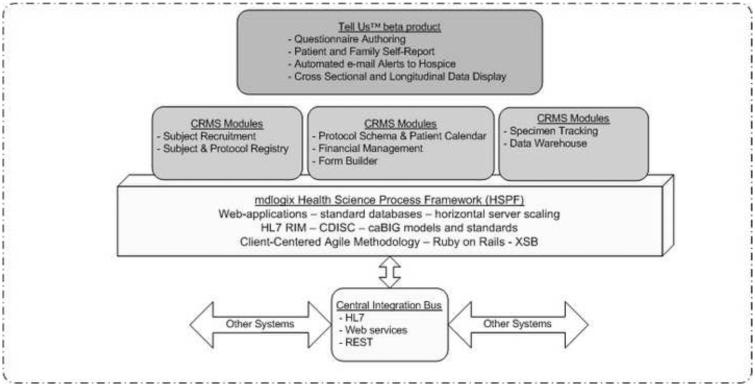
We developed Tell Us™ based on an existing pure Web technology platform, the Medical Decision Logic, Inc., Health Science Process Framework. The software development process included eliciting information on systems and needs, mapping care processes with three diverse hospices, and soliciting ideas for the software from clinicians and researchers. We developed a prototype software product, incorporated the hospices' processes, assessment questions, and educational materials, and refined the product with feedback from other hospice and palliative care professionals.

RESULTS

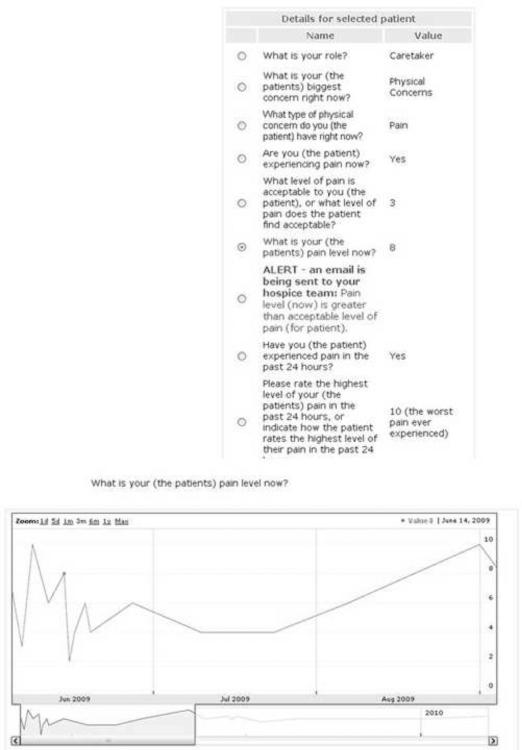
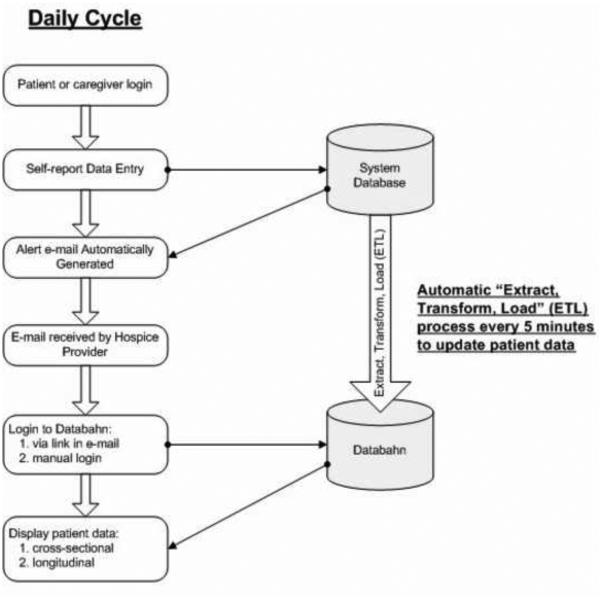
Tell Us™ includes modules for authoring and deploying clinical queries and completion schedules, for enrolling clinical sites and patients for patients and/or families to complete assigned assessments on a scheduled basis, and for providers to view patient-reported data. Tell Us™ provides customizable automated provider e-mail alerts based on patient responses (such as uncontrolled symptoms or need for medication refills) and provides educational materials targeted to patient needs.

CONCLUSION

This Web-based toolset may be useful for improving communication among hospice and palliative care patients, caregivers, and providers, and proactive patient management. Future research will involve integrating the software into care and evaluating its feasibility and use for data collection, patient education, and improving outcomes.

摘要

背景

在晚期疾病患者中常规进行电子患者报告结局采集,可以改善患者、照护者和提供者之间的沟通,及时发现问题,并提高后续治疗的效果。

目的

开发一种基于网络的工具,用于采集症状和所需数据,并为临终关怀和姑息治疗患者、照护者和提供者提供反馈。

方法

我们在现有的纯网络技术平台 Medical Decision Logic, Inc.,Health Science Process Framework 的基础上开发了 Tell Us™。软件开发过程包括收集有关系统和需求的信息,与三家不同的临终关怀机构映射照护流程,并从临床医生和研究人员那里征求软件创意。我们开发了一个原型软件产品,整合了临终关怀机构的流程、评估问题和教育材料,并通过其他临终关怀和姑息治疗专业人员的反馈来完善产品。

结果

Tell Us™ 包括用于编写和部署临床查询和完成计划的模块,用于为临床机构和患者注册,以便患者和/或家属按计划完成指定的评估,以及供提供者查看患者报告的数据。Tell Us™ 根据患者的反应(如未控制的症状或需要药物补充)提供定制的自动提供者电子邮件提醒,并提供针对患者需求的教育材料。

结论

这个基于网络的工具集可能有助于改善临终关怀和姑息治疗患者、照护者和提供者之间的沟通,以及主动的患者管理。未来的研究将包括将该软件集成到护理中,并评估其在数据收集、患者教育和改善结果方面的可行性和使用。
https://cdn.ncbi.nlm.nih.gov/pmc/blobs/2f90/4453929/cef64b2e6f26/nihms-275634-f0003.jpg
https://cdn.ncbi.nlm.nih.gov/pmc/blobs/2f90/4453929/60ce37f2e20d/nihms-275634-f0001.jpg
https://cdn.ncbi.nlm.nih.gov/pmc/blobs/2f90/4453929/c2d5c9f217bf/nihms-275634-f0002.jpg
https://cdn.ncbi.nlm.nih.gov/pmc/blobs/2f90/4453929/cef64b2e6f26/nihms-275634-f0003.jpg
https://cdn.ncbi.nlm.nih.gov/pmc/blobs/2f90/4453929/60ce37f2e20d/nihms-275634-f0001.jpg
https://cdn.ncbi.nlm.nih.gov/pmc/blobs/2f90/4453929/c2d5c9f217bf/nihms-275634-f0002.jpg
https://cdn.ncbi.nlm.nih.gov/pmc/blobs/2f90/4453929/cef64b2e6f26/nihms-275634-f0003.jpg