Gnaegi Center for Healthcare Ethics, Salus 5th floor, Saint Louis University, 3545 Lafayette Avenue, St Louis, MO 63104, USA.
Curr Opin Psychiatry. 2011 May;24(3):208-14. doi: 10.1097/YCO.0b013e3283459422.
To describe community-engaged research (CEnR) and how it may improve the quality of a research study while addressing ethical concerns that communities may have with mental health and substance abuse research. This article includes a review of the literature as well as recommendations from an expert panel convened with funding from the US National Institute of Mental Health.
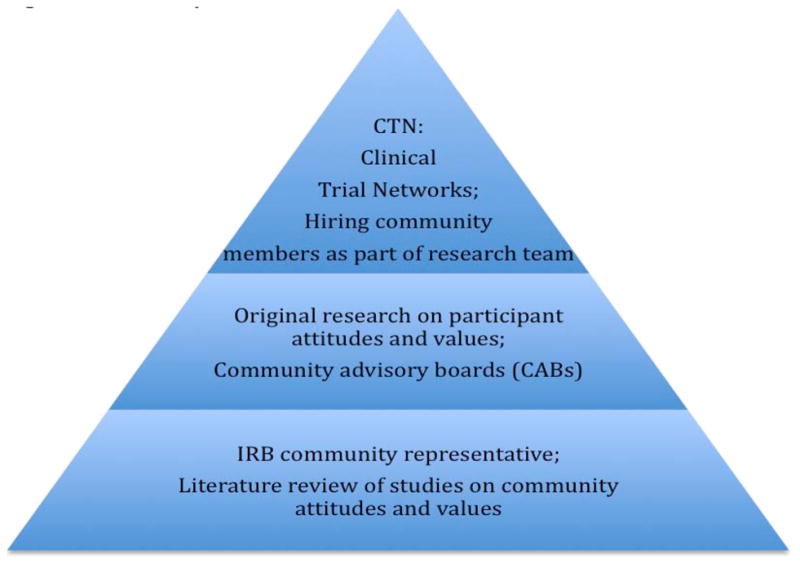
CEnR represents a broad spectrum of practices, including representation on institutional ethics committees, attitude research with individuals from the study population, engaging community advisory boards, forming research partnerships with community organizations, and including community members as co-investigators.
CEnR poses some challenges; for example, it requires funding and training for researchers and community members. However, it offers many benefits to researchers and communities, and some form of CEnR is appropriate and feasible in nearly every study involving human participants.
目的综述:描述社区参与式研究(CEnR),以及它如何在解决社区对心理健康和药物滥用研究可能存在的伦理问题的同时,提高研究质量。本文包括对文献的综述以及由美国国家心理健康研究所资助召集的专家小组的建议。
最近发现:CEnR 代表了广泛的实践,包括在机构伦理委员会中的代表、对研究人群中个体的态度研究、让社区咨询委员会参与、与社区组织建立研究伙伴关系以及让社区成员作为共同研究者。
总结:CEnR 带来了一些挑战;例如,它需要研究人员和社区成员的资金和培训。然而,它为研究人员和社区带来了许多好处,而且几乎在每一项涉及人类参与者的研究中,都需要某种形式的 CEnR。