Laboratory of Neuropsychology and Cognitive Neuroscience, Department of Neuroscience and Imaging, University G. d'Annunzio, Chieti-Pescara, Italy.
PLoS One. 2011 Apr 4;6(4):e17923. doi: 10.1371/journal.pone.0017923.
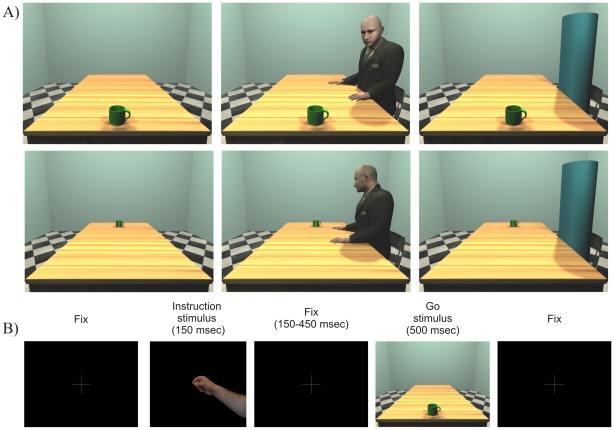
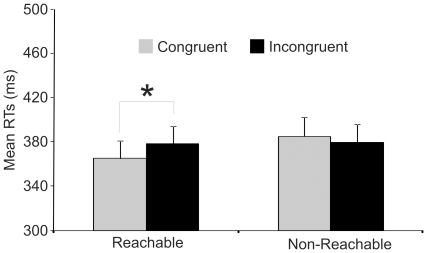
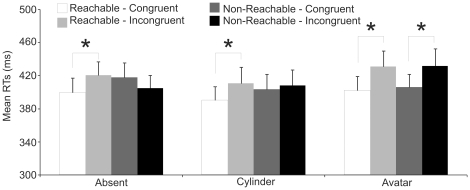
To date, mutual interaction between action and perception has been investigated mainly by focusing on single individuals. However, we perceive affording objects and acts upon them in a surrounding world inhabited by other perceiving and acting bodies. Thus, the issue arises as to whether our action-oriented object perception might be modulated by the presence of another potential actor. To tackle this issue we used the spatial alignment effect paradigm and systematically examined this effect when a visually presented handled object was located close either to the perceiver or to another individual (a virtual avatar). We found that the spatial alignment effect occurred whenever the object was presented within the reaching space of a potential actor, regardless of whether it was the participant's own or the other's reaching space. These findings show that objects may afford a suitable motor act when they are ready not only to our own hand but also, and most importantly, to the other's hand. Our proposal is that this effect is likely to be due to a mapping of our own and the other's reaching space and we posit that such mapping could play a critical role in joining our own and the other's action.
迄今为止,人们主要通过关注单个个体来研究动作和感知之间的相互作用。然而,我们是在由其他感知和行动的身体所居住的周围世界中感知和作用于可供使用的物体的。因此,出现了这样一个问题,即我们面向行动的物体感知是否可能会受到另一个潜在行动者的存在的影响。为了解决这个问题,我们使用了空间对准效应范式,并系统地检查了当一个视觉呈现的可处理物体位于接近感知者或另一个个体(虚拟化身)时,这种效应的情况。我们发现,无论物体是在参与者自己的还是另一个人的可触及空间内呈现,空间对准效应都会发生。这些发现表明,当物体不仅准备好迎接我们自己的手,而且最重要的是迎接另一个人的手时,它们可能会提供合适的运动行为。我们的假设是,这种效应可能是由于我们自己和他人的可达空间的映射,我们假设这种映射可能在连接我们自己和他人的行动方面发挥关键作用。