Shri Ramachandra Bhanj Medical College, Cuttack, Orissa, India.
PLoS Negl Trop Dis. 2011 Apr 12;5(4):e1018. doi: 10.1371/journal.pntd.0001018.
India has long been thought to have more snakebites than any other country. However, inadequate hospital-based reporting has resulted in estimates of total annual snakebite mortality ranging widely from about 1,300 to 50,000. We calculated direct estimates of snakebite mortality from a national mortality survey.
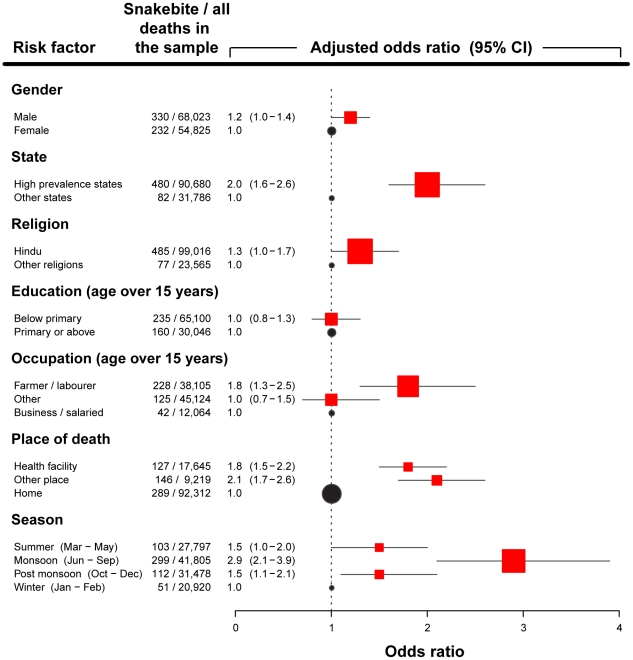
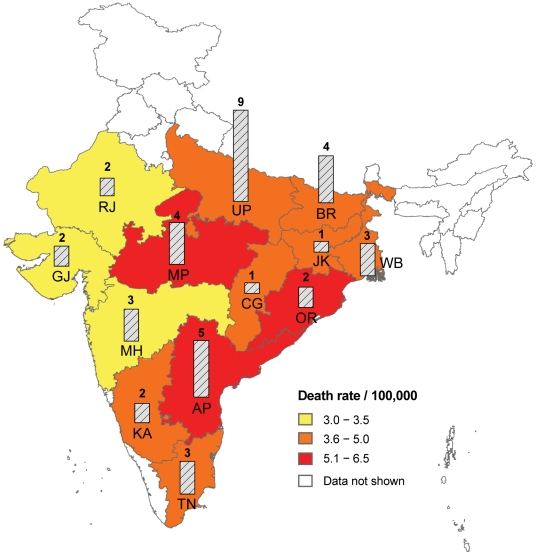
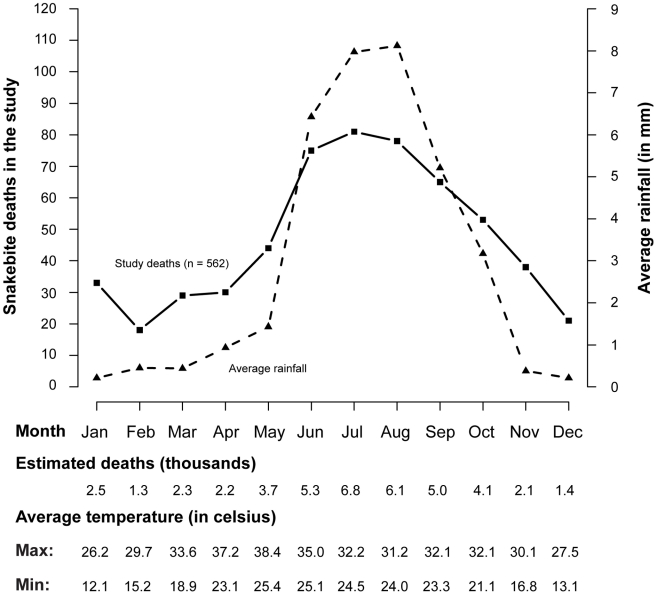
We conducted a nationally representative study of 123,000 deaths from 6,671 randomly selected areas in 2001-03. Full-time, non-medical field workers interviewed living respondents about all deaths. The underlying causes were independently coded by two of 130 trained physicians. Discrepancies were resolved by anonymous reconciliation or, failing that, by adjudication. A total of 562 deaths (0.47% of total deaths) were assigned to snakebites. Snakebite deaths occurred mostly in rural areas (97%), were more common in males (59%) than females (41%), and peaked at ages 15-29 years (25%) and during the monsoon months of June to September. This proportion represents about 45,900 annual snakebite deaths nationally (99% CI 40,900 to 50,900) or an annual age-standardised rate of 4.1/100,000 (99% CI 3.6-4.5), with higher rates in rural areas (5.4/100,000; 99% CI 4.8-6.0), and with the highest state rate in Andhra Pradesh (6.2). Annual snakebite deaths were greatest in the states of Uttar Pradesh (8,700), Andhra Pradesh (5,200), and Bihar (4,500).
Snakebite remains an underestimated cause of accidental death in modern India. Because a large proportion of global totals of snakebites arise from India, global snakebite totals might also be underestimated. Community education, appropriate training of medical staff and better distribution of antivenom, especially to the 13 states with the highest prevalence, could reduce snakebite deaths in India.
长期以来,人们一直认为印度的蛇伤比任何其他国家都多。然而,由于医院报告不足,每年蛇伤总死亡率的估计值从约 1300 人到 50000 人不等。我们从国家死亡率调查中计算了蛇伤死亡率的直接估计值。
我们对 2001-03 年从 6671 个随机选定的地区中发生的 123000 例死亡进行了全国代表性研究。全职、非医疗领域工作人员采访了在世的受访者,了解所有死亡情况。由 130 名经过培训的医生中的两名医生独立对根本原因进行编码。通过匿名和解或必要时通过裁决解决差异。共有 562 例死亡(总死亡人数的 0.47%)被归因于蛇咬伤。蛇咬伤死亡主要发生在农村地区(97%),男性(59%)比女性(41%)更常见,在 15-29 岁(25%)和 6 月至 9 月的季风期间达到高峰。这一比例代表了全国每年约有 45900 例蛇伤死亡(99%CI 40900 至 50900)或每年标准化年龄死亡率为 4.1/100000(99%CI 3.6-4.5),农村地区的死亡率更高(5.4/100000;99%CI 4.8-6.0),安得拉邦的州死亡率最高(6.2)。每年蛇伤死亡人数最多的是北方邦(8700 例)、安得拉邦(5200 例)和比哈尔邦(4500 例)。
在现代印度,蛇伤仍然是意外死亡被低估的原因。由于印度发生的全球蛇伤总数很大,全球蛇伤总数也可能被低估。社区教育、对医务人员的适当培训以及更好地分配抗蛇毒血清,特别是在发病率最高的 13 个州,可以减少印度的蛇伤死亡人数。