Riddet Inst., Massey Univ., Palmerston North, New Zealand.
J Food Sci. 2010 Sep;75(7):R151-62. doi: 10.1111/j.1750-3841.2010.01748.x.
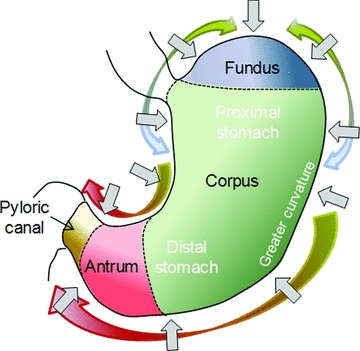
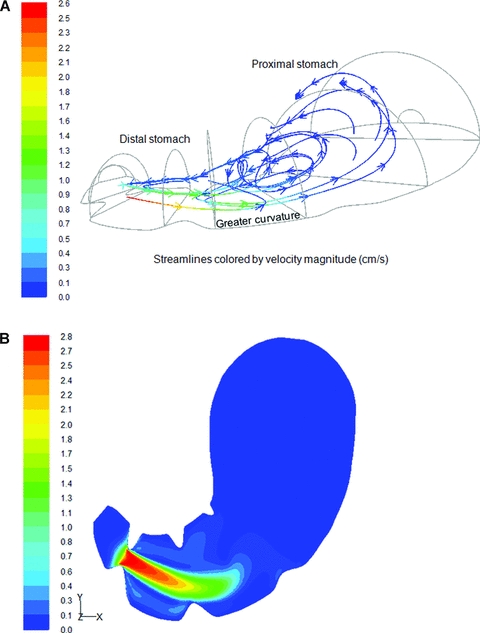
During gastric digestion, food is disintegrated by a complex interaction of chemical and mechanical effects. Although the mechanisms of chemical digestion are usually characterized by using in vitro analysis, the difficulty in reproducing the stomach geometry and motility has prevented a good understanding of the local fluid dynamics of gastric contents. The goal of this study was to use computational fluid dynamics (CFD) to develop a 3-D model of the shape and motility pattern of the stomach wall during digestion, and use it to characterize the fluid dynamics of gastric contents of different viscosities. A geometrical model of an averaged-sized human stomach was created, and its motility was characterized by a series of antral-contraction waves of up to 80% relative occlusion. The flow field within the model (predicted using the software Fluent™) strongly depended on the viscosity of gastric contents. By increasing the viscosity, the formation of the 2 flow patterns commonly regarded as the main mechanisms driving digestion (i.e., the retropulsive jet-like motion and eddy structures) was significantly diminished, while a significant increase of the pressure field was predicted. These results were in good agreement with experimental data previously reported in the literature, and suggest that, contrary to the traditional idea of a rapid and complete homogenization of the meal, gastric contents associated with high viscous meals are poorly mixed. This study illustrates the capability of CFD to provide a unique insight into the fluid dynamics of the gastric contents, and points out its potential to develop a fundamental understanding and modeling of the mechanisms involved in the digestion process.
This study illustrates the capability of computational fluid dynamic techniques to provide a unique insight into the dynamics of the gastric contents, pointing out its potential to develop a fundamental understanding and modeling of the human digestion process.
在胃消化过程中,食物通过化学和机械效应的复杂相互作用而被分解。虽然化学消化的机制通常通过体外分析来描述,但由于难以再现胃的几何形状和运动,因此对胃内容物的局部流体动力学仍缺乏很好的理解。本研究的目的是使用计算流体动力学(CFD)来开发胃壁在消化过程中的形状和运动模式的 3D 模型,并利用它来描述不同粘度的胃内容物的流体动力学特性。创建了一个平均大小的人体胃的几何模型,并通过一系列高达 80%相对闭塞的胃窦收缩波来描述其运动特性。模型内的流场(使用 Fluent™软件预测)强烈依赖于胃内容物的粘度。通过增加粘度,通常被认为是推动消化的主要机制的两种流动模式(即逆行喷射状运动和涡流结构)的形成明显减少,而预测的压力场显著增加。这些结果与文献中先前报道的实验数据吻合良好,表明与传统的快速且完全均匀化食物的观点相反,高粘性食物相关的胃内容物混合不良。本研究说明了 CFD 技术在提供胃内容物流体动力学的独特见解方面的能力,并指出了其在开发对消化过程中涉及的机制的基本理解和建模方面的潜力。
本研究说明了计算流体动力学技术在提供胃内容物流体动力学的独特见解方面的能力,并指出了其在开发对消化过程中涉及的机制的基本理解和建模方面的潜力。