CSIRO Plant Industry, PO Box 350, Glen Osmond, SA 5064, Australia.
J Exp Bot. 2011 Aug;62(12):4267-80. doi: 10.1093/jxb/err134. Epub 2011 May 4.
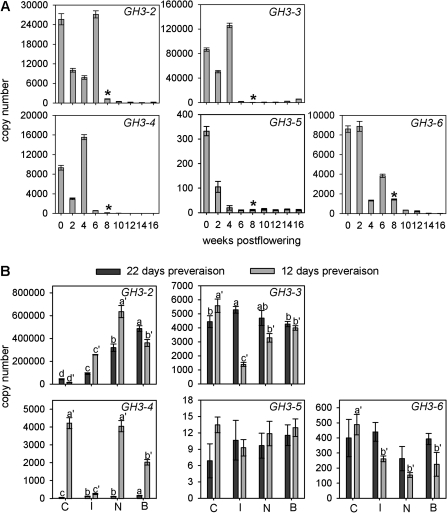
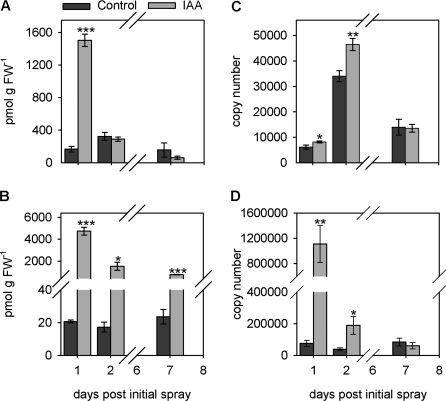
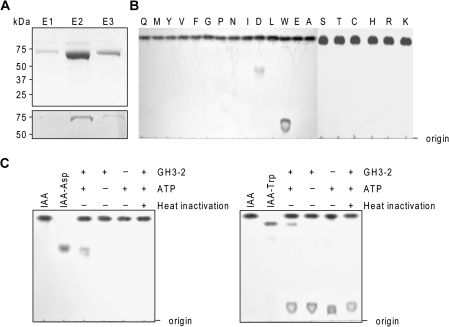
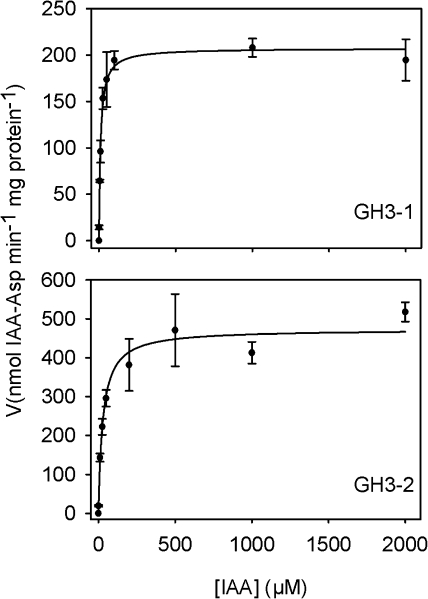
Nine Gretchen Hagen (GH3) genes were identified in grapevine (Vitis vinifera L.) and six of these were predicted on the basis of protein sequence similarity to act as indole-3-acetic acid (IAA)-amido synthetases. The activity of these enzymes is thought to be important in controlling free IAA levels and one auxin-inducible grapevine GH3 protein, GH3-1, has previously been implicated in the berry ripening process. Ex planta assays showed that the expression of only one other GH3 gene, GH3-2, increased following the treatment of grape berries with auxinic compounds. One of these was the naturally occurring IAA and the other two were synthetic, α-naphthalene acetic acid (NAA) and benzothiazole-2-oxyacetic acid (BTOA). The determination of steady-state kinetic parameters for the recombinant GH3-1 and GH3-2 proteins revealed that both enzymes efficiently conjugated aspartic acid (Asp) to IAA and less well to NAA, while BTOA was a poor substrate. GH3-2 gene expression was induced by IAA treatment of pre-ripening berries with an associated increase in levels of IAA-Asp and a decrease in free IAA levels. This indicates that GH3-2 responded to excess auxin to maintain low levels of free IAA. Grape berry ripening was not affected by IAA application prior to veraison (ripening onset) but was considerably delayed by NAA and even more so by BTOA. The differential effects of the three auxinic compounds on berry ripening can therefore be explained by the induction and acyl substrate specificity of GH3-2. These results further indicate an important role for GH3 proteins in controlling auxin-related plant developmental processes.
在葡萄(Vitis vinifera L.)中鉴定出了 9 个 Gretchen Hagen(GH3)基因,其中 6 个基因是根据蛋白质序列与吲哚-3-乙酸(IAA)-酰胺合成酶的相似性预测的。这些酶的活性被认为在控制游离 IAA 水平方面很重要,先前已有研究表明,一种生长素诱导的葡萄 GH3 蛋白 GH3-1 参与了浆果成熟过程。离体实验表明,在使用生长素化合物处理葡萄浆果后,只有另一个 GH3 基因 GH3-2 的表达增加。其中一种是天然存在的 IAA,另外两种是合成的 α-萘乙酸(NAA)和苯并噻唑-2-氧乙酸(BTOA)。测定重组 GH3-1 和 GH3-2 蛋白的稳态动力学参数表明,这两种酶都能有效地将天冬氨酸(Asp)与 IAA 缀合,与 NAA 的缀合效率较低,而 BTOA 则是较差的底物。IAA 处理预成熟浆果会诱导 GH3-2 基因表达,同时伴随着 IAA-Asp 水平的增加和游离 IAA 水平的降低。这表明 GH3-2 对过量生长素作出反应,以维持低水平的游离 IAA。在葡萄浆果成熟之前,IAA 的应用并没有影响到其成熟过程(开始成熟),但 NAA 和 BTOA 的应用却大大延迟了这一过程,BTOA 的影响甚至更大。因此,三种生长素化合物对浆果成熟的不同影响可以用 GH3-2 的诱导和酰基底物特异性来解释。这些结果进一步表明 GH3 蛋白在控制与生长素相关的植物发育过程中发挥着重要作用。