Department of Pathology and Laboratory Medicine, University of Wisconsin-Madison, Madison, Wisconsin, United States of America.
PLoS One. 2011 Apr 22;6(4):e19056. doi: 10.1371/journal.pone.0019056.
Simian hemorrhagic fever virus (SHFV) has caused lethal outbreaks of hemorrhagic disease in captive primates, but its distribution in wild primates has remained obscure. Here, we describe the discovery and genetic characterization by direct pyrosequencing of two novel, divergent SHFV variants co-infecting a single male red colobus monkey from Kibale National Park, Uganda.
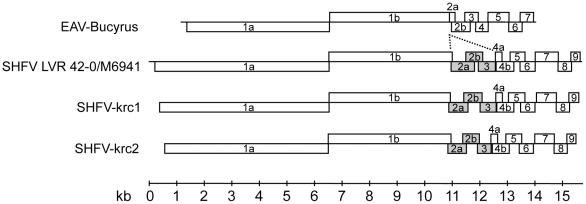
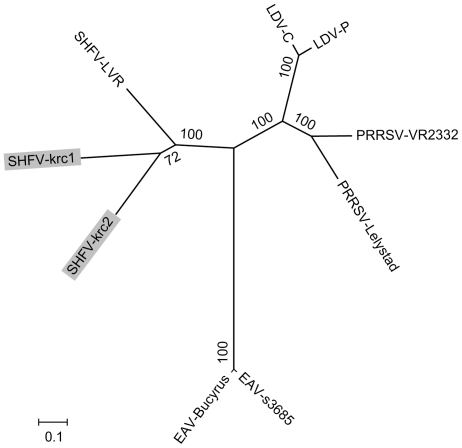
METHODOLOGY/PRINCIPAL FINDINGS: The viruses were detected directly from blood plasma using pyrosequencing, without prior virus isolation and with minimal PCR amplification. The two new SHFV variants, SHFV-krc1 and SHFV-krc2 are highly divergent from each other (51.9% nucleotide sequence identity) and from the SHFV type strain LVR 42-0/M6941 (52.0% and 51.8% nucleotide sequence identity, respectively) and demonstrate greater phylogenetic diversity within SHFV than has been documented within any other arterivirus. Both new variants nevertheless have the same 3' genomic architecture as the type strain, containing three open reading frames not present in the other arteriviruses.
CONCLUSIONS/SIGNIFICANCE: These results represent the first documentation of SHFV in a wild primate and confirm the unusual 3' genetic architecture of SHFV relative to the other arteriviruses. They also demonstrate a degree of evolutionary divergence within SHFV that is roughly equivalent to the degree of divergence between other arterivirus species. The presence of two such highly divergent SHFV variants co-infecting a single individual represents a degree of within-host viral diversity that exceeds what has previously been reported for any arterivirus. These results expand our knowledge of the natural history and diversity of the arteriviruses and underscore the importance of wild primates as reservoirs for novel pathogens.
猿猴出血热病毒(SHFV)已导致圈养灵长类动物发生致命性出血性疾病,但该病毒在野生灵长类动物中的分布仍不清楚。在此,我们描述了在乌干达基巴莱国家公园的一只雄性红色疣猴中同时感染的两种新型、分化的 SHFV 变体的发现和直接焦磷酸测序遗传特征。
方法/主要发现:使用焦磷酸测序直接从血浆中检测到病毒,无需病毒分离和最小的 PCR 扩增。两种新的 SHFV 变体 SHFV-krc1 和 SHFV-krc2 彼此高度分化(核苷酸序列同一性为 51.9%),与 SHFV 原型株 LVR 42-0/M6941 的核苷酸序列同一性分别为 52.0%和 51.8%,并且在 SHFV 内表现出比任何其他动脉炎病毒都更多的系统发育多样性。然而,这两种新变体都具有与原型株相同的 3'基因组结构,包含在其他动脉炎病毒中不存在的三个开放阅读框。
结论/意义:这些结果代表了在野生灵长类动物中首次发现 SHFV,并证实了 SHFV 相对于其他动脉炎病毒的独特 3'遗传结构。它们还表明,SHFV 内的进化分化程度大致相当于其他动脉炎病毒种之间的分化程度。两种如此高度分化的 SHFV 变体同时感染单个个体,代表了宿主内病毒多样性的程度超过了以前报道的任何动脉炎病毒。这些结果扩展了我们对动脉炎病毒的自然史和多样性的认识,并强调了野生灵长类动物作为新型病原体储主的重要性。