Department of Oral Biology Division of Periodontology and Endodontology, Graduate Dental School, Tohoku University, Sendai, Japan.
J Appl Oral Sci. 2011 Apr;19(2):147-53. doi: 10.1590/s1678-77572011000200011.
To assess and to compare the effects of Gluma® Desensitizer (GDL) with an experimental glutaraldehyde and HEMA containing fumed silica dispersion (GDG) on dentin permeability using a chemiluminous tracer penetration test.
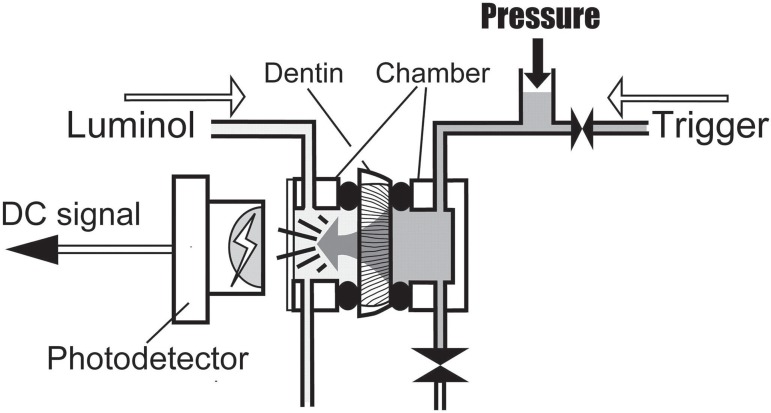
Twenty disc-shaped dentin specimens were dissected from extracted human third molars. The dentin specimens were mounted in a split chamber device for determination of permeability under liquid pressure using a photochemical method. Ten specimens were randomly selected and allocated to the evaluation groups Gluma® Desensitizer as aqueous solution and glutaraldehyde/HEMA as fumed silica dispersion, respectively. Dentin disc permeability was determined at two pressure levels after removal of smear with EDTA, after albumin soaking, and after application of the desensitizing agents. Two desensitizer-treated and rinsed specimens of each group were examined by scanning electron microscopy (SEM) for surface remnants.
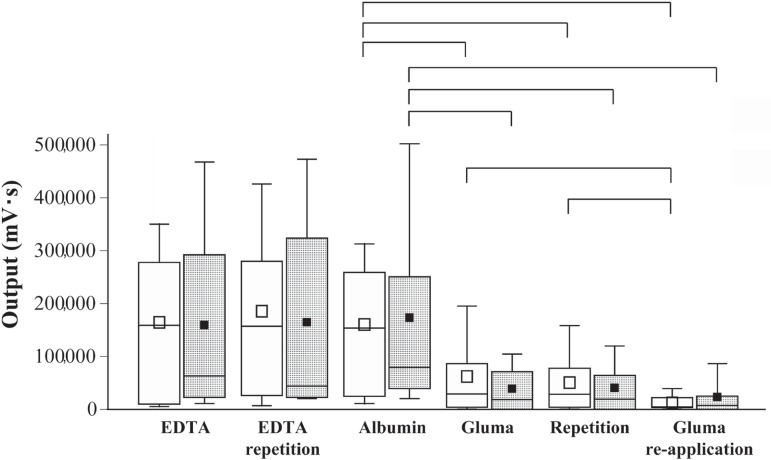
Comparatively large standard deviations of the mean EDTA reference and albumin soaked samples permeability values reflected the differences of the dentin substrates. The mean chemiluminescence values of specimen treated with GDL and GDG, respectively, were significantly reduced after topical application of the desensitizing agents on albumin-soaked dentin. The effects of GDL and GDG on permeability were not significantly different. Treated specimens showed no surface remnants after rinsing.
The experimental desensitizer gel formulation reduced dentin permeability as effectively as the original Gluma® Desensitizer solution.
采用化学发光示踪剂渗透试验,评估并比较 Gluma® 脱敏剂(GDL)和含戊二醛及 HEMA 的实验型二氧化硅分散体(GDG)对牙本质通透性的影响。
从人第三磨牙中切取 20 个圆盘状牙本质标本。将牙本质标本安装在分裂室装置中,在液体压力下采用光化学方法测定渗透性。随机选择 10 个标本,分别分配到评估组 Gluma® 脱敏剂(水溶液)和戊二醛/HEMA(二氧化硅分散体)。用 EDTA 去除玷污层后、白蛋白浸泡后和应用脱敏剂后,在两个压力水平下测定牙本质的渗透率。对每个组的两个经脱敏剂处理和冲洗的标本进行扫描电子显微镜(SEM)检查,以观察表面残留物。
EDTA 参考值和白蛋白浸泡样本渗透率的平均值的较大标准偏差反映了牙本质基质的差异。经 GDL 和 GDG 处理的标本的平均化学发光值在白蛋白浸泡牙本质上局部应用脱敏剂后显著降低。GDL 和 GDG 对通透性的影响无显著差异。冲洗后的处理标本无表面残留物。
实验性脱敏凝胶配方可有效降低牙本质通透性,与原始 Gluma® 脱敏剂溶液效果相当。